 Democracy in Pakistan has died yet another death following the introduction by squeaky-clean President/General (or General/President depending on which week it is) Musharraf of martial law on the basis that the country was "in the grip of militant violence and an unruly judiciary", which same unruly judiciary just happened to be about to rule on the legality of the good General's October election victory.
Democracy in Pakistan was born in 1947, the fragile child of the British Empire's favourite method of bringing peace and harmony to their former colonies, partition, as the newly-formed states of India and Pakistan happily went their separate ways with barely a care in the world, merrily agreeing that they should share Kashmir ... preferably as a potential nuclear battleground for decades to come.
Following religious riots, martial law was imposed in Pakistan for the first time in 1953 and proved so popular that it was quickly introduced as a major module at law schools across the country. Following a breather of a couple of years while the army recharged its batteries (particularly the ones they liked to attach to opposition politicians' testicles), Democracy in Pakistan was back in the dock again in 1958. By an astonishing coincidence, it was during this time that Pakistan's relations with the West were cemented as it entered into an anti-Soviet pact with those paragons of democracy: Iran, Iraq and Turkey.
In 1977, part-time Terry-Thomas impersonator and full-time General, Muhammad Zia-al-Haq, took up the reins of power in a "bloodless" coup (so-called because Prime Minister Zulfikar Ali Bhutto, was hanged rather than shot for the audacious crime of having won a parliamentary election). But when, in 1988, that "magnificent" man in his flying machine tumbled out of the sky in circumstances more mysterious than Glenn Miller's disappearance over the English Channel or the popularity of Big Brother, Zia's dictatorship was over and Pakistan entered a golden 11-year period of civilian rule with Benazir Bhutto and Nawaz Sharif both leading the country twice and both removed from office on charges of corruption.
It was in 1999 that General Pervez Musharraf decided he was the people's champion - whether they wanted him to champion them or not - and stepped forward to take over the country ... completely coincidentally just as President Sharif was about to fire him from his job. For the next eight years his shiny military boots graced the Chief Executive's desk. Fortunately the General was keen to prove his democratic credentials and held an election in 2002. Not only did this election show all the probity of Western elections (provided the Western elections one is talking about happen to be the Presidential ones in Florida in 2000(1)), it also served to keep the Pakistani Supreme Court from getting too het up about trivial details like the rule of law and the constitution. With his credentials thus proven to all and sundry, particularly in the White House and Downing Street, General President Capo di Tutti Capi Musharraf was swiftly ushered into the noble company fighting for democracy, alongside Egypt, Saudi Arabia, Kuwait and other such fine nations.
Despite his penchant for riding roughshod over the rule of law (normally in a tank) and extending Mr Sharif's exile, General Musharraf remained eager to prove himself at least on nodding terms with the notions of democratic behaviour, and promised to step down as head of the army on the 15th of November 2005 and hold a general election(2) in January 2008. Democrats around the world took comfort in the fact both that the General had apparently shown himself to be on their side, or if not that at least that the fingers normally poised near the nuclear button would be crossed behind the General's back for a few months. Sadly, such comfort was but brief: for on 3 November 2007 the constitution and hundreds of opposition politicians, members of the Supreme Court and anyone who looked at the General "a bit funny" were arrested. Troops took up positions on the streets and television and radio stations were taken off the air including, to the relief of TV lovers, BBC World. So with Imran Khan and his collection of nuclear cricket bats under house arrest, General President Musharraf was safe once more from the condemnation of democratic governments the world over, and the "deep disappointment" of the Bush administration.
Democracy in Pakistan will be buried at the 24/7 Drive-Thru Chapel of Democratic Rest. The service will be conducted by the Right Reverend President General Musharraf and the congregation will sing whatever song he tells them to.
(1) in fact it is widely rumoured that more poor African-Americans got to vote in the Pakistani election than did in Florida.
(2) ie an election which would end up electing a general ... called Musharraf.
05 November 2007
| [+/-] |
Democracy in Pakistan 1947 - 1953 - 1958 - 1971 - 1977 - 1985 - 1988 - 1999 - 2002 - 2007 |
12 September 2007
| [+/-] |
The US Troop Surge's Tour of Iraq 2007-2008 |
 The streets of Baghdad were today filled with emptiness as the people of that shining jewel 'mid the Mesopotamian sands chose to commemorate the ending of the US Troop Surge's Tour of Iraq by not going out in case they got blown up by a celebrating insurgent or decorated with bits of their own anatomy by happy and contented members of a rival tribal group.
It was on January 10th 2007 that President Bush announced The Surge's birth to a joyful nation. The President's child was a bonny and bouncing baby, whose mere presence - the President assured America - was enough to bring a powerful desire for peace and democracy (not to mention a deep wish to run away from the 30,000 heavily armed new troops) to any "evildoer".
Though still very young, Mr Bush's baby was sent away in February 2007 to gain an education in the ways of nascent democracy - taking in extra tuition on the ways of Explosively Formed Penetrator warheads - on a grand tour of Northern Iraq. Led by its new tour guide, General David Petraeus(1), The Surge was shown the many sights of the ancient streets of Baghdad, from the delights of its famous illuminations(2) to the charms of its many insurgents, always eager to greet a foreign soldier with a smile on their face and a bomb near their heart.
Despite the many highlights of its tour, the root of The Surge's ultimate disappointment was to be found in the fact the chief object of its journey - a successful democratic government in Iraq - was closed for the summer and not expected to open for at least several decades. Unable to see the shining beacon of democracy promised to it by Mr Bush, The Surge instead had to content itself with amassing a large supply of souvenir mortar rounds, bullets and Improvised Explosive Devices readily provided by local militia groups. Bored, tired and missing home, The Surge began to complain about the length of its tour and wonder aloud about the whole purpose of its trip.
Unable to show his tour group any sign of functioning government, General Petraeus was forced to put a brave face on things, gamely telling anyone who asked him that he was sure that democracy would soon be up and running in Iraq, whilst at the same time announcing that The Surge's tour of Iraq would soon be brought to an end.
The US Troop Surge in Iraq will be quietly buried in mid-2008 at St Rumsfeld's Church of the Holy Jesus What Kind of A Mess Has This Doofus Left Behind?! It was predeceased by the British Military Presence in Basra and is survived by an Iraqi Government unable to find its arse with both hands.
(1) a man easily distinguishable from previous tour guides provided to the US Army in Iraq by the fact that he doesn't believe Al Fallujah is that guy down the block who runs the falafel stand.
(2) usually, given the unreliability of the electricity supply, a couple of candles and the odd bomb explosion.
05 September 2007
| [+/-] |
British Military Presence in Basra 2003-2007 |
 The British Military Presence in Basra, part of that joint mission with the United States to extract oil from bring peace and democracy to the benighted country of Iraq, has been zipped up in a body bag as troops withdrew relocated to the airport – marking the end of a foreign adventure with all the mishap-free success of M. Hulot's Holiday.
The British Military Presence in Basra was first established in 1917 as our brave Tommies secured the Anglo-Persian Oil Company’s interests in neighbouring Persia freed the region from the evil clutches of the Ottoman Empire, and formed the modern state of Iraq from three rival ethnic groups – the Kurds, the Shi’as and the Sunnis – who have, ever since, co-existed peacefully with their new neighbours.
Granting independence to Iraq in 1932 the British retained a military presence in the region because large deposits of oil had been discovered there, re-invading the country in 1941 to stop Germany from stealing the oil and just “minding it for the Iraqis” for a short while as part of the struggle against the evils of Hitler. Despite British heroism in defence of the oil 17 years later an ungrateful Iraqi Army overthrew the Anglophile puppet government monarchy and set about using their new-found freedom and economic independence to terrorise their population all by themselves.
And so, for a while, Britain withdrew altogether from Iraq. In 1991, however, the latest of Baghdad's loyal friends of the West despots, Saddam Hussein, had set his sights on Kuwait’s oil fields and American and British troops again invaded to restore peace and democracy. While the Americans stopped short of Baghdad, our brave boys conquered Basra and soon felt at home there amidst its ancient streets and traditional Officer’s Club and NAAFI (est. 1917). Withdrawing from the city after a regimental sherry and bridge evening got out of hand, British troops were powerless to intervene as the Republican Guard slaughtered Shi’as in their thousands.
Following the discovery of weapons of mass destruction a dodgy thesis written by a Canadian student a fictional link between the Saddam regime and Al Qaeda, the Allies were welcomed back into Iraq as heroic liberators in 2003, as Tony Blair decided to make his mark in history and to be judged by God back Donald Rumsfeld's George W. Bush’s daring plan to overthrow Saddam Hussein and free Iraq’s giant oil reserves.
Although it was our American allies who were to bear the brunt of Iraqi ingratitude for bombing their country back to the Stone Age liberating their oil them from the nightmare of Saddam Hussein’s Ba’ath Party, even in Basra mutterings of discontent were heard. Soon these mutterings grew into a more audible collective tut and British troops found they were no longer welcome in the city’s clubs and late-night kebab houses, unless accompanied by a large amount of bombing and rifle-fire from local insurgents.
So it was this week that the “pre-planned” decision to withdraw all British troops to the city’s airport was taken amidst much criticism from the Americans whose decision to “surge” more troops into Baghdad earlier in the year had so successfully pushed the insurgents into the rest of the country and enabled the Iraqi government to take a well deserved holiday.
Denying accusations that they were abandoning Basra to the Iraqi Army – an organisation with all the effectiveness of Warmington-on-Sea's Home Guard (but with better weapons) and all the loyalty to its leadership of a member of the Tory party, the Queen’s Own Light Baggage Handlers Brigade and 2 Para Confiscation of Water Bottles and Nail Files Battalion quickly established control of Basra airport and began merrily wishing happy tourists and business travellers “a good one-way flight out of Basra”.
And so it was that with the US accusing the UK of abandoning Basra and the UK accusing the US’s policy in Iraq of being “fatally flawed”, the last post was sounded and the owners of Basra’s clubs and late-night kebab houses breathed a sigh of relief.
The British Military Presence in Basra will be buried very quietly. The service will be conducted by the CEO of British Petroleum. It is not expected that our American allies will attend. It is survived by The British Military Presence in Afghanistan and The British Military Presence in Aldershot – both of which have been causing much hardship and unhappiness to locals since the 19th century.
24 August 2007
| [+/-] |
America's Withdrawal from the Bush Administration 2006 - 2007 |
 As A Dodo must today report the grave news that the Withdrawal by America from the Bush Administration is almost at an end and that the last helicopters have been seen pulling away from the White House in scenes not witnessed since the end of the Vietnam War.
It was in the middle of the first decade of the 21st century that it became apparent to many Americans that the country's strategy in relation to the Bush Administration had gone awry. Though vast amounts of money and large numbers of young troops had been expended on keeping the Bush Administration in power and supporting its aims, the Administration itself - poorly led and indifferent to allegations of internal corruption and a casual disregard for either the rule of law, the provisions of the Constitution or the terms of the Geneva convention - seemed incapable of achieving America's desires and ill-suited to its stated aim of defending democracy.
There had been many previous calls for withdrawal but these had always been ignored - largely because so many of them came from Sean Penn - but by 2006 the atmosphere had changed and the demands that America step back from the Bush Administration were being heard from many people who were not members of the popular music or motion picture industries.
It was with the defeat of Republican Troops under General Rove at the Battle of Capitol Hill in November 2006 and the taking of Congress by the troops of the DemoCong, that it became clear that America had now decided to step back from the Bush Administration. It was not long before Republican Congressmen and Congresswomen were to be seen packing up all their belongings in the nearest available pork barrel and preparing to flee. All the time, the Administration itself was suffering heavier and heavier losses: once important figures such as Donald Rumsfeld, Lewis "Scooter" Libby, Dan Bartlett, Harriet Miers and Sara Taylor all fell by the wayside, while others such as Attorney General Alberto Gonzales were left fatally wounded. Even senior Republican figures such as respected Virginia Senator John Warner now advocated withdrawal.
The rush to quit the Bush Administration became rapid, with politicians of all hues frantically battling with each other as they sought to make their way to the helicopters and put as much distance between themselves and the President's policies as they could. Finally there was only President George W Bush himself, left standing on the roof of the White House as friends, aides and officials, among them even such old allies as General Rove, leapt to the last helicopter and humiliatingly fled the scene. Mr Bush was heard desperately begging for America to come to his assistance and warning of "a new Vietnam" and the takeover of Washington by DemoCong troops under Ho Chi Clinton and Barack Vo Nguyen Obama, just before his voice was drowned out by the sound of the helicopter blades.
A nation will mourn the Bush Administration ... sadly no-one is yet sure which nation it will be.
(1) inasmuch as getting Iraqi insurgents to stop bombing Baghdad and start blowing up other bits of Iraq instead can be said to be a success.
27 June 2007
| [+/-] |
The Middle East 3,000BC-2007AD |
 It is with great sadness (and not a little alarm), that As A Dodo must today report what is understood to be the imminent passing of the Middle East - that part of the world that saw the creation of civilisation, the birth of Judaism, Christianity and Islam and (partly as a consequence of those three births) the fomentation of several thousand years of conflict and destruction - following news that a Mr Tony Blair, former resident of Downing Street and Prime Minister of the United Kingdom, is to be appointed as Special Envoy to the region.
The Middle East was born in about 3,000BC when peoples in and around Egypt, Gaza and Mesopotamia became tired of the boring aspects of a life of itinerant goat-and-camel-herding (the boring bits being just about everything to do with goat-and-camel herding, especially all the getting spat at and butted by those they were responsible for (1)) and decided to build themselves a more settled and less goat-and-camel-intensive existence by setting up mighty city states.
Now free from the constant butting and spitting that had so distracted them in their past lives, the people of those city states were able to go about the business of creating the foundations of civilisation, such as reading, writing, mathematics, politics and having really good wars. This last was particularly aided by the habit of those in the region of coming up with new and mutually incompatible religions.
The millennia would see the rise and fall of many civilisations and empires in the region: the Sumerians, Babylonians, Ancient Egyptians and Assyrians were all to find themselves on top at one point and wiped away the next. Soon the Romans were getting in on the act, incidentally deciding to sow the seeds of future conflict by destroying the Jewish temple and abolishing the land of Israel. The (initially) pagan Romans themselves were later replaced as regional rulers by the Christian Byzantines. By the 7th Century AD they were to find themselves having to share space with the newly arrived Muslims. With Jews, Muslims and Christians all reluctantly sharing the same land and all convinced that the region of Palestine was really, really sacred to them, the conditions for a really good scrap were now set.
Over the next several hundred years, the peoples of the region - along with various Crusaders, Turks, Mongols, Ottomans, Germans, Italians, French, British and Americans - would do their best to ensure that the fighting never ceased. Yet somehow the region managed to survive ... until today. For today it became clear that the powers of Europe, Russia, America and the UN had chosen to give responsibility for assisting peace negotiations in the Middle East to none other than Tony Blair, a man whose policies on the region have proved so unpopular with his own people that he has been forced into a premature resignation.
Mr Blair impressed reporters with his immediate pledge to "do whatever is necessary" to find an "enduring resolution to the Israeli-Palestinian issue" ... provided always that "whatever is necessary" didn't mean disagreeing with President Bush. He is expected to set off for the region - guitar in hand, crucifix in pocket and cilice round thigh - as soon as possible to re-start peace negotiations, a process it is understood that he plans to assist by lightening the current awkward atmosphere by persuading his good pal Sir Cliff Richard to sing a couple of choruses of The Millennium Prayer to the assembled representatives of Israel, Egypt, Syria, Jordan, Lebanon, Hamas and Fatah before calling - like President Bush before him - for all those present to show a little Christian charity to each other ... and then suggesting the whole Middle East problem could be resolved by bombing Iran.
The Middle East will be buried under large piles of rubble and a weatherbeaten "road map for peace" at St Tony's Church of the Legacy. It will be survived by increased oil prices, nuclear proliferation, numerous terrorist groups and 15 iPods the captured British sailors left behind in Iran.
(1) Interestingly, these same things are today the most boring bits about being a Premiership referee.
PS As A Dodo readers wishing to revel in contemplate the Prime Minister's departure may wish to click on our obituary for Tony Blair's Premiership.
15 June 2007
| [+/-] |
Those Who Knew Them: Kurt Waldheim 1918-2007 |
 The As A Dodo Team must confess that it has had more than a little difficulty in obtaining the following tribute to the controversial former Austrian President and UN Secretary General Kurt Waldheim. Having had considerable trouble in tracking down Mr Waldheim's former associate, Don Diego Alfonso von Martin Bormann, in his delightful landhaus in Argentina, we felt it best to publish his responses - such as they were - to our questions, verbatim.
"von Martin Bormann ... ach ... ¿Bueno?"
"Si, senor, yes I speak English a little. Is it safe?"
"Oh I am sorry, I must have confused you with someone else. I am a simple Argentine dentist."
"Waldheim? ... Waldheim? ... no it does not ring a bell."
"Now, when you say you are not from the police ... can you prove that?"
"And the diamonds will be passed to me via New York? ... Very well, the interview may proceed."
"Oh yes, I knew Kurt very well. We were just two little Austrian kids together before the war, you know. We would play games together. Kurt always loved Pelmanism ... you know, the 'Pairs' game mitt cards? Kurt was superb ... we once went three days without matching a single pair. Such bad memories we had! I swear we would have forgotten our own names .... particularly if they appeared on any party papers."
"No, no, it was a terrible time the glorious liberation of ... I mean, the invasion of Austria ... by Hitler and his Nazis. Terrible. All those crowds of joyous people welcoming their new leader, all those bands, all those spiffy uniforms and marching. Absolutely terrible."
"Yes, it was so terrible that me and Kurt immediately joined the Nazi party and signed up for the Sturmabteilung. I always thought the brown shirt suited Kurt very well."
"The Wehrmacht? Well, we was drafted in, you know. Served on the Eastern Front. Of course, we was both given medical discharges in 41."
"Oh ... you have got the papers there have you? Well, it was a long time ago, you know ... the memory it plays tricks."
"Well, maybe we weren't disharged."
"Yes, it is possible we did serve a little time mitt General Löhr. Honestly, we thought he was called the Butcher of the Balkans because he did a great Wiener schnitzel. I tell you, he may have been a war criminal but the things that man could do with a bit of veal."
"Jews? There were Jews killed in the war?! No! I had no idea. I'm sure Kurt had no idea."
"So? ... We lived next door to a Konzentrationslager, did we? ... We thought it was just a simple holiday camp ..."
"We signed papers did we? No ... I can't remember that ... 'They ordered the deportation of Jews, execution of British commandos and bloody suppression of the partisans'. You see I'm sure I'd remember something like that ... or my name's not ... er ... whatever my name is."
"No, no ... these things are best forgotten, you see. Kurt knew that. I know that. I mean ... if we'd remembered them, he would never have become UN Secretary General and President of Austria, would he? And I wouldn't be a simple Argentine dentist with no fear of being extradited."
"Ja ... si ... I'm afraid I must end it there. I have a tooth extraction I must be doing. I must remember to forget the anaesthetic."
"Wiederhören ... ach ... Platicamos."
Kurt Waldheim will be buried at St Adolf's Church of the Blessedly Short Memory. The celebrant will be an innocent South American dentist in an SA uniform. The hymn will be number 666, The Horst-Wessel-Lied.
04 June 2007
| [+/-] |
Freedom from The Fear of World War III 1991-2007 |
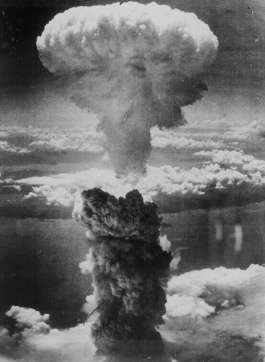 The peoples of Europe were today stocking up on tinned goods and shotguns, converting their brand new wine cellars back into fallout shelters and laughing mordantly at the contents of old "Protect and Survive" leaflets as they bewailed the sudden death of Freedom from The Fear of World War III, that astounding - yet disturbingly brief - epoch when it was possible for citizens across the Northern Hemisphere to go to bed at night without fearing that some
 trigger-happy idiot senior military official in Russia or the USA might mistake a flock of seagulls1 for a missile attack and initiate a nuclear conflict.
Freedom from The Fear of World War III was the product of the long but stormy relationship between the United States of America and the Union of Soviet Socialist Republics. From the USSR's birth in 1917 right up to the early 1940s the pair had eyed each other suspiciously across the global dance-floor, only kept apart by the fact most of it was occupied by a lot of ageing Europeans in silly uniforms dancing the Imperialist Frug with impressionable young African and Asian nations overwhelmed by the ageing Europeans' wealth, savoir-faire and tendency to slap around any young African or Asian nation that didn't want to put out on a first date. All this was to change in the mid-1930's with the rise of a new type of European in Germany, possessing all the anti-social tendencies of the old Europeans with the addition of a psychotic devotion to racial theories, a tendency to see the presence of other peoples in the world as a mere engineering problem and much, much snazzier uniforms.
The USSR had been initially attracted by the new Germany, with whom it shared such interests as watching lots of soldiers marching as if auditioning for Monty Python's "Ministry of Silly Walks" sketch and a real enthusiasm for pogroms, but ended the relationship in the early 1940s after Germany turned up drunk on several bottles of extra-proof Blitzkrieg and attempted to beat it up. Hurt - both physically and emotionally - by Germany's behaviour, the USSR turned for comfort to both the macho young USA and the once-debonair but now ageing United Kingdom, the three states indulging in a brief ménage-à-trois during which they cut up the dancefloor and, indeed, most of Europe.
The relationship could not last: as the USA and UK spent more and more of their time alone together, the USSR began to feel left out. Soon it was to quit the relationship altogether, preferring to hang around behind an iron curtain with like-minded (if they knew what was good for them) countries, winning their absolute loyalty by beating them up if they got out of line giving them generous gifts of aid and assistance when they needed help. Thus the Cold War was born and with it the global fear of a new World War.
For more than 40 years the USSR and the USA returned to eyeing each other across the global dance-floor, hanging around at its edges while buying drinks for all their pals and trying to impress the other nations by setting up puppet dictatorships in third world countries and amassing massive nuclear arsenals. Such displays were not without their costs, both for the superpowers themselves - who had to pay for enormous numbers of drinks, plentiful puppet dictatorships and vast nuclear arsenals - and for all the other countries, who had to pay the price of sucking up to their superpower friends and having their governments subverted or countries invaded by their "best mates" not to mention forking out billions on Valium to help their inhabitants cope with the fear of imminent nuclear destruction.
Eventually the costs were to prove too great for the USSR which - despite putting on a brave face - was down to its last rouble and had been living off a diet of boiled beetroot and state propaganda for years. Unable to afford even the tanks necessary to put down a popular uprising in a satellite state, in 1991 it fell apart. In doing so it gave birth to Freedom from The Fear of World War III.
For 16 years, Freedom from The Fear of World War III led a happy life - spreading peace dividends across the globe, freeing billions from the dread of another World War and forcing James Bond scriptwriters to try and come up with new baddies. During its life, the world (or at least that part of it which hadn't been right-royally ballsed up by all those ageing Europeans and their empires) enjoyed unprecedented growth and wealth as well as a lot of fun laughing at the antics of Boris Yeltsin. It was all the sadder, then, that Freedom from The Fear of World War III should be struck down in its prime, set upon by none other than those some-time lovers and some-time sparring partners, the USA and Russia as America - its military muscles inflated, its testosterone levels sent into overdrive and its brain shrunk by daily injections of Neocon steroids - insisted on deploying a nuclear defence shield on Russia's borders and Russia - having pumped up its own muscles on a regime of new-found oil and gas wealth, the smack (not to mention cattle-prod, enforced detention and nuclear-tipped salmon sushi) of firm government and a blithe disregard for democratic norms - threatened to kick sand in America's face by pointing missiles at the US's best buddies in the European Union. With detente getting wound up and TV producers blowing the dust off old videotapes of "Threads" and "When the Wind Blows", Freedom from The Fear of World War III passed away.
Freedom from The Fear of World War III will be buried at St Oppenheimer's Church of the Mutually Assured Destruction. The service will be conducted by the Reverend Dr Strangelove and the hymn will be number 462 "Come, sound His four-minute warning abroad".
1 or any other early 80s synth-pop band.
17 May 2007
| [+/-] |
Prince Harry's Bad Boy Reputation 2002-2007: A Correction |
We at As A Dodo Towers wish to apologise to our readers for yet another massive cock-up serious errors in our obituary for Prince Harry's Bad Boy Reputation. We have been contacted by officials at Clarence House who have asked us to note that senior Army officers have now realised that it is entirely possible that as (a) a soldier in the British army and (b) in all probability the son of the heir to the throne, there is some slight chance of the young Prince being targeted by those opposing the British and American presence in that benighted land(1). Indeed we further understand from reports in the British press (apparently based on a conversation with someone in the pub, who knows a bloke who knows a bloke who once read Andy McNab's "Bravo Two Zero") that orders have already been issued to an unidentified (and almost certainly fictional) sniper to regard Prince Harry as his sole target(2). In the circumstances we have been asked to point out that Prince Harry will not now be joining his regiment in Iraq and, accordingly, his Bad Boy Reputation will, far from being dead, continue to get drunk at West End nightclubs, dress up in Nazi regalia and punch the odd journalist just for the hell of it.
We apologise most sincerely for any distress our report may have caused to either the Prince's family or to tabloid editors desperate for a Royal story for the front page.
(1) currently understood to be everyone in Iraq except the guy with the lucrative illicit booze contract for the US forces at Baghdad's Camp Justice.
(2) we are further advised that Mohammed Al fayed's lawyers are now seeking to have the current inquest into Diana, Princess of Wales, ruled a nullity owing to the refusal of the coroner, Baroness Butler-Sloss to allow them to call this same fictional sniper to give evidence.
10 May 2007
| [+/-] |
Tony Blair's Premiership 1997-2007 |
 The streets of Britain were today filled with weeping hordes as a great portion of humanity gathered to greet the passing of the Premiership of Tony Blair with tears of unalloyed joy.
To understand the Premiership, one must first understand its parents. Its father was a Labour Party desperate to return to power after the bruising humiliation of defeat in 1992 by John Major's Conservatives (a group who had the economic know-how of George IV, the political savoir-faire of Neville Chamberlain and the deep moral sense of Aleister Crowley). Like so many beings of a certain age, the Party decided that the best way to prove its continuing virility was to abandon its long-term partner, Socialism, and take up with younger lovers, in this case two bright young MPs - Gordon Brown and Tony Blair.
Soon the Party was shucking off its cloth cap, sticking its whippet in a bag with a couple of bricks and locking itself away with Tony one night, Gordon the next, to make mad passionate love to the free market and globalisation. It was following one of these wild nights with the Party that Tony met Gordon in Islington's "Granita" restaurant to announce that he was expecting the party leadership. Luckily for all, Gordon took the news stoically, pausing only to stab his hand with a fork in frustration and extract a solemn pledge from Tony that he would one day hand over the leadership to him, before congratulating his rival for the Labour Party's love whilst keeping his fingers crossed behind his back.
And who was the Party's new paramour? Anthony Charles Lynton Blair had the assets to turn any ageing Party's head: he was young, he had a nice smile and he had an extraordinary ability to fully and honestly believe what he was saying at any given moment - an ability he showed from an early age, casting himself as a through-and-through Englishman despite having been born and educated in Scotland(1), not to mention watching Jackie Milburn play for Newcastle United from the, completely fictional at the time, seats behind the goal at St James, stowing away on the utterly non-existent Newcastle-Barbados plane service and - most impressively of all - standing four-square behind the 1983 Labour manifesto's call for nuclear disarmament and for the country to quit the EEC while privately informing his selection conference that he disagreed with both policies. By the time of his maiden speech he was informing the Commons and the nation that he believed in socialism because it stood for "cooperation, not confrontation; for fellowship, not fear. It stands for equality" - words which can happily stand in the Hall of Historically Ironic Speeches alongside Margaret Thatcher's quotation of St Francis's Prayer in 1979, "Where there is discord, may we bring harmony. Where there is error, may we bring truth. Where there is doubt, may we bring faith. And where there is despair, may we bring hope" not to mention General John Sedgwick's "They couldn't hit an elephant at this dist...".
Utterly infatuated by the youthful Blair, the Party cast aside all that it once believed in, whether it be promises to raise income tax and restore trade union rights, pledges to pursue nuclear disarmament or even its long-held desire to "secure for the workers by hand or by brain the full fruits of their industry and the most equitable distribution thereof that may be possible upon the basis of the common ownership of the means of production, distribution, and exchange, and the best obtainable system of popular administration and control of each industry or service" (a desire which was in any event so wordy that the Party usually managed to forget what it was going on about half way through reading it), all in the burning need to be seen as "New".
And so, having reduced his lover to a besotted devotee, ready to do anything its new leader wanted for the slightest chance of successfully getting up an election, and aided by a Conservative party which, under John Major, evinced all the togetherness and discipline of a member of the Yugoslav Federation, Tony Blair found himself ready to give birth to his Premiership. The Premiership was born on 2nd May 1997. Like the Roman people, exhausted by the cruel and incompetent rule of Tiberius, gleefully saluting their new emperor Caligula, so the British people, exhausted by the cruelty of the Thatcherites and incompetence of the Majorites, gleefully saluted their new Prime Minister as, flanked by his loyal Praetorian guard of spin doctors, he swept into Number 10 Downing Street.
Young and bold, the Premiership moved with a reckless pace, acting swiftly on its greatest priorities - such as evicting Downing Street cat Humphrey from its long-time home for fear of aggravating Cherie's allergies. Sadly, the Premiership's greatest enemy - the very same Gordon Brown who had given it his blessing in Granita - was already acting with even greater swiftness, choosing to prove his own New Labour credentials by throwing away years of party tradition and centuries of governmental responsibility by privatising the Bank of England.
Though briefly distracted by the need to produce the appropriate strained expression and catch in the voice around the time of the death of Diana, Princess of Wales, the Premiership was soon to strike back at Chancellor Brown. While the brooding figure at Number 11 contented himself with taking benefits away from single mothers, the wholesale privatisation of both the nation's assets and almost all public-sector investment, and restricting pension increases to 75p, Mr Blair was embarking on a series of wide-ranging reforms, introducing devolution, removing peers from the House of Lords, passing the Freedom of Information Act and creating the post of Mayor of London. All were hailed as great successes. Unfortunately the Premiership itself was later to regret each and every one of them, even trying to nobble the mayoral vote by putting up a joke candidate, former Health Secretary and full-time Santa impersonator Frank Dobson. Happily, the Premiership had other strings to its bow. Unhappily one of them was the Millennium Dome, a folly on an (this being prior to the attempts to win the World Cup 2006 for England, the Olympic funding farce and, indeed, the Iraq war) unimaginable scale, which sought to commemorate the past thousand years by putting a big tent on some disused wasteland and filling it with exhibits so staggeringly tacky they could have been "lovingly handcrafted" for the Franklin Mint.
By the end of its first term, however, the Premiership was able to boast one unalloyed success(2): the Northern Irish peace process. At last there was an achievement Mr Blair felt able to call completely his own, even despite the fact much of the spade work had actually been done by Mr Major.
Buoyed by this knowledge, the memory of the dark days under John Major and housing prices rising faster than a city trader's bonus, Tony Blair's Premiership was swept back to power in 2001.
With Mr Brown once more seeking to demonstrate his mastery of domestic politics, this time by giving oodles of cash to educational and health bodies whose idea of fiscal planning was to drop all their new money into a big hole in the ground in the hope it might grow into a money tree, Mr Blair knew he would have to look elsewhere to make an impression. Having already discovered the enormous kudos that could be won by blowing places up following his intervention in the Yugoslav conflict, he was delighted to find that the new President of the United States of America was intent on destabilising as much of the globe as possible, by tearing up any treaties he could find and sending troops to anywhere Dick Cheney told him to Halliburton could find reconstruction work democracy needed spreading(3). Soon Bush and Blair were bringing the benefits of all their skills to bear on Iraq, seeking to convince the world that it constituted an imminent threat to peoples across the globe - despite there being absolutely no credible evidence to back them up - and, when the world refused to agree with them, going ahead and blowing Iraq up anyway.
Not only did the Iraq war have the effect of giving Mr Blair the opportunity to pose with tanks and try to sound Churchillian, the hatred and suspicion it stirred up, combined with the activities of groups such as Al Qaeda, also gave him - along with a succession of Home Secretaries all of whom regarded Genghis Khan as a namby-pamby liberal - the opportunity to bring in more and more repressive legislation and restrict further and further the freedom of the individual. With more and more ASBOs, instant fines, powers of detention without charge, supervision orders, soon the prisons were filled to overflowing.
Despite all this and more(4) the Premiership somehow succeeded in returning to power once more in 2005. However, none who looked upon it could doubt that it was wounded, even as they noted that the majority of the wounds were self-inflicted. Worse was yet to come when it became clear that, in accordance with immemorial practice, the Government had been merrily sending major party donors towards the ermine outfitters and seats in the House of Lords with all the speed and urgency normally associated with one's bladder suddenly realising that it contains eight pints of Special Brew and it's a long journey to the lavatories. Thus it was that the Premiership saw Mr Blair become the first Prime Minister to be interviewed by police whilst in office, even as eternal rival Gordon Brown at last plucked up courage to insist that Mr Blair set a timetable for his departure.
So it was that, despite a sincere desire to do good, Tony Blair's Premiership passed away, Mr Blair having found himself in charge of a country where the rich have got much richer, widening the gap between themselves and the poor to an unbridgeable gulf; where our children are increasingly segregated by race and/or religion from the moment they enter their schools, at which they may well be taught that the world is mere thousands of years old and the theory of evolution is a lie; where our streets are littered with CCTV cameras and our every detail is recorded on computer; where the poor cannot afford a home and the young cannot afford an education; where Muslims feel themselves vilified by their fellow Britons and other Britons feel fear of their Muslim compatriots; where destitute refugees seeking succour are reviled as spongers and denied the basics of existence; where our prisons are bursting while a hysterical media whips up fear of crime in the streets; and where our armed forces are sent to die on foreign fields in a hopeless cause.
The remains of Tony Blair's Premiership will tour the globe over the next seven weeks, before being buried on 27th June at St Gordon's Church of the Best Served Cold. Buried alongside it will be the corpse of its pet bulldog, John Prescott. It is survived by a country which is more confrontational and less co-operative; for fear, not fellowship and is far, far less equal than it should be.
(1) This is the reverse of the ability of certain university students to insist that they are Irish - running around in heavy sweaters, swilling pints of Guinness, listening to folk music and going on endlessly about "the craic" and "me da''" - despite having been no nearer to Ireland than an accidental trip to Kilburn after failing to get off at Finchley Road on the tube.
(2) or two if you count the brilliant way Mr Blair made sure the smoking ban didn't apply to Bernie Ecclestone's Formula One championship.
(3) unless the place democracy need spreading was North Korea, China, Kuwait, Saudi Arabia, Burma, Oman, Qatar, Florida &c &c
(4) top-up fees, the David Kelly affair, Foundation hospitals to name just a few
02 May 2007
| [+/-] |
Congress's Timetable for Withdrawal from Iraq 26 April 2007 - 1 May 2007 |
 Four years to the day after he, somewhat prematurely, donned his best GI Joe fighter-pilot outfit to report the death of the War with Iraq (we must confess that at the time of his announcement the President was As A Dodo's Washington correspondent. Having thus contributed to our already dubious reputation for accuracy (for an example of which see eg here) and having developed a habit of leaving copies of the Gideon bible in our bedside tables and improving homilies about the dangers of alcohol all over As A Dodo Towers on every visit, we regret that we had no alternative but to fire him), President George W Bush has now confirmed the death of Congress's Timetable for Withdrawal from Iraq.
The Timetable was born in the final days of April 2007, when a Congress eager to be seen to be doing something about the war with Iraq (and even more eager to have a multi-billion dollar bargaining chip to back up its negotiations with the President) insisted on attaching a timetable for withdrawal to a bill providing funding for the continued US presence in that benighted part of the globe.
From its first moments it was plain that the Timetable could not hope to survive beyond a few days. The merest glance at its delicate frame revealed it to be not merely a transparent attempt to gain political capital but also a bid to humiliate the President, the Timetable containing as it did not merely detailed plans for withdrawal from Iraq but also a requirement that Mr Bush attend double English lessons in the morning and Geography lessons in the afternoon (the latter presumably aimed at persuading him that - contrary to the assertions of Vice-President Cheney - Iraq could not be confused either with Al Qaeda's former base of operations in Afghanistan or the home of the 9/11 suicide bombers in Saudi Arabia).
Indeed, so lacking in strength was the Timetable that it took it some five days to struggle the mile from Congress to the White House. By the time it arrived, the President made it plain that he had no alternative but to put it out of its misery, consigning it to oblivion with a stab of a pen which he let be known (in an in-no-way utterly distasteful manner) had been given to him by the father of a marine killed in Iraq two years ago.
Seeking - like Brutus on the steps of the forum - to justify his actions, the President announced that the bill had sought to "substitute the opinions of politicians for the judgements of military commanders" - an action which he wholly condemned (unless the politicians in question were Paul "I could be so good for you, baby" Wolfowitz or Donald "I see no torture" Rumsfeld) - as well as "setting a timetable for chaos and confusion" that would "demoralise the Iraqi people and encourage killers across the Middle East", which tasks the President's administration already had well in hand.
Thus it was that the Timetable passed away. It will be buried quietly this weekend at the Church of St Mike Dukakis the Politically Hopeless. The Reverend Hillary Clinton will read from the Book of "What Me? Vote for the War? 'Fraid You've Got the Wrong Person, Squire. I was Tying my Shoelaces at the Time" and the hymn will be Number 582 "There is a Baghdad Far Away Without a City Wall, Reliable Electricity or Working Plumbing".
30 April 2007
| [+/-] |
The White Cliffs of Dover c.12,000BC-2007 |
 The As A Dodo Editorial team apologise for the following obituary. It would seem that, contrary to approved practice, our obituarist did not attend the scene from which he was reporting, relying instead on the in-no-way-hysterical reportage provided by the BBC, ITV News, Sky News and print media, all of whom chose to cover a small earthquake in which one person suffered minor injuries as the end of the world. The obituarist will be offered a pearl-handled revolver and asked to do the decent thing just as soon as he can be bothered to unstick himself from the sofa and trudge into the office.
There are no more bluebirds over the White Cliffs of Dover, after that ancient symbol of this sceptred isle crumbled and sank beneath the English Channel following the complete destruction of Kent, and everyone in it, during a massive earthquake on Saturday morning.
The White Cliffs of Dover were born 12,000 years ago at the end of the Devonian era as the Ice Age ended and the melting glaciers exposed those chalk edifices in their full, pasty glory for the first time. Within days, the Cliffs became a rallying point for patriotically-minded hunter-gatherers unnaturally proud of their new island status, sending out a message of British independence to those pesky Gauls across the Channel – not to mention becoming a popular jumping-off point for effete Guardian-reading hunter-gatherers who had already grown weary of patriotically-minded hunter-gatherers' intolerance towards their European neighbours.
Over the centuries the Cliffs guarded the gateway to Britain, warning off invaders from Napoleon to Hitler who schemed to add this green and pleasant land to their empire of subjugated territories, and completely failing to halt those invaders like Julius Caesar and William the Conqueror who had the nous to land at more gently-sloping beaches further along the coast.
During the darkest days of World War Two, The Cliffs had their “finest hour” – single-handedly defeating the Luftwaffe – and were immortalised (or so it was believed at the time) by Vera Lynn in her 1940 hit download, White Cliffs (Don’t Do It) in which she rapped about the dangers of becoming addicted to a powerful narcotic cut by profiteering spivs with large quantities of Dover chalk. (might need to check this bit, where's Wikipedia?)
But the war had taken its toll on the Cliffs and they no longer had the strength to raise two fingers to the Continent. Membership of the European Union led to the construction of a monumental folly – a railway tunnel linking France and England. Giant machines bored a huge hole through the Cliffs' heart, allowing millions of tourists to travel at high-speeds to London and thousands of desperate refugees dreaming of a better life to take up those really crappy jobs that Britons themselves refused to touch with a barge pole - much to the outrage of those very same Britons who kept complaining loudly about "these bloody people coming over here" even as they purchased their burgers from them, got them to fix their dodgy sewerage systems and sent them out to drown whilst cockle-picking.
Fatally undermined, the Cliffs stood no chance against the powerful earthquake measuring a massive 4.3 on the Richter scale (about the equivalent of two bluebirds colliding) which struck in the Straits of Dover. Panic ensued as Canterbury Cathedral collapsed, its extensive building insurance failing to protect it from an Act of God, the people of Tunbridge Wells were buried under an avalanche of disgusted letters to the Daily Mail about the incorrect use of the word "whom" and the town of Sandwich's plan to shelter itself between two layers of bread proved a complete and utter failure.
Kent slid into the English Channel and the Garden of England became the Sunken Garden of England, the White Cliffs of Dover hanging on until the very end when even they were submerged beneath the churning grey water and buried at sea, along with the last vestiges of Britain’s insular and arrogant attitude towards the rest of Europe and everyone in it. But still… at least we’re now a lot further away from the French.
25 April 2007
| [+/-] |
Terrorism 1793-2007 |
 We are grateful to a Mr J Reid of the Home Office (of whose passing Mr Reid has already informed us) for alerting the As A Dodo editorial board to the end of Terrorism, which he assures us cannot possibly survive the birth of the Home Office's offspring, The Ministry of Love The Office for Security and Counter-Terrorism.
Terrorism was born in 1793 in France, the younger brother of the famously attractive triplets Liberté, Egalité and Fraternité who at the time were the toast of the land thanks to their stirring performance during the ongoing French Revolution. Though it was later to set out on its own, Terrorism's early years were spent in close proximity to the state, ousting its elder sisters from the national bosom in the hope that false arrests, conviction on the flimsiest of evidence and a surveillance society could be nurtured in their place. Arm in arm with Citizen Robespierre and Madame Guillotine it wandered up and down France, stirring fear in the hearts of all it met and a desire to hide among all it didn't (a role today played by itinerant Mormons, Jehovah's Witnesses and Chuggers). It was not long, however, before Terrorism (unlike the aforementioned Mormons, Jehovah's Witnesses and Chuggers) tired of such behaviour.
It was at this time that Terrorism turned to philosophy, just as so many young people in France still do to this day. Thanks to the work of Immanuel Kant, Terrorism came to mean a pessimistic view of the destiny of mankind, in which guise it was swiftly seized upon by anarchists such as Bakhunin as a means of bringing down the state and providing Joseph Conrad with plots, as well as being seized on by the inhabitants of assorted colonial outposts as a means of ridding themselves of their various Imperial oppressors (and in the case of TE Lawrence, a really good excuse for mucking around on camels in a keffiyeh).
Soon Terrorism came to mean the use of the threat of violence to put people in a permanent state of fear, and was distinguishable from the behaviour of parents after catching their offspring playing with matches, really scary teachers discovering that one somehow hasn't quite managed to complete that extra tricky piece of homework they set and Governments eager to pass a few more laws by the fact that the people carrying it out usually had an indifference to the sanctity of human life combined with a different accent and/or political philosophy and/or religion to whoever was calling them "terrorists".
From the latter part of the 20th Century, Terrorism came to be a significant force in global politics, filling millions across the globe with fear, causing the death of thousands upon thousands and inflicting numerous episodes of 24 upon the world. Where once people merely had the prospect of nuclear annihilation to keep them awake at night, now they had the possibility of being shot, gassed tortured or blown up (either by the terorrists or by Jack Bauer) as they went about their daily business to keep them from the arms of Morpheus. Few, apart from some very disturbed people with uniform fetishes and/or a worrying belief that this year's most vital accessory was a semtex bandolier, could be happy about such a situation. Yet not even this was enough for Terrorism which, it turned out, had long regretted its decision to turn away from the ways of its youth and whose attention-seeking and destructive behaviour had merely been an attempt to return to the bosom of the state, where it could go back once more to practices such as placing the populace in a permanent state of fear, imprisoning the citizenry without trial, indulging in constant surveillance of the public at large and abrogating the liberty of the people.
Happily, we are told that Terrorism's time is now over. We are assured by John Reid, the father of The Office for Security and Counter-Terrorism, that his new offspring's "faster, brighter and more agile response" to Terrorism gives us the brightest prospect of putting an end to this dreadful scourge... and if that fails it can simply put Terrorism out of business by doing much of its work for it.
Terrorism will be buried in an undisclosed location by men in balaclavas. It is survived by freedom fighters, jihadis, rebel/freedom/liberation movements, militants, fedayeen, guerillas, paramilitaries, mujahadeen, participants in armed struggle and assorted other nutters in quasi-military dress who think the best way of resolving a dispute is to bomb the hell out of something (as opposed to those of the same opinion without balaclavas, who are often in government).
17 April 2007
| [+/-] |
The Prospect of Des Browne Falling on His Sword 6 April 2007 – 16 April 2007 |
 The Prospect of Defence Secretary Des Browne Falling on His Sword, following the media and political furore over his decision to allow the 15 sailors captured by the Iranians to sell their stories to the highest bidder, has passed away following a statement by Mr Browne in the House of Commons, during which he apologised for making a mistake but failed utterly to plummet on to the assorted sabres, daggers, katanas, zweihanders, rapiers, spadones and schiavonas proffered by members of the opposition parties, much to the disappointment of the large crowd that had gathered to witness the death-defying-enabling feat.
The Prospect was conceived rapidly following the release of the Iraq hostages when the Defence Secretary chose the aftermath of one of the more significant naval cock-ups since Robert Maxwell accidentally took up deep-sea-diving to go on holiday and thus failed to question the Navy’s ruling that the sailors could profit from their tales of derring-do and attempts to escape their captors by doing exactly as they were told.
The Prospect was a popular child from the moment of its conception as the newspapers that had failed to offer enough money to secure the sailors’ stories called instead for Mr Browne to thrust his breast forcefully on the nearest pointy object, claiming that sensational tabloid revelations about the sailors' plucky plan to outwit the Iranians – by agreeing to be paraded on Iranian television praising their captors, calling for Britain and America's immediate withdrawal from Iraq and having a nice cup of tea – had caused more damage to the reputation of the Navy than the carnage resulting from a Saturday night in a Plymouth public house.
Despite the Prospect's popularity, it was clear from the outset that the child's father, Mr Browne, had little time for it. Within days of its birth he was already denying he was its father and seeking to smother it by reversing his earlier decision and halting the further sale of stories by the nation’s greatest military heroes since Captain Mainwaring and Corporal Jones.
Despite - or perhaps even because of - its father's callous attitude towards it, the Prospect remained dear to the hearts of large sections of the press, the opposition parties and Iran's President Ahmadinejad. Speculation reached fever pitch as a nation held its breath for Mr Browne's Commons statement, fully expecting him to the decent thing, acknowledge his parentage of the Prospect and allow it to fulfil it's destiny by dropping him on to the nearest sharp implement from a great height.
It was not to be. Expressing "a degree of regret that can be equated with an apology”, Mr Browne failed utterly to acknowledge his offspring, leaving it to pass away as peacefully as a boat full of Royal Navy ratings and Marines surrendering to an Iranian boarding party.
The Prospect of Des Browne Falling on His Sword will be buried quietly at sea, but not too close to Iranian waters. It is survived by the Prospect of Des Browne Being Brutally Assassinated in Gordon Brown's Cabinet Reshuffle.
15 March 2007
| [+/-] |
The Death of the Cold War 1989-2007 |
 The Death of the Cold War died last night when MPs voted by a majority of 248 to renew Britain's Trident nuclear submarines, thus bringing the country kicking and screaming into the 1950s, prepared at any moment to deter the threat of a massive nuclear attack by the forces of the USSR, the Eastern Bloc and Red China with the prospect of mutually assured destruction, despite the fact that the USSR no longer exists, the Eastern Bloc's forces are already working over here as plumbers and the biggest invasion threat from China is from a large amount of extremely cheap T-shirts.
The Death of the Cold War began in 1989 with the fall of the Berlin Wall which left that once divided city vulnerable to unscrupulous capitalists determined to (literally) smash communism - charging $10 a throw for a piece of grafittied rubble and leaving the city wide open to the horror of an invading army of Pink Floyd fans.
Soon Eastern Bloc countries - sick of suffering under the yoke of communist oppression and the occasional visit by Sir Paul McCartney - were demanding the right to hold their own concerts featuring 70s rock dinosuars, elect democratic governments, eat quarter-pounders with cheese and yearn for the days of communist oppression.
Thanks to the Death a generation raised on a constant diet of Cold War paranoia - including Invasion of the Body Snatchers, When the Wind Blows, Red Dawn and Noel's House Party - breathed a collective sigh of relief as the superpowers stepped back from the brink of nuclear annihilation. At last ordinary citizens could go about their business safe in the knowledge that the man in the park whispering "the red squirrel flies low over the Volga tonight" wasn't a Soviet agent trying to start World War Three but an alternative comedian filming an ironic lager commercial.
All seemed well with the Death of the Cold War until yesterday when, urged on by our Great Leader and his predecessor Comrade Blair, Britain chose to follow the examples of such great nations as Iran and North Korea and commission itself some nuclear weapons to prove to the world that, for all it seems to be a crumbling state unable even to care for the health of its people, it is in truth a powerful player on the global stage. The great leader's success was due in no small part to the work of the official opposition and its leader Comrade Cameron, whose only request was that all the new missiles be fitted with windmills so they can generate gigaWatts of environmentally-friendly electricity as they hurtle towards Minsk at several thousands mile per hour.
The Death of the Cold War will be buried on May Day at Whitehall at a ceremony witnessed by Comrade Brown, who will stand on the newly erected balcony at Ten Downing Street, smile grimly beneath his Homburg, and stiffly salute a march-past of the missiles of the Glorious People's Republic of Britain... before personally executing the 95 Labour rebels who voted against him.
It is survived by the memory of a time when Tony Blair supported CND, the four-minute warning and shooting your irradiated grandmother with a 12-bore to stop her getting her crazed, mutated hands on your last tin of Alphabetti Spaghetti.
07 March 2007
| [+/-] |
Lewis "Scooter" Libby's Political Usefulness 1981-2007 |
 Lewis "Scooter" Libby’s Political Usefulness as assistant to President Bush and Chief of Staff to Dick Cheney was legally terminated yesterday when it was found guilty on four counts of obstruction of justice and perjury in the cover-up of the leaking of the name of a CIA operative, and one count of being named after a character in The Muppets.
Scooter Libby’s Political Usefulness was born in 1981, the offspring of a legal career defending dodgy businessmen and military-industrial corporations and a job offer from his friendly old Yale professor, Paul Wolfowitz, who always likes to help out someone in need, provided that someone is already a hugely successful, go-getting, higher-rate-tax-payer and not some welfare-guzzling schmo who might actually be in, er, need.
The Usefulness quickly proved its worth at the State Department, specialising in East Asian and Pacific affairs, before moving to the Pentagon in 1989, as Principal Deputy Under-Secretary Of Defense For Strategy And Resources And Making Up Stuff About Foreign Countries As An Excuse To Start A War With Them.
By the end of the century, The Usefulness had become part of George W Bush’s core security team, along with Donald Rumsfeld, Condoleezza Rice, and Mr Wolfowitz – a network of neo-conservatives known as “The Vulcans”, completely devoid of human emotion, able to kill a liberal with their “death grip” but, strangely, singularly unsuccessful in achieving a mind-meld with the President.
In 2001, The Usefulness was made Vice-President Dick Cheney’s Chief of Staff becoming so close to the Vice President that it was known as “Dick Cheney’s Dick Cheney”. At the same time, it also became an assistant to Mr Bush (“Dick Cheney’s Dick”) and national security adviser, shaping policy on Afghanistan, Iraq, North Korea and other countries neocons thought the US could easily whup in a fight that posed a threat to world peace.
It was during the build-up to the invasion of Iraq that the seeds of The Usefulness's demise were sown, when former US ambassador Joseph Wilson publicly cast doubt on the President’s insistence that Saddam Hussein had the ability to develop nuclear weapons. Why Mr Wilson should have cast such doubt no one can say, perhaps it was out of envy of Mr Bush, perhaps a deep and abiding hatred of freedom or perhaps even because Saddam Hussein was not developing nuclear weapons. Nonetheless it was at this time that The Usefulness's nemesis arrived, in the guise of some shadowy figure - who may or may not have loved hunting quail and septuagenarian lawyers - authorised the leaking of the fact Mr Wilson’s wife, Victoria Plame, was a CIA operative and – far, far worse – the owner of several Joni Mitchell albums, details which were both capable of putting her life in danger and ending her career.
With the hunt for this shadowy figure on in Capitol Hill and among the press and indictments being threatened, The Usefulness entered its last moments, nobly allowing itself to be cast into the path of the ravenous pursuing lawyers, who set upon it with glee. Even as it was being devoured the Usefulness strove to protect those who had cast it aside, unwilling to call on its former masters even to speak in its favour. Found guilty of covering-up the Plame leak, The Usefulness was useful no more. It blinked its last and died yesterday in Courtroom 17.
Scooter Libby’s Political Usefulness will be buried at the Lee Majors Church of the Fall Guy. It is survived by Dick Cheney, Karl Rove, Richard Armitage, Paul Wolfowitz and a pardon from George Bush just before he leaves office in January, 2009.
05 March 2007
| [+/-] |
The Attorney General of England and Wales 1315-2007 |
 Legal and constitutional experts are lowering their wigs and closing up their dusty tomes this morning following the announcement by As A Dodo that the office of Attorney General of England and Wales has passed away, after an attempt to advise itself on the decision to advise itself about advising the government of which it was a member on the legality of a member of the government of which it was a member advising the government of which it was a member about its decision to take out of injunctions which might be seen to be to the advantage of the government of which it was a member resulted in a rip in the fabric of reality, not to mention assorted conflicts of interest.
The office of Attorney General was born in 1315, when Edward II took time out from being defeated at Bannockburn and avoiding pointed fire irons (especially the heated ones) to appoint an individual (ideally someone who worked out a lot and had an encyclopaedic knowledge of all the latest madrigals) to prosecute his business in the Court of Common Pleas.
Over the following centuries the office of Attorney General went happily about its business of advising the Crown (and whoever happened to be wearing it) without anyone ever questioning its role. Soon it was deciding who could and could not bring cases in the courts, handing out injunctions, being responsible for the criminal law and representing the public interest.
Early signs of future disaster began to appear in the late 17th century and early 18th century when the gradual spread of a phenomenon experts have identified as "democracy" first began to appear in the British constitution. By the 20th century definite questions had begun to arise over whether, as a government minister, the Attorney General could really safeguard the public interest when the government kept doing things that the public weren't interested in at all like having wars and buggering up the National Health Service.
It was in the early 21st century that the Attorney General embarked on the course which was to lead to his office's doom. The first sign of the disaster awaiting humanity came in 2003 when Lord Goldsmith was asked to advise his cabinet colleagues on the legality of war with Iraq and, when he indicated that he wasn't one hundred per cent sure it was legal was told to go away and think again until he came up with the answer Tony wanted. With the fabric of reality already beginning to twist as the Attorney General engaged in a novel form of quantum superposition, being at one and the same time a loyal member of the government and also an impartial law officer, many experts were already issuing dire warnings that "the constitution cannae take it captain".
Undeterred, the Attorney General ploughed on with his experimentation, insisting that the British constitution itself required him to test the public's tolerance by being the final arbiter of whether his cabinet friends and colleagues, including the Prime Minister that appointed him could ever be prosecuted should the police decide that they had been offering passing billionaires a "touch of the old ermine" for a loan of a spare million or two. Matters came to a head when, acting on a request from the police, the Attorney General attempted to obtain injunctions to prevent the public from finding out anything about the police's investigation and to prevent them from knowing he'd asked for an injunction in the first place. The attempt to act "completely independently of government" whilst at the same time being a member of that government caused the public's belief in reality to explode, irrevocably destroying the Attorney General's office.
The office of Attorney General will be buried under a vast selection of constitutional hats at the Heisenberg Church of Quantum Uncertainty. It is survived by the equally confused offices of Solicitor General and Lord Chancellor as well as being both survived and not survived at the same time by Schrödinger’s cat.
23 February 2007
| [+/-] |
Prince Harry's Bad Boy Reputation 2002-2007 |
 Buckingham Palace insiders and Ministry of Defence officials have today confirmed to a shocked nation that the "Bad Boy" reputation of third in line to the British throne Prince Harry has passed away, replaced in its prime by the heroic reputation of plain "Cornet Wales": not, as some had assumed, a Duchy Organic ice cream flavour but rather the title the Prince will bear during his military service in Iraq as a member of the Blues and Royals Regiment.
Prince Harry's Bad Boy reputation was born in 2002. Like so many Bad Boys, Prince Harry earned his reputation after years of living off the state and wandering around aimlessly on vast estates. Though admittedly the estates Harry wandered around had much better grouse shooting than the average inner-city tower block, the Prince nonetheless followed the path of many a bored British teen and began drinking heavily and smoking cannabis. Relatives feared these habits might go from bad to worse, leading to addiction to hard drugs or even dabbling with standing for the Conservative leadership.
Despite the Prince's antics having landed him on the front page of every British tabloid, there were soon concerns for his newbown Bad Boy Reputation when it was announced that he would be attending a drug counselling centre for a day. Much to the consternation of all those - chiefly newspaper editors - who cared about the Reputation, Harry soon seemed to have turned his back on his rebellious ways and learned to follow more traditional Royal standards of behaviour, falling off polo ponies and calling his French chef a "F***ing Frog".
Happily for all concerned, Harry was soon back on form again and by 2005 he was partying the nights away in West End nightclubs and engaging in drunken scuffles with members of the paparazzi.
In the same year the Prince entered the Royal Military Academy Sandhurst, intent on becoming a cavalry officer despite warnings that he was obviously overqualified for such a post, being in possession of a chin. Thankfully he passed the Sandhurst intelligence test with flying colours, pushing hard on a door marked "pull" for well in excess of the half hour normally required for officer material. Those who feared that pulling on the uniform his ancestors had worn with pride might prove a fatal blow to his Bad Boy reputation were proved wrong when the uniform in question turned out to be that of a Schutzstaffel Oberfũhrer.
Despite such positive signs, Prince Harry's Bad Boy Reputation - a vital part of both the nation's heritage and the newspaper circulation battle - slipped away this week following the announcement that the Prince is to lead a troop of 12 men in Iraq. The Reputation will be buried with full military honours and an item of fruit inserted in its rear after a street brawl outside a Mayfair nightspot. It is survived by acres of newsprint praising Harry as a modern-day Achilles and the only 12 British soldiers in Iraq who can be absolutely confident of having all the latest military equipment (boots, body armour, working guns) and backup they could ever want.
21 February 2007
| [+/-] |
Bush and Blair 2001-2007 |
 Comedy fans are mourning the death of one of the world's funniest double acts, Bush and Blair, following today's shock announcement by British Prime Minister Tony Blair that he has decided to withdraw from his comic partnership with the USA's President George Bush and will no longer be joining him on the set of the latest in their series of hilarious "Road To" movies, "The Road To A New Vietnam".
It was in 2001 that Tony Blair decided to replace his former sidekick Bill "Slick Willie" Clinton after Clinton's comic persona as a loveable lothario - and catchphrase "I did not have sexual relations with that woman" - began to prove box-office death in America's post-millennial moral climate. Initially Blair had hoped to hook up with Clinton's old straight man, Al Gore, but was to opt instead for the guy behind the tongue-tied goof routine that stole American hearts and votes during the 2000 Presidential Election.
Almost immediately Bush and Blair began preparations for their hilariously titled - and now notorious - "Bringing Democracy" World Tour, Blair spending each day working on the wonderfully ludicrous "I'm a Pretty Straight Kinda Guy" routine that had won him the laughter of audiences across the United Kingdom, while Dubya perfected everything from his "Kenny Boy Lay? - Never Met Him In My Life" skit to the death-defying piece of physical comedy that was "Chewing A Pretzel".
With Bush and Blair's comic characters in place, Dubya playing a knuckle-dragging jock and Blair the smooth-talking poodle that insisted on following him everywhere he went, Bush's long-time manager Dick Cheney spotted the box-office potential in the sequence of scripts that would become the pair's "Road To" movies. Soon they were laughing on "The Road to Democracy", sweeping along the dusty "Road to Afghanistan Liberation" and crying on "The Road to Iraqi Freedom" (known in Britain under the title "The Road to Electoral Suicide").
It was during the filming of the last of these three movies that rumours of a split first began to surface. Crew members reported the sounds of heated arguments emerging from the pair's trailer and more and more often the once inseparable duo were seen to arrive and leave the set apart. The cause, some claim, was the latest script optioned for the pair by Mr Cheney, "The Road To Iran" (also known as "The Road to Armageddon"). Whatever the basis for the dispute, it was increasingly clear that relations between the two men had begun to sour. Indeed it came as little surprise when, on Tuesday night, Mr Blair announced that he would be pulling out of the duo's latest lraq tour, "The Big Troop Surge", to concentrate on other projects.
The comedy duo that was Bush and Blair will be remembered fondly by its fans, both of whom can be found in a secure wing of The Charge of the Light Brigade Hospital for the Militarily Insane.
Bush and Blair are now working on their solo projects: Tony Blair's "Legacy Tour" (fans should be aware that the tour has now been considerably shortened) and George Bush's "Who Gives A Crap? I Ain't Standing For Election Again" stand-up appearances in Washington's premier comedy venue, the White House.
30 December 2006
| [+/-] |
Saddam Hussein 1937-2006 |
 The sudden death of Saddam Hussein in the early hours of this morning in a secure facility in Northern Baghdad will have come as a surprise only to those who presumed that the "highly trained" Iraqi officers who were given custody of him yesterday were bound to be either (a) so incompetent or (b) so corrupt that they expected the former dictator to have escaped and secured his own Al Jazeera chatshow by tonight.
Born in 1937, Saddam enjoyed the kind of brutal upbringing that fitted him only for the role of dictator or multi-million-selling author of childhood memoirs suitable as reading matter only for voyeuristic weirdos. Sadly for the world, but not for literature, Saddam was to choose the former path.
Always a happy-go-lucky evil bastard, the young Saddam spent much of his youth hanging around with his best friend. It is a mark of the society in which he was living at the time that the fact that his best friend was an iron bar with which he used to beat people and torture small animals was not seen as particularly odd. It is even more a mark of that society that Saddam was to prove his manhood to his elders by killing four people - a requirement usually unheard of outside James Bond novels and the upper echelons of city solicitors firms.
Ambitious to escape his home town of Tikrit and ever-eager to find new opportunities to do unto others before they could even think of doing unto him, Saddam was to join the Ba'ath party in the mid-1950s. By 1959 he was already playing a prominent role in national politics, being the man responsible for bungling an attempt to kill Iraq's recently self-installed revolutionary leader, general Abdul Qarim Qassim, when - like many a young man before and after him - his powerful weapon went off in his hand prematurely. Having fled to Cairo after the failed assassination attempt, Saddam was to return to Iraq in 1963 following the fall of the Qassim regime. Taking control of his Party's civilian apparatus in a way unseen since Stalin and not seen again until the rise of Peter Mandelson, Saddam found himself the power behind the throne of President Ahmed Hassan al-Bakr following the Ba'athists "glorious July 1968 revolution".
In the following years Saddam was to preside over many Ba'athist reigns of terror and was responsible for the sudden disappearance of vast numbers, along with beatings, torture, murder and other practices which the whole world, except Dick Cheney, condemns.
By 1979, after overseeing a series of bloody purges both within and without the party, Saddam was ready to assume power. Ousting his former friend President Bakr with a cold-blooded ruthlessness unseen outside the vicinity of the struggle for the last Roland Mouret dress in the Harvey Nichols sale, the new President Saddam was quick to celebrate his ascent to power by holding a massive show trial, in which he persuaded half his party to condemn the other half (a feat which he achieved through terror, rather than the method favoured at British wedding celebrations where a simple mumbled reference to "what your Sheila said about Dawn's wedding dress" will usually achieve the same result).
With Western governments and Middle-Eastern hereditary rulers always eager to find an evil dictator to favour for their own geo-political ends, Saddam soon found himself courted by all, sundry and Donald Rumsfeld. He increased his popularity with these regimes even further when in 1980 he launched his eight-year war against the Iranian theocracy, thus securing himself supplies of cash from the Gulf states and arms and technology from the West, not to mention a virtual guarantee that every Western state would be tying its shoelaces or looking the other way when he decided to "solve the Kurdish problem" by gassing thousands at Halabja and in "operation Anfal".
As convinced of his genius as any deluded X-Factor wannabe or, indeed, British Prime Minister, Saddam was to follow up his humiliating score draw with Ayatollah Khomeini in the Iran-Iraq war with the even more unsuccessful assault on Kuwait in 1990, resulting in a crushing defeat mere months later. Despite this, thanks to his own ruthlessness and the failure of the West to support those they had told to rise up against him, Saddam was able to remain in power for another 12 years, keeping enemies at bay with fantasies of stores of weapons of mass destruction and friends onside with the fear of Iran. Sadly for Saddam his invented arsenal, along with the fantasies of the neocons, a President apparently lacking the necessary brainpower to watch TV and eat pretzels at the same time and a media willing to associate his regime with the World Trade Centre attack of 11 September 2001 despite there being less evidence to link the two than there is to link Bono with humility, was to prove the ruthless leader's, and Iraq's, undoing. Within weeks of America's invasion of Iraq in 2003, Saddam was to find himself, like many of his "liberated" fellow countrymen, living in a hole with no access to regular water or electricity and in constant fear of being shot or blown up. With his discovery by US forces in December 2003 and subsequent trial, his end became inevitable.
Saddam Hussein is survived by chaos in Iraq, a nuclear-capable North Korea, an ever-more-powerful hardline regime in Iran led by a man who believes himself to be the Mahdi and the Bush presidency.
08 December 2006
| [+/-] |
Iraq Study Group 15 March 2006 - 6 December 2006 |
 The Iraq Study Group, the bipartisan panel commissioned to suggest policy recommendation on the Iraqi conflict, was gunned down in cold blood in Washington DC on Thursday.
Headed by former Secretary of State James Baker, the ISG was first appointed in March of this year to analyse and investigate the surprising lack of success in bringing peace, democracy and freedom to Iraq following the US-led decision to bomb the crap out of it in the name of peace, democracy and freedom.
In September, Baker claimed there was no “magic bullet” to resolve the Iraqi conflict, displaying a sensitive command of the English language and a wholesome lack of irony that confirmed he was the right man to head the commission.
After nine months of extensive investigation and vigorous political debate, the ISG revealed its 79 recommendations for resolving the conflict in Iraq including: cut and run, run away, give up, blame it on someone else, and start a war with another country to distract attention from the godawful mess we're in.
Just minutes after releasing its ground-breaking formula for peace, an assailant known only as “The President” calmly strolled up to the presidential podium in full view of the world’s media assembled at the White House and began pumping bullets into the body of the ISG - shouting that Iran and Syria could only sit down at the table if they made some decisions which lead to “peace, not conflict”.
He then blasted the ISG in the phased withdrawal of US troops before claiming that he would seriously consider the report as he fired the fatal shot, snarling, “Seriously consider this, asshole!”
To add to the tragedy, caught up in the crossfire was a small British poodle - "Tony Blair of 10 Downing Street" according to the tag on its collar - which had run to join the ISG members.
President Bush addressed the nation last night, condemning the brutal assassination of the ISG, which he blamed on al-Qaida insurgents, and calling for the immediate invasion of their headquarters in Antarctica, but definitely not North Korea or Iran or anywhere else with nuclear weapons.
The Iraq Study Group will be buried beneath the Joint Chiefs of Staff military report into the situation in Iraq. It is survived by civil war and the George W Bush Bible Study Group.


