The people of Great Britain are today willingly locking themselves up and throwing away the keys as they mark the death of Magna Carta, which passed away this week after being set upon in the Houses of Parliament.
Magna Carta, the eight-hundred-year-old document in which were enshrined some of the fundamental liberties of the people(1), was born in 1215, after the brooding, treacherous and incompetent King John got drunk on power one night and was accosted by a large group of rebellious barons whilst on his way to meddle with the forest law, increase scutage(2) and have one of those kebab things the crusaders kept banging on about. It was when the King awoke the following morning in a damp field in Surrey that he discovered that not only had he given birth to one of the earliest examples of constitutional law and sewn the tiny seed from which democracy might one day flower, he had also lost most of his power and inadvertently given Englishmen the right to equality under the law and not to be locked up without trial.
Given the circumstances of its birth, it is unsurprising that Magna Carta proved to be an unloved child. No sooner had it been born than its father attempted to disown it, even getting the Pope to annul large parts of it as "shameful and demeaning" and forced on the King by "violence and fear"(3). Yet despite this, Magna Carta refused to go unnoticed. Thanks to its provisions, for the first time a council was set up to represent the people of England (or at least as many of them as happened to be rich and powerful and have a significant body of knights to back them up) rather than merely to serve the King. It was Magna Carta that first granted the right to be tried by one's peers and insisted fines should be proportionate to the offence, as well as decreeing that only competent people should be appointed to ruling posts (a provision which sadly does not extend to the roles of England Football Manager, Heathrow baggage handler or successful candidate on The Apprentice).
As time passed, the popularity of Magna Carta was to grow. By the reign of Elizabeth I it was being hailed as the embodiment of ancient English liberties, by the time of her Stuart successors as an indispensable limitation upon the powers of the Crown and it was under Magna Carta's banner that Parliament was to seize power from Charles I. Indeed, so useful was it in overthrowing the country's leader that, upon becoming that leader himself, Oliver Cromwell immediately started slagging it off to anyone who would listen, memorably describing it as "Magna Farta".
Despite such attacks, Magna Carta fought on, travelling alongside the common law to all parts of the British Empire and influencing the laws of countries from America to Zambia and encouraging our Georgian and Victorian ancestors to proclaim the superiority and nobility of the British system, even as they sold people into slavery, nicked their land and exported assorted criminals to Australia, where their descendants would one day be responsible for giving us Neighbours and Home and Away in return.
Throughout the 20th Century (aside from a brief funny turn in the 1970s when the British Government decided to help the IRA recruitment drive by locking up without trial anyone in Belfast who pronounced "H" as "haitch" on suspicion of being a terrorist) Magna Carta was hailed as a hero. Yet heroes are not always universally popular(4). By the early Noughties, politicians in such enlightened countries as America, Britain and Zimbabwe found themselves publicly questioning Magna Carta's role. The aged document was said to be looking dowdy and old-fashioned, ill-fitted to a modern world where Presidents and Prime Ministers might need to lock people up in order to defeat terrorism/steal elections and/or look really tough in the pages of the tabloids and the bulletins of Fox News.
In America, Magna Carta found itself hooded, locked up and "questioned" without trial for giving succour to terrorists. In Zimbabwe it was quietly shot for giving succour to people who weren't Robert Mugabe. In the UK it staggered on, forced year by year to turn an ever more scarred cheek as its provisions were slowly whittled away by those whose job it was to defend it.
Just as it was born, so Magna Carta was to die. On 11 June 2008 an incompetent and much-disliked leader was to find himself locked in a room with a group of privileged people of negotiable morality eager to extract any concessions they could. Mere hours later, the body of Magna Carta was found bruised and bleeding its last on the floor of the House of Commons.
Magna Carta will be buried under several promises of knighthoods, the odd multi-million pound bribe, an "Ulster Says No" badge and a populace ever more eager to see their last freedoms destroyed in the name of an unwinnable and illogical "war on terror". It is survived - somewhat surprisingly - by former Shadow Home Secretary David Davis.
(1) as well as not-so fundamental rights relating to the ability of widows to inherit fiefdoms, the duties of towns to build bridges and the like, and a complete ban on any member of the D'Athée family being made a royal official.
(2) a medieval tax, relating either to the right of a knight to buy himself out of feudal service or, possibly, to the use of obscure and long-disused words whilst playing Scrabulous on facebook.
(3) By strange coincidence, these are the same reasons given by many people for wanting to expunge all memory of their renditions of "Uptown Girl" at "the karaoke last night".
(4) As anyone who has ever played a licensed computer game tied-in to the release of the latest superhero blockbuster can affirm.
12 June 2008
| [+/-] |
Magna Carta 1215-2008 |
08 October 2007
| [+/-] |
The Prospect of an Early General Election 27 June 2007 - 7 October 2007 |
 Friends of Gordon Brown were today weeping into their glasses of puritanical water and Conservatives laughing into their jubilant champagne following news of the death of The Prospect of an Early General Election, which slipped under the psephological waters over the weekend with the Prime Minister's confirmation that he will not be seeking a mandate(1) from the electorate until 2009 at the earliest.
Despite having been born so recently and having spent so much of its time in the eye of the media, the parentage of The Prospect remains uncertain to this day. Those close to the Prime Minister insist that it was the child of a series of drunken liaisons between political journalists eager for a story and a few overenthusiastic Labour MPs intoxicated by Mr Brown's enormous success in looking dour but responsible while plague, pestilence, famine and death chose the first hundred days of his premiership to visit the country. The dark mutterings of others(2), however, would suggest that The Prospect was actually the child of Mr Brown himself, born on the wrong side of the bedsheets after Mr Brown's attempts to screw the Conservative party and get his own supporters to toe the line by making a General Election seem - like an object in the wing mirror - to be much closer than it really was.
Whatever the truth of its origins, The Prospect certainly grew quickly. With political correspondents tired of their stories only appearing as the third item on the news bulletins, below shark sightings off the British coast or the latest prurient and unfounded speculation about a child abduction, it was soon being touted around as the great hope of political journalism. Before long it was impossible to turn on a news programme without having to face a twenty minute dissection of The Prospect's prospects. Soon discussion of The Prospect was drowning out all other news (save in The Express which continued to deal at length with the most important news of the day, though the day in question was usually 31 August 1997).
Though once closely associated with Mr Brown, The Prospect now seemed to be electrifying everyone. At the LibDem party conference Sir Menzies Campbell became so excited he was seen by at least one witness to twitch his left eye briefly before slipping back into his habitual coma. At the Conservative conference, young Dave "David" Cameron was moved to bounce around on stage calling for Mr Brown to "bring it on" - causing alarm to local hoteliers and restaurateurs who remembered that, in his Bullingdon Club days, such a phrase was normally the preface to thousands of pounds worth of damage being done to a local hostelry or eating establishment.
Mr Brown, meanwhile, found himself increasingly enamoured of The Prospect. Impressed by the attention granted to it by the media and assured of his own performance after an injection of good polling returns, he sought to woo the Prospect - bringing forward announcements he had promised would be made to Parliament, demanding that TV stations prepare for a major statement to be made and (in no way cynically) attempting to upstage Mr Cameron by (in no way cynically) rushing off to Iraq to double count (in no way cynically) the troop reductions he was planning there. The Prime Minister's amour fou for what many believed to be his own child was now obvious to all.
Such a liaison - straight out of the worst 19th Century melodrama as it was - was, of course, doomed. No sooner had the Prime Minister's enormous desire for an early election become clear than The Prospect itself was set upon by Shadow Chancellor George Osborne with a loaded Inheritance Tax cut. Severely wounded by the Tories' plan to enable feckless children to inherit up to a million pounds tax-free from their hard-working parents, The Prospect became a mere shade of its former self. Where once it had been attractive to all, now it was an embarrassing, shambling figure, capable only of inspiring pity. Thus it was that, horrified by what had happened to his former love, Mr Brown chose to steal out of Downing Street at the weekend and drown The Prospect under a sea of unfavourable opinion polls.
The Prospect of an Early General Election will be buried at the Church of St Bob Mckenzie of the Broken Swingometer. Conservatives, LibDems and Labour MPs in southern marginal seats will celebrate loudly into the night, while Mr Brown himself will stand silently at the graveside, a much-diminished man.
(1) younger readers are advised that "mandate" here means the commission as to policy granted by electors to their elected representatives and is in no way a suggestion that the Prime Minister was looking for a romantic liaison with a member of the male gender.
(2) not to mention "the facts".
05 October 2007
| [+/-] |
Political Speechwriters ????-2007 |
 The death of Political Speechwriters is today being reported in blogs, in newspapers and on the television - but not in any political speeches - following the barnstorming, "unscripted" performance by Conservative leader David Cameron at the end of his party conference.
There have long been disagreements between the experts over the dating of the birth of the first Political Speechwriter. Some have suggested that speechwriting goes back to the very dawn of humanity itself, with Ug the Chieftain's brilliant "Ug smash!" oration(1) actually being written by Ug the Speechwriter - though the fact that Ug the Speechwriter could not, in fact, write anything at all and usually contented himself with trying to rub two rocks together in a futile attempt to create fire admittedly militates against this theory.
Others claim the Political Speechwriter was born during the Roman Republic, suggesting that Julius Caesar could not have "come, seen and conquered" without considerable help from his favourite Greek slave - though whether this theory refers to Caesar's famous "Veni, vedi, vici" report to the Senate following his battle with Pharnaces at Zela or merely to the Roman leader's activities at a particularly eventful orgy is still disputed.
There have, of course, been suggestions that the first Political Speechwriter was born during the time of the Tudors. Many believe that Queen Elizabeth I's announcement that she had "the body of a weak and feeble woman(2); but ... the heart of a king, and of a king of England too" was in truth ghost-written by William Shakespeare ... though given that many believe that Shakespeare himself was ghosted by Francis Bacon, Christopher Marlowe, William Stanley, 6th Earl of Derby, Edward de Vere and/or Dr Who mean this theory advances debate very little.
What is certainly true is that even by the middle of the 20th century, many politicians still felt it incumbent on them to write their own speeches. Any doubts as to Churchill having dictated his most famous speeches to his secretary were recently allayed by the discovery of the first draft of his first speech to the Commons as Prime Minister, which reads "I have nothing to offer but blood, toil, tears and ... oh bloody Hell! I've knocked over the Johnnie Walker".
By the Presidency of John F Kennedy however, the Political Speechwriter had come to the fore. Without the work of his Special Counsel and Adviser, Ted Sorenson, the President would never have asked the Americans to "Ask not what your country can do for you (3), ask what you can do for your country(4)" or informed the people of Berlin that he was a doughnut(5).
Soon Political Speechwriters were informing us that Margaret Thatcher was "not for turning", Ronald Reagan wanted us to "win one for the Gipper" and John Major wanted to "get back to basics" (such as losing elections). At the same time the dangers of not employing a Speechwriter were also being made clear, not least in the notorious speech by former Labour leader Neil Kinnock, which reached its second day before it closed its first sentence(7). So it was that the Speechwriter came to dominate the political scene. Brilliant words and phrases were focus-grouped and honed before being permitted to issue forth from the lips of great communicators such as Bill Clinton and Tony Blair. Verbs were abandoned, "people's Princesses" were born. All seemed to augur well for the Speechwriters.
And yet, and yet. Some time in the noughties, people across the globe began to tire of the slick and well-honed phrase and began to question the sincerity of those who delivered them. Matters came to a head in Britain in September 2007, when - during his scripted speech to his party conference - Prime Minister Gordon Brown seemed to have been taken over by dark forces, calling for "British jobs for British workers" and the instant deportiation of "newcomers" who "sell drugs to our children or use guns" ... though, fortunately, he managed to stop himself before mentioning that, "like the Roman, I seem to see 'the River Tiber foaming with much blood'".
Political Speechwriters might perhaps have limped on even after this debacle, had it not been for the arrival of that knight in shining armour, David Cameron, who sought at one stroke to do away with political spin and deception by delivering his speech to the 2007 Conservative Conference unscripted and aided only by a few notes and an arcane process known only as "learning by heart" - a process which enables any politician to bestride the political stage like a colossus, exhibiting unspun sincerity and deep engagement with the issues of concern to the British people even as they dole out the same bland platitudes, feel-good-phrases and dog-whistle buzzwords that they have studiously workshopped with their presentation teams for the past three weeks.
With the country enraptured by Mr Cameron's performance and the new "learning by heart" process becoming all the rage, there was no more room for Political Speechwriters. They passed away, unloved and unmourned, with not even a single memorable phrase to mark their departure.
Political Speechwriters will be buried at the Church of St Soapbox on the Speakers' Corner. The funeral oration will be entirely spontaneous and unrehearsed, which is to say ill-thought-through and rambling and the congregation will sing Hymn 117 A Little Bit of Politics (Music: Andrew Lloyd-Webber; Lyrics: Ben Elton).
Political Speechwriters are survived by a bounce for the Conservatives in the polls and a worried Gordon Brown.
(1) Later shamelessly plagiarised by The Incredible Hulk during a stump speech to a large number of tanks he was, er, smashing.
(2) believed to be Mary, Queen of Scots
(3) definitely not provide affordable medical care, for one thing.
(4) if you are poor, this will conventionally involve dying in a foreign country of which you know little.
(5) Ich bin ein Berliner(6)
(6) There is, of course, no truth in the myth that the phrase translated in context into "I am a doughnut" but, dammit, it's funny.
(7) Though cf. John Prescott, for whom Speechwriters did their best best but were sadly thwarted by Mr Prescott's insistence on trying to read out a minimum of three separate lines of his prepared text at the same time.
21 September 2007
| [+/-] |
British Party Politics c.1765-2007 |
 It is with deep regret that we at As A Dodo must today report the death of Party Politics in Great Britain, following news that the policies of the major parties have now become so interchangeable - if not indistinguishable - that there seems to be little or no point in trying to tell them apart. Given Party Politics' long and not always ignoble history, the news that political parties have ceased to be a source of ideological belief and Hegelian dialectic and instead become mere vehicles for the election of their leaders to the Premiership will have come as a shock to many (particularly Sir Menzies Campbell) and a source of delight to Gordon Brown and David Cameron.
Given the long decline and sad end of Party Politics, few can today picture them as they were in their youth: two boisterous (not to say belligerent) lads, "Whig" and "Tory", both the children of turbulent times, both engaged in endless battles over the royal succession and the power of the monarchy. By all accounts they were bold youths, never happier than knocking back a few swift ones in the pub before a gentle evening of trying to beat seven shades out of each other as they vied for the favour of a various royals, in scenes which (fortunately) would not be seen again until the tragic and disturbing events of "It's A Royal Knockout" in 1987.
As they moved from their teens into their twenties and beyond, however, Party Politics began to settle down. With independence in the offing in the Americas and revolution nascent in France, Whig and Tory had begun to feel that fighting in the streets was best left to others - preferably German mercenaries trying to keep down revolt on the streets of America and effete members of the British Aristocracy going under the dread-inspiring pseudonym of "The Scarlet Pimpernel" brawling with the sans-culottes on the streets of France. Tired of their youthful ways, Party Politics began to grow respectable - debates in the Houses of Parliament began to involve fewer punch-ups, brawls became confined to only the worser class of election hustings and monarchs became too interested in talking to trees to interfere. By the mid 1800s, Tory had begun to let it be known that he'd much rather be known as "Conservative", Whig started referring to himself "Liberal"(1) and both found themselves able to stand at the same bar in the House of Commons without either attempting to physically wound the other.
Over the following decades Conservative and Tory went about the business of Party Politics with a vengeance - arguing over free trade and protectionism, repealing Corn Laws, spinning off and then absorbing an assortment of splinter parties and ensuring that the House of Commons had some of the cheapest bars in all of the UK.
In the early 20th Century, Party Politics were given a further boost by the arrival of Liberal and Conservative's horny-handed and cloth-capped brother, Labour. This feisty new addition to the political scene, complete with his socialist ideology and Methodist convictions had soon injected new life into the old two-party system ... even if much of this new life was added at the expense of Liberal, who found himself swiftly transformed from a significant figure on the political stage to third understudy in the local am dram players.
By the middle of the century, Party Politics had become a gripping clash between the ideologies of Socialism and Conservatism, capable of sweeping up millions as National Health Services were created, industries nationalised, nuclear weapons purchased, wars fought, unions confronted and much more cheap beer served in the many House of Commons bars.
With the arrival of Margaret Thatcher as Conservative leader and the rise of the Labour left wing in the 1970s, Party Politics arrived at its most glorious hour. There was now no issue which was not a point of principal, no argument which was not vital and no drink which was not a necessary stiffener before a debate.
Few knew it at the time but Party Politics' finest hour was also the beginning of Party Politics' decline. After 18 years of Conservative rule, Labour had begun to rue its old ways. Where once "conviction" had been its watch word, now it began to prefer "pragmatism" and "triangulation": free markets, nuclear weapons and low taxes ceased to be a source of division between the parties and instead became sources of agreement. By 1997, the British public knew they could vote for either Labour or Conservative without fear of sweeping change.
So it was that Party Politics drifted first into consensus and then, with Conservative eager to ape Labour's success by shadowing its policies, into confusion. By 2007 the most fiscally conservative party was the old socialist party, the most ecological party was the centre party and the most socially liberal party was the former right wing party. Thus it was that party difference ceased to mean anything beyond the difference between the party leaders and so Party Politics - despite Ming Campbell's literally breathtaking rendition of "Say It Loud, I'm Old and I'm Proud!" at Brighton this week - sleepwalked off a cliff at a seaside political conference.
Party Politics will be buried all at sea at Brighton, Bournemouth and Blackpool over the Party Conference Season. Mourners have been asked to send large donations and a request for a seat in the House of Lords to the Labour, Conservative and Liberal Democrat election funds.
(1) Our American readers are here asked to note that this was in a time when the word "liberal" meant to believe in liberty, rather than being the vilely offensive curse word, indicative of a total lack of moral fibre and a willingness, nay eagerness, to be violently taken from behind by communists, terrorists and other evildoers, that it is today.
22 August 2007
| [+/-] |
Dave “The Windmill” Cameron 1966–2007 |
 Dave “The Windmill” Cameron, “the upper class twit with the upper cut hit”, has finally met his match in the bare-knuckle fighting world of politics after his latest political bout to settle an argument about the poor performance of NHS hospitals ended in a fatal knockout delivered by one of his own backbenchers.
Born in the middle of that most peaceful decade of modern history, the Sixties, young Dave (or “David” as he was nicknamed by his peers(1)) turned his back on the Summer of Love when he won his first trophy, a silver spoon, after returning his midwife’s slap.
His reputation as a belligerent baby preceded him as Dave enrolled at the School of Hard Knocks – or Eton as his peers(2) preferred to call it. Whilst there Dave dealt severely with any challengers, eschewing the Marquis of Queensbury’s rules, saying “hold my tailcoat, mate” and directing his fag - a shadowy figure known only as "Big Boris" - to affix the unfortunate opponents' testicles to the floor of the junior common room with his crumpet toasting fork.
At university Dave's bare-knuckle career continued as he and his famous “Band of Scrapping Toffs”, "The Bullingdon Club", frequently challenged dining rooms, public houses and restaurants to go mano-a-bricko.
After graduating, Dave began throwing his weight around for the Conservative Party. Rapidly establishing a reputation as a quick-footed and handy fighter he rose through the rankings and, despite being tarnished by mentor Norman "Black Eye" Lamont’s defeat in the big-money Black Wednesday prize fight, young Dave eventually fought his way, in 2005, to replace Michael “Bite Yer Neck Off” Howard as all-Conservative champion.
However, a number of high-profile wins against Tony “Fist of God” Blair were followed by a string of defeats - often at the hands of his own MPs - which left the once-proud champion in desperate need of a big win. Staking everything he had, including what was left of his once unassailable authority as Conservative Party leader, he threw down the gauntlet to the NHS. Some mocked Dave for picking an opponent that was already on its last legs and as he stepped into the ring accusing the Government of planning to cut emergency and maternity services in 29 hospitals, all expected the NHS to throw in the (unwashed and blood-stained) towel. Instead it called for its second, Tory backbencher Henry Bellingham MP, who felled Dave with the news that - contrary to Dave's claims - his local hospital had no plans to cut services. Stunned and bloodied, Dave fell to the floor.
Even after so bruising a defeat, however, Dave refused to give in. His characteristic belligerence held out to the last as, bloodied yet unbowed, he accused the Human Rights Act of spilling his pint and looking at his wife, challenging it to fisticuffs "just as soon as I get my breath back". Fortunately for the Human Rights Act, the ambulance from the local NHS hospital was delayed as the driver had been asked to demolish the maternity ward during his tea-break, and so Dave passed away amidst the boos and jeers of his former supporters and the chuckling of David Davis.
Dave “The Windmill” Cameron will be buried at St "Iron" Michael Tyson's Church of the Bitten Ear. As a mark of respect his family have asked that all should fly their solar-powered windmills at half-mast.
13 August 2007
| [+/-] |
Red Tape c 100,000BC - AD2007 |
 Red Tape, the bureaucratic binding that has for millennia tied up the people of Britain in rigid rules and regulations, has today been pronounced dead by Conservative MP and multilingual karaoke star John Redwood.
Red Tape was born in around 100,000BC following Ug the Bureaucrat's decision to insist that Ug the Hunter fill in a twenty-seven page risk assessment form before building his new smilodon trap ... sadly resulting in Ug the Hunter's death after he was savaged by a sabre-toothed tiger whilst still trying to work out what to put in section 3(b)(iv)(aa). Very quickly it became an important part of Neanderthal life and local government, providing a common evil for the community to grumble about yet, at the same time, providing health and safety conditions which proved vital – especially following Ug the Inventor’s discovery of fire.
Throughout history nothing got done without Red Tape: King Harold had to file a claims form following his accident with William the Conqueror’s arrow, Henry VIII’s divorce papers ran to so many volumes that he had to build Windsor Castle to house them (but only after a 12-year legal battle with local peasants who claimed it would spoil their panoramic views of the Slough plague pits) and even Neville Chamberlain wasn’t allowed to appease Hitler without having in his hand a piece of paper.
Always controversial, by the 20th century Red Tape had become the Marmite of the political and economic world: beloved of faceless bureaucrats, trade unionists and anyone who didn't fancy being sacked on the spot for failing to come in to work after losing their head in that unfortunate accident with the defective electric fire their boss ordered them to use to dry the toxic lead paint with which he'd insisted they cover over the cracks on the cut-and-shut job for the new kiddies' school bus, whilst loathed by industry, employers who didn't see why the loss of an arm should prevent someone working the rest of their 20-hour shift on the meat-packing line and politicians of all stripes eager to find an easy way to promise billions of pounds of savings.
Down the years politicians of all stripes - provided such stripes had been properly applied in accordance with the Political Stripes Act of 1937 as amended by the Journalistic Cliche (Amendment) Order of 1993 and the EU Striping Standardisation Regulations of 2004 - sought to win over the public by promising to do away with unnecessary bureaucracy and liberate the people from the tyranny of Red Tape and somehow free up vast amounts of money without ever having to mention tax cuts. Thus it was perhaps unsurprising that in 2007, with the Conservatives lagging behind Labour in the polls for the first time since the election of David Cameron as party leader, Mr Cameron contacted John Redwood - one of the Tories' most feared Vulcans senior figures and invited him to do away with Red Tape, ushering in a new era guaranteed to free ordinary Britons from the kind of petty-minded governmental meddling that had stopped kids happily climbing up chimneys and pensioners licking dustbins for sustenance.
Eager for the kill and belting out his battle cry of "Easing the restrictions on data protection, employees’ hours and health and safety conditions will provide the equivalent of a £14 billion tax cut and incentive to businesses", Mr Redwood levelled his trusty nuclear laser pistol at Red Tape and doubtless would have blown it halfway across the universe had he not been asked to fill in the necessary forms for his nuclear laser pistol licence first.
Red Tape will be buried at St Kafka’s Church of the Bureaucratic Nightmare following production of docket Z678907/34/X/iv, stamped by the relevant authorities and countersigned by the deceased. On its final, duly certified, expiry and interment it will be survived by As A Dodo's newly hired six-year-old asbestos sweeper, chimney cleaner and chainsaw juggler ... though probably not for long.
11 July 2007
| [+/-] |
Quiet Man 1954-2007 |
 Quiet Man (aka Iain Duncan Smith), the superhero from another planet empowered with the ability to roar more quietly than the hoarsest bat, lead more ineptly than the worst John Major and bore potential voters with a single word, who led the Conservative Party from 2001 to 2003, has passed away following the publication of the Conservatives' Social Justice Policy Group report into the UK’s “broken society”.
Born in 1954 on the planet Shh!, Quiet Man was the son of Dreadful Sy-Lenns and Awful Kwy-Ett, keepers of the planetary library. Facing the destruction of all they held dear by an invasion from the planet BluddyLowd, the pair placed their son in a - very quiet - spacecraft and sent him on the long and silent journey through space to Earth, where they felt his quiet voice and incredibly stiff demeanour could make a difference to the fate of humanity.
Quiet Man was discovered in a small field outside the rural farming town of Edinburgh, Scotland by a simple highly-decorated RAF Group Captain and his simple ballerina wife, who chose to bring up the boy they would name Iain Duncan Smith(1) as their own.
From the beginning it was clear that young Quiet Man was different. Schooled in a naval academy on the Isle of Anglesey he was marked out from the moment the teacher called the register and mistook his answer for the flapping of the wings of a passing moth. A career in the army followed, Quiet Man spending hour after hour not barking orders at NCOs, before he entered the world of business, mostly as the silent partner in a mime agency.
During all these years Quiet Man bided his time, quietly, knowing that one day "the call" would come. That day came in 1992, when the grateful people of Chingford, tired of their former MP Norman Tebbit's habit of grabbing them by the lapels and shouting at them endlessly about how the country was going to "the dogs, the Eurocrats and the namby-pamby-pinko-crypto-communist-lesbian-muesli-munchers", chose to elect Quiet Man as his successor.
Keen to disguise his mighty powers, Quiet Man passed his time in Parliament gazing silently (bar the odd cough) but strongly at the Government benches on the other side of the Commons chamber, or being mistaken for an usher. Nonetheless, he knew the country's hour of need was coming and, when William Hague resigned as Conservative leader in 2001, he chose to throw his name into the hat, mainly because no-one could hear him when he spoke his name out loud.
So it was that Quiet Man at last found his place among the band of heroes that was the Tory Party of Great Britain. Alongside such mighty figures as Nicholas "The Blob" Soames and Michael "The Fang" Howard he took on villains from Tony Blair ("The Smiler"), to Gordon "Iron Man" Brown and John "Twelve Pies" Prescott.
Yet despite his bravery and courage, Quiet Man was to be defeated by a kryptonite-like substance made up of a lethal combination of his own inability to stir up enough passion among his supporters to elicit a luke-warm round of applause and the tendency of Conservative MPs to act as if they were applying for the post of first assistant to Niccolo Macchiavelli
Almost fatally weakened Quiet Man crawled - very quietly - away to his Fortress of Quietude, where he established his awesome Centre for Social Justice think tank. However, there was one last battle to fight: in his hour of greatest policy need, the new leader of the Conservative Superheroes, David Cameron ("Green Man"), called on his predecessor to defeat the forces of social breakdown. Quiet Man had no choice but to answer, turning up the volume at last in a 1000 decibel (and £6 billion) vocal blast of policy initiatives, tax breaks and benefit increases for married couples. And so Quiet Man passed away, replaced by Fairly Audible Man with a Bit of a Cough and a Thing for Married Couples.
Quiet Man will be buried at St Marcel’ Marceau's Church of the Man Trapped in a Glass Box. The service will be signed for the hard of speaking and the congregation will silently mouth hymn No. 453 The Sound of Silence.
(1) Thus failing miserably to comply with The Superhero Alter Ego (Alliterative Naming) Regulations of 1952.
18 June 2007
| [+/-] |
David Cameron "Heir to Blair" 2005-2007 |
 Political commentators are today snorting into their third bottle of that rather decent red and ordering up a couple of decent brandies to wash it down in memory of David Cameron's oft-proclaimed status as "the heir to Blair", which has passed away this weekend after being crucified in the press and by the Conservative party faithful.
Until 2005, few suspected Mr Cameron's true nature. To all intents and purposes he seemed merely to be a simple direct descendant of William IV and his mistress, happy to toil his way through Eton and Oxford (via the odd bit of genteel thuggery at The Bullingdon Club). Whereas in previous generations the landed classes were given to sending their less obviously distinguished scions into the Church of England, changing times forced the young David instead into the Conservative Party, where he was later to distinguish himself by acting as special adviser to Chancellor Norman Lamont during the Black Wednesday fiasco. From here, his journey towards a safe seat as a Tory MP was assured. Yet still there seemed nothing particularly special about the man who would eventually be hailed as the Tories' new Messiah.
It was in the Garden of Gethsemane of Winter in Blackpool at the Conservative Party Conference of 2005 that Mr Cameron's closest political friend and honorary life-president of the Eton Tuck Shop Debating Society, George Osborne, first proclaimed his ally's rebirth as "the heir to Blair". Given that Mr Cameron was at this time a rank-outsider to succeed Michael "I don't drink ... wine" Howard as Conservative leader and Mr Blair was marginally less popular with the public than a severe genito-urinary infection or a Davina McCall chatshow, Mr Osborne's announcement seemed both ill-timed and ill-advised. Nonetheless, the signs of Mr Cameron's new incarnation should have been clear for years: he was, after all - and just like Mr Blair - a glibly charming public schoolboy with - again, like Mr Blair - all the deeply-held political conviction of a stick of bubble-gum; he had - just like Mr Blair before his journey to the leadership - wholly endorsed a general election manifesto pandering shamelessly to his party's more extremist members without believing a word of it; he did - like Mr Blair - see presentation as superior to policy; he was - like Mr Blair - eager for power.
Mr Cameron's new status was confirmed within days of Mr Osborne's proclamation, as he manifested on TV and radio, eager to deny his Messiah-hood thrice before John Humphrey's crowed, whilst equally eager to fill the airwaves with vacuous, policy-free statements about hope, opportunity and how nice it is when things are nice. Soon he was performing miracles, casting out the monomaniacal obsession of his party with Europe, resurrecting the Conservatives' position in the polls and appearing to the faithful in visions(1).
Yet this was not enough to satisfy the Pharisees and Sadducees among the Tories. When he sought to cast the Grammar Schools out of the Conservative Temple he was turned on by those he had thought his disciples and dragged before the court of the righteous to be examined before the high priests of the Conservative press, who demanded that "the heir to Blair" be put to death.
David Cameron "Heir to Blair" will be formally buried in a speech to the party faithful. Mr Cameron himself is expected to be resurrected in a few days as "The Niece to Heath", unable to stick with any policy and unsure of exactly who should be governing Britain. The Heir to Blair is survived by a smile flitting over the face of Shadow Home Secretary David Davis and by Gordon Brown.
(1) well, on webcameron.
16 May 2007
| [+/-] |
The Grammar School 1944-2007 |
 Hundreds of middle class parents are today tearing up their 11-plus practice papers and bitterly lamenting the thousands they forked out for extra tuition in a desperate attempt to get their Nintendo DS-addicted Julian and Poppy through the 11-plus examination, following the announcement by Conservative Education spokesman David Willetts that the Grammar School has failed its final test and been condemned to the great Secondary Modern in the sky.
Though it could trace its origins back to Anglo-Saxon colleges of Latin grammar - where young Aelwulf, Leofric and Bede could learn exactly how to say that the slave of Caecilius was serving dormice at the orgy of the Emperor - the modern Grammar School was only born in 1944, following the passing of the Butler Education Act, which offered the children of domestic servants the chance not to follow in their fathers' footsteps.
In its early years the Grammar School was a popular child, with many friends on both the left and right of the political spectrum. Alongside its brothers, the Technical College and the Secondary Modern School, it promised to sweep away class divisions, granting a proper education to all and offering a real chance of advancement to any child. All this was to be achieved by the "11-plus" examination, under which each and every child at the age of 11 (that is, each and every child whose parents could not afford to opt out of the system and buy Nigel a nice place at Eton despite his inability to add two and two together without making "zebra") was categorised according to their ability to say 'what is to "hand" as "hat" is to "head"' and what time the 11.32 from St Pancras will be derailed by the 12.27 from Nottingham if both are travelling at 120mph. Soon children up and down Britain found themselves being divided up and allotted to their appropriate schools, with those who passed their 11-plus going on to Grammar Schools and those who didn't instead being offered a more vocational education at Secondary Moderns and Technical Colleges, which process left them completely untraumatised and in no way conscious of failure.
Despite this, the Grammar School had barely entered its teens when questions began to be raised about its fitness, as more and more people began to notice that larger and larger proportions of the pupils at Grammar School (by now usually referred to by their parents as "the clever ones") were middle-class while more and more of those at the other schools (by now usually referred to by the parents of the children at Grammar School as "the thickies") were working-class. Despite this, the Grammar School's fond parents in Westminster continued to dote upon it (and upon the votes of all those middle-class parents), even to the extent of lavishing money on it at its siblings expense. While the young Alan Bennetts of the Grammar School were enjoying after-school clubs where they discussed classical music recordings and enjoyed the attentions of fat, fond teachers with a liking for conducting lessons in French and quoting lines from "Now, Voyager", teenage children at London Secondary Moderns were sitting on chairs made for nine-year-olds and learning how to hit pieces of wood with a hammer.
Matters went from bad to worse as the 11-plus system itself came under fire, when it was found that the main test for whether a child on the borderline of passing should be sent to the Grammar or the Secondary Mod was to take him or her to the nearest WC and see if they referred to it as a lavatory or a toilet. With the frightening realisation that if the results of an IQ test really did reveal who would be the future rulers of the country then we could soon expect our sceptered isle to fall into the hands of the selection-of-biros-in-the-right-shirt-pocket geeks and weirdos from Mensa, the writing was on the wall for the Grammar School - in the form of a derogatory statement hastily scribbled by a pupil from a new rival, the Comprehensive School, which outrageously offered every child the same education irrespective of their background.
Nonetheless, the Grammar was to struggle on. While it soon found itself unwelcome in many parts across Britain, it still had many powerful friends. For decades it was able to rely on the support of thousands of parents eager to see Toby and Pippa do better than those children on the council estate they met at primary school while at the same time being reluctant to splash out thousands on public school fees. Even stauncher was the support the Grammar received from the Conservative Party. Yet all seemed doomed when, in 1997, the Labour Party swept to power and with it arrived an Education Secretary, David Blunkett, pledged to end all selection and break down class barriers - a goal he bizarrely attempted to achieve by mingling with the upper classes at parties held by The Spectator.
Even at this darkest hour, The Grammar School somehow found strength to struggle on, quietly whispering to senior members of the Labour Party how badly its death would play in the Daily Mail and how well the children of those very same party members might do if they got to go to a nice selective school rather than the local "bog-standard" Comprehensive.
Yet how often the best laid plans gang agley. The Grammar School had sown the seeds of its own destruction. Even as the Government reneged on its promises to end selection, so it created a new rival for The Grammar: the Academy. Young and fresh, the Academy was unhindered by the Grammar's historical baggage. It was backed by rich and powerful businessmen, eager to indoctrinate the young give something back to the community. It was able to select its pupils in more under-the-counter ways, seeking "aptitude" where the Grammar had clung to "IQ" and even interviewed pupils to check their suitability where the Grammar had been increasingly forced to stick to the arid results of an exam. It was little surprise when the Academy won even the heart of the Conservative Party and, increasingly unloved, ever-more-confused and unable even to find the hidden four-letter-word in the sentence "Roger paid over the asking price for his peerage", The Grammar School sang the school song (in Latin) no more.
The Grammar School will be buried at St Cameron's Church of the Apostasy. The Reverend David Willetts will preside. The hymn will be the number that completes the sequence 12,12,13,15,18.
The Grammar School is survived by the Academy, the Faith School, the Public School, the Trust School and, just barely, by the Comprehensive School.
23 April 2007
| [+/-] |
The Bullingdon Club c.Mid-19th Century-2007 |
 Waiting staff, pub landlords and other inhabitants of the city of Oxford are today breathing sighs of relief and downgrading their insurance policies, following news that The Bullingdon Club, Oxford University's most notoriously irresponsible "dining club", is expected to pass away after calls by its most celebrated member, Conservative Leader David Cameron, for a new "responsible society".
Born in the mid-19th Century (the details are, like so many members of the society, a little hazy) the Bullingdon Club was a late flowering of Regency irresponsibility in a more sober Victorian age. Though originally conceived as a sporting society, before its first year was out the club was already establishing for itself a reputation for drunkenness and debauchery previously only held by the Hellfire Club and now rivalled only by Premiership footballers and British under-30s on their summer holidays. It is understood that it is in order to distinguish themselves from the last two groups that the Club's members insist to this day on wearing an eccentric uniform of blue tailcoats (though, sadly for the club, this has led to many claims that former boxer and present-day oddball Chris Eubank is an honorary life member).
So irresponsible was the Bullingdon, indeed, that to this day those invited to join the Club's 20-strong membership are welcomed by having their rooms trashed (something which, admittedly, many students are capable of achieving without the aid of some chinless types in dinner dress) and then required to book a private room at a local establishment where the Club's members can drink themselves into near insensibility before reducing the room to a state where it would look far from out of place in Central Baghdad.
Down the years the Club's reputation grew and grew. Lampooned by Evelyn Waugh as the Bollinger Club and attracting such (usually only briefly) upright members of society as bad artist and zookeeper Lord Bath, fraudster and thug Darius Guppy, gleefully caddish former minister Alan Clark and er, David Dimbleby, the Club spent its time in glorious irresponsibility, throwing bikes through windows, smashing street lights and carrying out assorted other activities which lead lesser mortals to criminal charges and Club members to throw large amounts of daddy's money at the victims.
With members such as Shadow Chancellor George Osborne, Shadow Minister for Higher Education Boris Johnson and Mr Cameron himself all poised to take power, a future of untrammelled irresponsibility seemed assured. Who could have predicted that one of the Club's own offspring would forsake his vows and turn against it, using a speech to the Royal Society of Arts and an article in The Guardian to espouse the virtues of social responsibility and condemn those who cause wreck and ruin in their failure to offer others the respect that they deserve?
The Bullingdon Club will be buried at a secret dining event at St Alan Clark's Church of the Extended Wine Tasting. The Vicar will read from The Book of "Dear Lord You Can't Really Be Doing That In The Font Can You? Oh, 'Here's £500 For The Church Roof', You Say? Just Carry On". The church itself will be condemned as structurally unsound tomorrow.
15 March 2007
| [+/-] |
The Death of the Cold War 1989-2007 |
 The Death of the Cold War died last night when MPs voted by a majority of 248 to renew Britain's Trident nuclear submarines, thus bringing the country kicking and screaming into the 1950s, prepared at any moment to deter the threat of a massive nuclear attack by the forces of the USSR, the Eastern Bloc and Red China with the prospect of mutually assured destruction, despite the fact that the USSR no longer exists, the Eastern Bloc's forces are already working over here as plumbers and the biggest invasion threat from China is from a large amount of extremely cheap T-shirts.
The Death of the Cold War began in 1989 with the fall of the Berlin Wall which left that once divided city vulnerable to unscrupulous capitalists determined to (literally) smash communism - charging $10 a throw for a piece of grafittied rubble and leaving the city wide open to the horror of an invading army of Pink Floyd fans.
Soon Eastern Bloc countries - sick of suffering under the yoke of communist oppression and the occasional visit by Sir Paul McCartney - were demanding the right to hold their own concerts featuring 70s rock dinosuars, elect democratic governments, eat quarter-pounders with cheese and yearn for the days of communist oppression.
Thanks to the Death a generation raised on a constant diet of Cold War paranoia - including Invasion of the Body Snatchers, When the Wind Blows, Red Dawn and Noel's House Party - breathed a collective sigh of relief as the superpowers stepped back from the brink of nuclear annihilation. At last ordinary citizens could go about their business safe in the knowledge that the man in the park whispering "the red squirrel flies low over the Volga tonight" wasn't a Soviet agent trying to start World War Three but an alternative comedian filming an ironic lager commercial.
All seemed well with the Death of the Cold War until yesterday when, urged on by our Great Leader and his predecessor Comrade Blair, Britain chose to follow the examples of such great nations as Iran and North Korea and commission itself some nuclear weapons to prove to the world that, for all it seems to be a crumbling state unable even to care for the health of its people, it is in truth a powerful player on the global stage. The great leader's success was due in no small part to the work of the official opposition and its leader Comrade Cameron, whose only request was that all the new missiles be fitted with windmills so they can generate gigaWatts of environmentally-friendly electricity as they hurtle towards Minsk at several thousands mile per hour.
The Death of the Cold War will be buried on May Day at Whitehall at a ceremony witnessed by Comrade Brown, who will stand on the newly erected balcony at Ten Downing Street, smile grimly beneath his Homburg, and stiffly salute a march-past of the missiles of the Glorious People's Republic of Britain... before personally executing the 95 Labour rebels who voted against him.
It is survived by the memory of a time when Tony Blair supported CND, the four-minute warning and shooting your irradiated grandmother with a 12-bore to stop her getting her crazed, mutated hands on your last tin of Alphabetti Spaghetti.
12 March 2007
| [+/-] |
Cheap Flights 1985-2007 |
 Cheap Flights reached the end of their short but lucrative runway this weekend following the announcement that the Conservatives plan to introduce a tax on frequent flyers with a green air miles scheme designed to limit damage to the environment - particularly if that environment is anywhere in the vicinity of a hen party with £1.00 tickets to Dublin.
Cheap Flights took off for the first time in 1985 when Ryanair went into competition with British Airway and Aer Lingus, flying from Waterford to London, and providing a much cheaper alternative by economising on "fancy frills" such as customer service and leg room for anyone taller than The Seven Dwarves.
By the early 90s Cheap Flights had become a popular and cost-effective way of enjoying what felt like a near-death experience at a fraction of the cost of Alton Towers. With EU deregulation of the air industry in 1997, the skies over Britain were filled with planes carrying passengers to weekends in such romantic European destinations as Stuttgart, that strange bit of Paris that is actually 50 miles from the city itself and is only used by cheap flights and the crop dusting plane from "North by Northwest" and the Stansted Travelodges that are the only alternative when you've been unexpectedly bumped off a flight despite having booked it several months in advance.
With growing concern over the environmental impact of Cheap Flights during the noughties, the 21st century equivalent of the Battle of Britain began. In the early days of the conflict, Ryanair and EasyJet prevailed, but despite increased demand for short-haul flights (so-called because the passengers were often called upon to haul the plane from the terminal concourse to the runway) environmentally-aware politicians and Conservatives looking for an image change soon began to inflict heavy losses.
The last post was sounded when Shadow Chancellor, George Osborne, dared to speak out on behalf of the environment in a brave move to protect our beautiful planet in no way connected with the opportunity to embarrass a Labour government with all the green credentials of Jeremy Clarkson. When David Cameron - who had joined the Mile High club as a teenager despite never having boarded a plane - came flying out of the sun with all environmental policies blazing, Cheap Flights were riddled with holes, took a sudden nose-dive and crashed and burned... something many passengers had been predicting would happen for years.
Cheap Flights will be buried at St Leslie Nielsen's Church of Airplane! Mourners will be flown to East Midlands airport, 120 miles from the service held in the duty-free concourse of Luton Airport. Admission will be £0.50 (inc. wake taxes £75.00), a 100cl bottle of Lithuanian red wine £4.00 and complementary nuts £12.50. Passengers will be asked to join in the singing of Cheap Flights favourite hymn "There is an airport far away".
Cheap flights are survived by unseasonably warm weather, a load of lonely raffia donkeys and a massive increase in day-glo fake tans.
09 March 2007
| [+/-] |
Patrick Mercer's Conservative Front Bench Seat 2003-2007 |
 Conservatives across the country are today singing the blues for the Front Bench Seat of Patrick Mercer MP, which has died at the age of four in what is being reported as an unsavoury racist incident.
Patrick Mercer's Front Bench Seat was the lovechild of former Tory leader, ex-Scots-Guardsman and professional mute Iain Duncan Smith's need for a shadow cabinet member who didn't look as if he belonged in an 18th Century lunatic asylum and former army officer and ex-BBC Defence Reporter Patrick Mercer's desire to find a position where, if he bided his time, he could really shoot his mouth off.
It was a sign of the regard in which Mr Mercer was held that he retained his Front Bench Seat under three successive Conservative leaders - though this may have been due in part to the fact that in recent years the Tories have rarely given their chiefs enough time to put their lucky gonk on the leader's desk, let alone get round to reshuffling their shadow cabinet. Given the high degree of sensitivity and intelligence which has traditionally been displayed by British Army officers (only some of whom like to attend "natives and colonials" parties dressed in Nazi uniform) many were surprised when Mr Mercer failed to say anything outrageous at all for many years, preferring instead to leave foolish generalisations and ill-thought-through off-the-cuff remarks to Boris Johnson.
Mr Mercer's great moment - and his Front Bench Seat's darkest hour - finally came in March 2007 when his mouth took the opportunity of an interview with Times Online to begin channelling the spirit of Ron Atkinson, suggesting that during his time in the army he had come across "a lot of ethnic minority soldiers who were idle and useless, but who used racism as cover for their misdemeanours" and that, in the army, a "chap with red hair" would get a "far harder time than a black man".
From the moment that Conservative leader David Cameron became aware of Mr Mercer's remarks (or at least from the moment he became aware that they'd been made publicly and to a journalist) the death of Mr Mercer's Front Bench Seat was inevitable. Confirming The Seat's passing, friends of Mr Cameron told reporters that to claim he had overreacted was "utter rot" and that in his time as Tory leader he had known "a lot of Conservative MPs who were idle and useless but who used claims of 'political correctness gone mad' as cover for their misdemeanours".
Patrick Mercer's Conservative Front Bench Seat will be buried without ceremony at St Enoch's Church of the Rivers of Blood and as far away from Mr Cameron's shiny New Tory image as the spin doctors can manage.
12 February 2007
| [+/-] |
David Cameron's Squeaky-Clean Image 2005-2007 |
 David Cameron's Squeaky Clean Image inhaled its last breath, exhaled very slowly, said "Wow!" and expired this weekend following his refusal to deny claims in a new biography that he smoked cannabis while he was a pupil at Eton 25 years ago.
"Dave"'s Squeaky Clean Image was born in 2005, the offspring of a coterie of Eton chums united by a desire to mark the end of the dark days of Michael Howard's leadership which had, strangely, drained the lifeblood out of the party. Their far-out plan to fill the vacuum in the centre ground of British politics left by Labour's spritely trot to the right under Tony Blair was initially dismissed as the kind of nonsense that could only have been dreamed up en route to the all-night garage for a couple of Twix bars and those "chocolate things with the nuts on them, you know the ones".
The Squeaky Clean Image was soon sullied during its leadership campaign when it refused to deny that it had taken class-A drugs at university, with fellow alumni insisting that it had had "a normal university experience" - saving money from its grant by buying almost-past-ther-sell-by-date goods in the supermarket in order to be able to afford a bag of grass for the weekend which would, inevitaby, turn out to be parsley.
Despite this setback the Squeaky Clean Image quickly established itself as a lively presence in British politics, cycling through the streets of West London in vibrant day-glo colours and campaigning for home-owners to erect green windmills on their roof so that we could "all look at the pretty colours turning in the wind, man".
But it was the Squeaky Clean Image's adoption of Old Labour policies - most recently the decision to fight the imposition of ID cards - that led critics to suspect that the smoke coming from Conservative Party HQ wasn't the result of Margaret Thatcher spinning rapidly in her grave, but was the natural by-product of the enormous bong the young Tory policy wonks fired up each morning for inspiration.
Despite Tory leaders' traditional association with powerful intoxicants - Winston Churchill lived on a champagne and whisky drip, Margaret Thatcher's "vitamin injections" kept her in a state of hawk-like readiness for 22 hours a day and Michael Howard never slept at night at all - the hot knives were out for DC's Squeaky Clean Image once news of his teenage reefer madness was splashed across the front pages of the Sunday newspapers. The Squeaky Clean Image called for the right to a past that is private, thus immediately promising a future that is far too public for comfort. Friends and colleagues rallied around but when Norman Tebbit told him to come clean - in that way only he, and certain black site interrogation operatives, can - David Cameron's Squeaky Clean Image sniffed its last.
David Cameron's Squeaky Clean Image will be cremated in an environmentally-friendly, and very High Anglican service, at St Withnail's Church of the Camberwell Carrot. There will be a public memorial service, group hug and rave at Glastonbury this summer. It is survived by David Cameron's Youthful Indiscretions and the increasingly irrational ramblings of Tony Blair.
04 October 2006
| [+/-] |
David Cameron's Tory Conference Speech 2.35pm - 3.22pm 4 October 2006 |
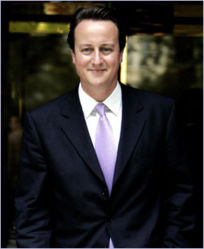 The political world is in turmoil today following the unexpected and wholly premature death of David Cameron's speech to the Conservative Party Conference. Once seen as the shining hope for both party and country, The Speech's sudden passing leaves behind countless devastated voters and a gleeful Norman Tebbit.
Conceived several weeks ago in an enthusiastic and energetic bout of love-making between Tory leader David Cameron, his spin doctors and large sections of the media, many had expected The Speech to grow up to be a triumphant tour d'horizon, that would see its maker swept to power on a wave of overwhelming enthusiasm. Given the difficulty of producing a wave of anything beyond faltering, Werther's-Original-and-Sanatogen-infused, breath from the aged audience who had gathered in the delivery room to greet it, it is hardly surprising that The Speech's entry into the world did not go well.
Matters worsened for The Speech as attempts to inject it with NHS, gay partnerships and the minimum wage - along with a total failure to administer life-saving tax cuts - by the junior spin doctors overseeing the delivery room caused the unfortunate oration's health to deteriorate more rapidly. With hopes for The Speech fading fast among well-wishers - and several members of the Shadow Cabinet - an emergency crash team of the armed forces, immigration controls and support for marriage were called in but to no avail. By 3.22pm The Speech was pronounced dead ... despite having another twenty minutes yet to go.
The Speech's funeral was attended by an audience of ageing party members, who gave The Speech a lengthy standing ovation after being told they could have tea and biscuits if they did so.
David Cameron's Tory Conference Speech is survived by David Davis, John Redwood, Edward Leigh and an unusually cheery Gordon Brown.
09 September 2006
| [+/-] |
Boris Johnson's Mouth 1964-2006 |
Tory frontbench spokesman Boris Johnson's Mouth has passed away during the night, mere hours after being shot off by Mr Johnson himself. Boris Johnson's Mouth was born in 1964, to a long line of Mouths. Educated at Eton and Oxford, and well-versed in the language of Ancient Greece, Rome and Billy Bunter, the Mouth had all the qualifications necessary to make it a senior body part at both the influential right-leaning Daily Telegraph newspaper and the influential right-leaning Spectator magazine. Its progress was swift, soon becoming Telegraph leader writer, a task made all the more difficult by having to grasp its pen between its teeth. Just one year after Mr Johnson's marriage to Marina Wheeler in 1993, it became Mouth to The Spectator editor, in which role it divided its time between conducting editorial meetings and whispering sweet nothings into Petronella Wyatt's Ear.
Beyond journalism, Boris Johnson's Mouth began to make a name for itself in comedy, appearing on satirical panel shows such as The News Quiz and Have I Got News For You, as well as in the long running Whitehall farce "The Conservative Party", in which it was to take a leading role in 2004 as Parliamentary Mouth to the Shadow Minister for Arts. Regretfully, the Mouth was already becoming increasingly eccentric and unreliable and, in October 2004, Mr Johnson is believed to have shot it off for the first time, making characteristically ill-judged reference to the Hillsborough disaster and claiming that Liverpudlians were mawkish. Despite doing dreadful penance by making a speaking tour of Liverpool, worse was to come only days later when Mr Johnson shot off his Mouth again, after it declared that claims it was having an affair with Petronella Wyatt's Ear were "an inverted pyramid of piffle" a declaration that led to the ground opening beneath it and attempting to swallow it up, while Mr Johnson's pants burst into spontaneous flame. Its reputation in tatters, the Mouth was dismissed from its role, only returning to the Conservative front benches in 2006 as part of new Tory leader David Cameron's assemblage of thrusting and radical Old Etonians.
Tired, weary and mentally unbalanced, Mr Johnson shot off his Mouth for the final time this week, accusing Papua New Guineans of being cannibals. Friends and journalists, hoping for one last misstatement from The Mouth, were gathered at its bedside as it uttered its final words which were "yoiks", or possibly "yarroo". It is to be buried next Saturday, alongside Gogol's Nose and Kafka's Dick.


