 It is with some glee and no little relief that As A Dodo must mark the passing of the, now, quondam England Football Manager Steve McClaren - a man for whom the words "over-promoted" and "gurning idiot" might well have been invented (the invention doubtless being attributable to a "source close to Terry Venables").
It was in 2006, amid the ashes of England's World Cup hopes, that the Football Association moved swiftly to dissociate itself from the lacklustre campaign masterminded by noted sexual athlete and part-time football manager, Sven Goran Eriksson, by appointing the man who had been beside him for every faltering step. True, some suggested McClaren was ill-suited for the job, having never managed at the highest level or, indeed, succeeded in his time at Middlesborough in achieving much beyond the occasional assault on the middle of the Premiership table by means of football so grindingly dull that even George Graham in his pomp (or Rafael Benitez in his frankly rather silly beard) would have been driven to bite his own face off at the sheer mind-numbing tedium of it all. However, driven by blind faith in the desirability of an English team having an English born manager (a faith notably not shared by the owners of any of the Premiership's top clubs) and the fact every top-level foreign manager had drilled his family to turn off all the lights and pretend to be out every time someone from the Football Association called round, the FA was left with little choice but to select the man with the frozen smile as the great beetroot-faced hope of English football.
Mr McClaren rose immediately to the challenge of his new post, revealing his priorities as manager by the rapid appointment of PR guru Max Hastings to act as his eminence grease gris. Tragically, Mr Hastings was to be the only silky-skilled appointment that the new manager was to make during his 18 matches at England's helm and even his smooth tongue and media savvy would never be enough to turn a draw at home to Macedonia into anything other than an unmitigated disaster.
McClaren's time as England manager has been described by many as a roller-coaster. Such a description is, of course, wholly inaccurate, given the total lack of any highs during the rapid journey towards oblivion that was his tenure. Indeed, anyone seeking a source for an appropriate metaphor would be best directed towards The Last of the Summer Wine, the sitcom in which misguided fools under the direction of a bemused Yorkshireman bugger about for half an hour before travelling downhill at great speed in a tin bath or giant carrot.
As England's campaign to qualify for Euro 2008 accelerated toward its inevitable doom, it soon became plain that McClaren's rival managers had him by the balls (which were generally long and headed in the vague direction of Peter Crouch - at least when they were not hoofed towards the toilet block behind stand C). With England's defeat by Croatia it became clear that the most golden thing about the nation's oft-hailed "golden generation of footballers" was the taps in their Cheshire mansions and the brightest thing about their manager was his teeth.
Unable to stand to watch so many dumb animals suffering any longer, the FA at last decided to put an end to the team's suffering (and the frequent anti-McClaren briefings from "sources close to Terry Venables") by putting their England manager down.
Steve McClaren, England Football Manager, will be buried under the hallowed turf of Wembley, just before it's dug up and replaced with a surface that wouldn't disgrace a junior school playing field. It is survived by overpaid Premiership stars, thuggish England fans who boo their opponents' national anthems and devastated TV companies, kit manufacturers and pub chains who face a long and quiet summer 2008. He is expected to be succeeded by a high quality manager, such as Alistair Darling.
23 November 2007
| [+/-] |
Steve McClaren, England Football Manager 2006-2007 |
14 November 2007
| [+/-] |
Golf c. 15th century - 2007 |
 Golf has played its last stroke - a massive and terminal one - with the news that elderly golfers are hogging the courses at golf clubs up and down the country.
Although the Chinese may claim to have planted the first long drive onto the green in the 11th century and, a hundred years later, the Dutch were busy thwacking a leather ball into a hole (through a giant windmill - thus inventing Crazy Golf), it is the Scots who lay claim to the true invention of the game in the 15th century, when Scots began using a small mashie niblick (or any other deep-fried snack to hand) to whack a ball across the country.
The game quickly became popular with Scots of all ages and all classes taking it up with great enthusiasm, with even Mary Queen of Scots reputedly playing at the Musselburgh Links in 1567 - although her lack of a head meant she had trouble playing out of the bunkers onto the green.
While the Scots were arguing about the correct ratio of holes for playing golf to watering holes for refreshment, the rest of the world was mastering the basics of teeing off, chipping out of the rough, shouting at the caddy and breaking a putter over their knee at the difficult 17th. By the time 18 holes became standardised and the 19th was introduced, the game as we know it could be said to have finally arrived - as bores, boors and bigots knocked back the whiskies while telling taller and taller tales about their drive and revealing their smaller and smaller minds about the wisdom of accepting anyone who didn't possess the right sort of golfing qualifications - usually white skin, at least one testicle and the ability to prove ones pure Anglo-Saxon parentage back sufficient generations to get you into the SS.
Despite the existence of a bunker mentality (that bunker being located deep beneath the Reich Chancellery just before the dogleg onto the green at Potsdamer Platz), Golf raised its game and ditched its plus fours and argyle sweaters for a golden age as players such from Jack Nicklaus to Tiger Woods entertained spectators across the globe by powerfully driving up the fairway and delicately putting in, and Colin Montgomerie entertained spectators across the globe by disembowelling caddies with a glowering look - frequently, and unsportingly, without first uttering the warning cry of "Fore!"
However, this popularity was achieved not without cost. For every birdie chipped in from off the green by the likes of Ernie Els, two or three superannuated middle managers, solicitors or comedians took up the game with gusto and hacked their way slowly towards a G&T in the clubhouse. So when the Golf Club Secretary Newsletter reported that retired golfers were paying less and playing more than younger members at their golf clubs - clogging up the courses as they searched for their driving spectacles, their putting zimmer frames and remembering loudly "when this was all fields" - Golf sliced its last shot into the water and, feeling well below par, sank without trace. Thus was a good walk spoiled no more.
Golf will be buried at the bunker on the 18th hole of the St Jimmy of Tarbuck's Pro-Celebrity Church of the Royal and Ancient. The service will be conducted by the Reverend Peter Alliss ("Oh... Ah...! The coffin has pulled up just two yards short of the church... Monty, Monty, Monty...!") and the congregation will sing hymn 365, Lalo Schifrin's theme from The Eagle Has Landed as Colin Montgomerie defenestrates the vicar after smashing the crucial putt into the font.
20 September 2007
| [+/-] |
Dodo News Alert: Jose Mourinho, Chelsea Manager 2004-2007 |
Chelsea FC fans, style-watchers and lovers of footballing mind-games are advised that As A Dodo has just been informed that Jose "The Special One" Mourinho's time as Chelsea Manager has passed away. The precise nature of Mr Mourinho's passing is as yet unclear, though those who in recent months have witnessed his rapid transformation from a grey-suited fashion icon and footballing mastermind into a grizzled figure in a tracksuit with all the footballing knowledge of an elderly high court judge (or, heaven forfend, Steve McClaren) believe that the cause was a polonium-enriched football delivered to the Chelsea manager in an armoured Zil following his failure to select Andriy Shevchenko for every match.
In the interim, those wishing to mourn Mr Mourinho are directed to this obituary for Jose Mourinho's Cool, which so sadly predeceased his passing as Chelsea manager earlier this year.
02 July 2007
| [+/-] |
Tiger “Tim” Henman 1974-2007 |
 Tiger “Tim” Henman, for many years Britain’s greatest hope of losing winning Wimbledon, has gone to the great practice court in the sky after being knocked out of the second round of Wimbledon this year by a combination of torrential rain, flooding, terrorist attacks, the death of Tony Blair’s Premiership, the end of smoking in public and not being quite good enough at tennis.
Tiger “Tim” Henman was born in 1974, with a silver strawberry in his mouth, the newest addition to a great British tennis family – his father a keen tennis player and both his grandfather and great-grandfather competitors at Wimbledon, making their millions in the cut-throat world of lucrative strawberries and cream concessions.
Slapped by the midwife “Tim” astounded his parents by returning the open-palmed volley – sending his umbilical cord across the maternity room with a beautiful top-spin smash (although he later lost to the midwife 6-3, 6-3, 7-6, 7-6, 6-0). He was immediately given the name “Tiger” – not because of his tenacious fighting spirit and ability to rip his opponents to shreds but because of his uncanny resemblance to the moth-eaten and broken-toothed tiger-skin rug the family had inherited from Great Aunt Letitia.
From an early age Tiger was encouraged to follow his natural talent, but like most children he quickly rebelled and decided instead to become a tennis player, a pursuit in which his passionate displays earned him the equally passionate sobriquet "Tim".
“Tim” quickly rose through the junior tennis ranks thanks to his extraordinary skill and dedication and the fact that all the juniors who are any good at sport are playing football, rugby or training for athletics. Having mastered the basics of tennis – the serve, the volley, the sliced cross-court return (although until the end of his career he failed to convincingly punch the air like he meant it) – “Tim”, in the absence of any real competition, soon graduated to the seniors circuit where he was greeted at Wimbledon as the second coming of the British tennis messiah and, everywhere else, as “that useless Brit who doesn’t even have the excuse that he’s actually Canadian.”
Unlike many successful tennis players, “Tim” refused to indulge in the competitive gamesmanship of his rivals, abstaining from barracking his opponents or the umpire and always remembering his manners, saying “please” and “thank you” but mostly “sorry” to his fans and Sue Barker after every match. So, it was a surprise that, in only his second Wimbledon tournament in 1995, he became the first player ever to be disqualified after smashing a ball into a ball girl’s head (although the ball girl later won in straight sets).
Despite this “Tim” quickly captured the imagination of a generation of British fans desperate for a hero, completely ignorant of the rules of tennis and relishing only the chance to drape themselves in a Union Jack and bellow “do come on, Timothy” at a crucial point in the match – normally as their hero was returning a difficult first serve or trying to work out how to operate the Robinson’s Barley Water dispenser. Indeed “Henmania” reached such a fever pitch that the size of his celebrity and his fans’ undying devotion led to the christening of “Henman Hill” – a scruffy mound on the verges of Wimbledon, nearly several feet high.
Tiger’s frustrating losses on the Grand Slam circuit were easily compensated by his amazing Wimbledon performances – as year after year he was knocked out by the rain (or, in 2002, by wild card David Blunkett). But his gritty determination still won him the support of his fans as he clawed defeat from the jaws of victory, all the while punching the air (although he later lost to the air in straight sets in the first round of the French Open).
With the rise of tennis player Andy Murray, Tiger’s status slipped and he became Britain’s Number 2 – a status his harsher critics had been euphemistically granting him some time. As he entered this year’s Wimbledon he fought valiantly to beat Moyà in the first round before succumbing to Feliciano López in the second in a five-set struggle that “Tim” lost only after his Adidas-sponsored wellingtons were stuck in the mud on Centre Court. The spell was broken – as his mentally-disturbed loyal fans and the media realised that Henman was not the name of his superhero alter ego and that the Tiger had miaowed its last.
Tiger "Tim" Henman will be buried at the Fred Perry Church of Nostalgia. The service will be too fast for him to return, but the congregation will struggle on as the final eulogy is delayed by rain for 24 hours before being knocked out in the last set.
He is predeceased by Greg Rusedski and survived by Andy Murray – the spotty 20-year-old with “wrist” injuries.
06 June 2007
| [+/-] |
The London 2012 Olympic Logo 2007-2007 |
 Graphic designers are today weeping into their vodka and Red Bulls as they mark the passing of The London 2012 Olympic Logo, that astonishing piece of imagery which had briefly succeeded in uniting the nation ... in utter condemnation.
The Logo was the child of the middle-aged and besuited London Games Organising Committee(1) and dashing, Hoxton-finned, brand consultant Wolff Olins. The conception, it must be admitted, was not without attendant difficulties. For several months the committee lay back, thought of England and handed over hundreds of thousands of pounds, while the dashing Wolff tried everything from running things up flagpoles, pushing the envelope, thinking outside the box, leveraging its creativity, empowering its knowledge-base and fast-tracking its synergies. All was to no avail until Wolff briefly gave up its attempt to service the needs of the Committee, took a moment to stare out of the window and spotted a gang of hoodies incompetently spray-painting a Committee member's car with a pink swastika. Inspired, Wolff immediately called on the Committee to hand over £400,000 and bend over, before proceeding to give it what is usually termed "a right royal rogering".
After a short pregnancy, the Committee finally gave birth to the logo on 4 June 2007. The reaction to its appearance is perhaps best judged by the fact that the doctor overseeing the Logo's birth could only be restrained from his repeated attempts to slap it back into the womb by three hospital orderlies and a passing scrum-half. It was, in truth, an unlovely child, combining the graceful line of a tartrazined-up five-year-old's drawing, the delicate palette of one of Sir Elton John's stage outfits and the understated iconography of the Nazi party.
Such an ill-favoured infant could not be expected to have either a long or a successful life. When presented to the public it produced extraordinary displays of horror and disgust normally capable of being induced only by a Channel 4 documentary or showing Melanie Phillips a single mother. When presented to potential Olympic sponsors it resulted in the whittling down of their number to two graffiti-removal firms and a German-accented South American dentist going by the name of Diego Alfonso von Martin Bormann.
Yet the Logo might perhaps have struggled on even then, had it not been for experts warning that - in its animated form - it was capable of producing epileptic fits in those vulnerable to flashing images, and apoplectic fits in those who cared a damn about good design. Reluctantly, the Committee was forced to remove the Logo from its website.
The funeral for The London 2012 Olympic Logo will be held at St Sebastian Coe's Church of the Bleeding Disaster. The Reverend Tessa Jowell will read from an official advisory warning epileptics that the following funeral contains rapidly flashing images. The hymn will be number 728 "Dear Lord! They paid £400,000 for that?!!"
The London 2012 Olympic Logo will be buried under a vast petition calling for its immediate destruction. It is predeceased by the Olympic Spirit and several billion pounds.
(1) which has insisted that it's abbreviation should be Locog rather than Loco, at least proving that its members - contrary to popular opinion - are not completely stupid.
30 May 2007
| [+/-] |
The Second Michael Vaughan 2005-2007 |
 It is with great sadness that we at As A Dodo must report the passing - during our brief absence celebrating the impending publication of As A Dodo: The Obituaries You'd Like To See (soon to be available at all good bookshops, many bad bookshops, assorted remainder bookshops and many charity bric-a-brac stalls) - of The Second Michael Vaughan, the comically inept and permanently injured would-be cricketer whose farcical antics kept a nation entertained and appalled in equal measure during the enforced absence of Michael Vaughan from the England cricket scene.
The Second Michael Vaughan was born in 2005, when a desperate attempt to save the England cricket team from an inevitable descent into disaster following a severe knee injury to Michael Vaughan, resulted in a - frankly doomed - attempt to clone the inspirational England captain from a dodgy patellar fragment. That the attempt had proved less than successful was apparent from the moment that the newborn Second Michael Vaughan was tapped on the buttock by the midwife and immediately collapsed to the ground in agony whilst crying out "That's no way to treat The Second Michael Vaughan. England need The Second Michael Vaughan".
Moving with their usual swiftness, officials at the England and Wales Cricket Board ("the ECB") erected a cage in which to keep the misbegotten product of their tinkering in the gene pool. That this was to no avail was in part the product of the skill of their quarry but mainly down to the fact that the 17-month consultation process necessary before the ECB does anything meant the cage was only completed many months after The Second Michael Vaughan had fled and, in any event, lacked a lock following representations from the several county chairmen about locks being contrary to the spirit of the game.
Thus, while the real Michael Vaughan stoically set to work in the gym, undergoing hour after punishing hour of rehabilitation in an attempt to recover from an injury that could have destroyed the career of a lesser man, the Second Michael Vaughan was left to roam the outfields of cricketdom, amazing crowds with his extraordinary exploding knee and ability to refer to himself in the first, second, third, fourth, fifth and sixth persons during a single response in an interview.
Excluded from the England set-up following an ill-advised attempt to get a giggle out of England cricket coach Duncan "Less prone to laughter than a Yorkshire undertaker on Thorazine" Fletcher, The Second Michael Vaughan was left to loudly bemoan "The Second Michael Vaughan's" lot while the team went from disaster to disaster. With England suffering a drubbing in the Ashes and humiliation during the world cup, The Second Michael Vaughan's behaviour became increasingly erratic. Some even claim that the disgruntled clone was seen in the Caribbean hiring scuba-gear and an Acme junior torpedo-kit just before the tragic pedalo accident which saw Andrew Flintoff's national hero status going down with all hands.
By the summer of 2007, however, The Second Michael Vaughan was beginning to show signs of frailty. Even as the England team proved themselves unable even to beat a West Indies Test team with plenty of spirit but less cricketing talent than Sir Viv Richards's left testicle, the clone's protestations that England "need The Second Michael Vaughan" were sounding increasingly hollow. While The Second Michael Vaughan had been making a complete tit of itself with its pompous pronouncements, the genuine article had finally returned to fitness. Tired of being made a laughing stock by his William Wilson-esque doppelganger, on Friday 25th May 2007 Michael Vaughan set about mercilessly pounding his idiotic stand-in with a series of glorious and graceful cover drives, pulls, and laser-guided clips through the onside. Though police were called to the scene, all present were willing to attest that the returned England captain had merely acted in self-defence.
The Second Michael Vaughan will be buried at the Mike Gatting-Shakoor Rana Church of the Cricketing Embarrassment. The service will be conducted by an old buffer in a blazer making dodgy jokes about "getting caught by the googlies", "standing at leg slip, legs wide apart waiting for a tickle" and "the batsman's Holding the bowler's Willey".
18 May 2007
| [+/-] |
Jose Mourinho's Cool 1963-2007 |
 The football world has, for one day, abandoned its ridiculous pay demands, nightclub punch-ups and three-in-a-bed after-hours entertainments to mourn the passing of Jose Mourinho’s Cool, that air of tanned European style, tactical flair and a self-confidence that lesser mortals interpreted as arrogance, which in recent weeks has slipped away to be replaced by a grizzled figure in a tracksuit, much given to ridiculous declarations about opposing teams and claims that Mr Mourinho’s pet Yorkshire terrier, Gullit, was a better finisher than Shevchenko.
From the moment of its birth in Portugal in 1963, Jose Mourinho’s Cool was evident to all, as it held its first press conference (in both Portuguese and English) casually acknowledging the skill of the midwife, protesting at the failure of the referee to book the attending doctor for an obvious slap and, chiefly, praising Mourinho's skill in choosing to be born.
After a childhood of dismissing inferior teachers with a snappy putdown and enlarging upon the magnificence of Mourinho's innate talent, The Cool saw its charge gain a degree in Physical Education without breaking a sweat, or even once shouting at other students that they’d have to do the class in their pants.
Too assured of itself to need to chase a ball up and down the park for 90 minutes, Jose Mourinho’s Cool contented itself with hanging around the stands delivering withering looks to opposition players or admiring itself lovingly in the changing room mirror at half-time, whilst pointing out the manager’s tactical mistakes.
Word of The Cool began to spread, in no small part thanks to Jose Mourinho himself taking every opportunity to remind all and sundry of his superior intelligence, fashion sense and god-like footballing nous. Catching the eye of a desperately unfashionable Bobby Robson, languishing in purgatory in Portugal following England’s comically inept penalty shoot-out in the 1990 World Cup semi-final, The Cool accepted the offer to act as Robson’s interpreter at Sporting Lisbon, Porto FC and at FC Barcelona – where it learned Catalan overnight whilst redesigning Gaudi’s Sagrada Familia to make it more “tasteful” and playing an eight-hour sax solo with Miles Davis.
The Cool's self-confidence and personal magnetism drew players to Mourinho, as they sought alternatives to Robson’s tactical advice to “just hoof it up the field for the big lad to knock it in the back of the net”, alternatives which The Cool was able to provide by offering tips on dead-ball situations, physical fitness advice and clear directions as to where to get a really first-class suit.
It wasn’t long before a stammering and awed Benfica sidled up to The Cool and tugged on its four-button sleeve, shyly asking if Mourinho wouldn’t mind managing their team. Leading them only long enough to realise they were far too lacking in charisma or savoir faire for Mourinho to be their chief, after just nine games The Cool grew bored, shrugged nonchalantly and walked away – clicking its fingers at an adoring Uniao de Leiria who eagerly accepted his kind offer to turn them into a well-groomed outfit – and teach them something about football. A stint at FC Porto, where The Cool won the 2003 Super Liga all by itself after dismissing the team for turning out on the pitch with too much product in their hair, and a triumphant 2004 UEFA Cup final in which it easily outclassed Celtic by mocking their oh-so-last-season shorts and boots, led, ultimately to The Cool’s greatest role.
In 2004, Jose Mourinho’s Cool announced itself to a hushed and adoring world of English football as “The Special One”, immediately eclipsing third-rate purveyors of Hello! magazine ersatz cool like David Beckham. Over the next three years Roman Abramovich’s money The Cool’s superior footballing skills and know-how propelled its new club, Chelsea, to trophy after trophy. Yet worrying signs of stress were already beginning to show, with The Cool occasionally melting in heated verbal assaults attacking referees and fellow managers alike. With year after year passing and failure after failure to win The European Cup, questions began to be asked ... chiefly questions from Roman Abramovich like "Oi, Jose! What is happen to my billions of roubles?" Under greater and greater pressure from club board and fans alike, Jose Mourinho's Cool began to falter, its image tarnished as it battled on in the face of the disastrous decision to buy Andriy Shevchenko, Frank Lampard’s ever-greater delusions of midfield mastery and John Terry's "Village Idiot at Milletts" sense of style.
According to reports from eye-witnesses, The Cool passed away when animal welfare officers called at Jose Mourinho's Belgravia home to put his Yorkshire terrier, Gullit, into quarantine, leaving the once-adored manager to shout “No, please don’t take my lickle-wickle Gullit away!" while stamping on his pipe with his Marks & Sparks slippers and sobbing uncontrollably into the sleeve of his beige Primark cardigan.
Jose Mourinho’s Cool will be buried at the new Wembley Stadium. It is survived by Jose Mourinho’s new range of polyester cardigans and slacks with elasticated waists and Jose Mourinho Dog Biscuits – “For Your Special One”.
19 March 2007
| [+/-] |
Andrew "Freddie" Flintoff's National Hero Status 1998-2007 |
 Andrew "Freddie" Flintoff's National Hero Status was born in 1998, the child of a press eager to build up any cricketing all-rounder as the new Ian Botham before condemning him to ignominy as the old Derek Pringle and the precocious skills of a cheerful, 6'4" cricketer from Lancashire.
Even at such an early stage it was apparent to many that the man the nation would come to know as "Freddie" (a nickname granted by his fellow players in memory of either German philosopher Friedrich Nietzsche or - more probably, given that Mike Brearley wasn't on the team - yabba-dabba-doo-ing cartoon character Fred Flintstone) possessed many of the skills of a great all-rounder. As a bowler he could inspire fear in batsmen, as a batsman he could inspire fear in bowlers and as a drinker he inspired awe in such greats as Jeffrey Bernard, Oliver Reed and George Best.
With such unique attributes at his command it was inevitable that Freddie would be granted National Hero Status. Over the years there were many heroic achievements, two wickets in the vital final over in a one day match against India in 2001-2 that led to a shirt-ripping display, centuries against South Africa and the West Indies along with 5-wicket hauls in 2003-4 with many more to come, not to mention showing such extraordinary resolution in the face of the massed forces of pints of bitter and tins of Fray Bentos that he actually looked as if he could fit through the cricket ground turnstiles.
Freddie's National Hero Status was to reach its zenith in 2005 when his feats of cricketing excellence during the Ashes Test series (and drinking excess after it) succeeded in winning him the admiration of a whole nation, not to mention an award from the National Brewers Association for services to the industry. From such a peak, however, decline is inevitable.
In the following years, Flintoff found it hard to repeat the feats of his youth - whether on or off the field. With fame came responsibility and with the failure of Michael Vaughan's knee to survive anything beyond a shuffle out of the armchair to grab a newspaper came the responsibilities of the England captaincy. When England lost the Ashes to a resurgent Australia, Freddie's National Hero Status began to show signs of frailty.
It was during the Cricket World Cup in the Caribbean that the last innings was to be played. Over several hours in St Lucia's Rumours nightclub, Freddie - cheered on by his team-mates - worked steadily, first grabbing a few singles before moving on to doubles, pints and chasers, with the prospect of an extra spicy goat curry on the way home and some serious runs later. It was not to be. Determined that his legend should live on, Freddie took the unfortunate decision to grab a pedalo and set out into Rodney Bay, where he capsized and his England vice-captaincy sank without trace.
Andrew "Freddie" Flintoff's National Hero Status, along with the prospect of him ever captaining the England cricket team again - barring every other England-qualified human being capable of holding a bat being struck by lightning - was buried at sea. It is survived by David Gower's Tiger Moth, Mike Gatting's reverse sweeps and Geoffrey Boycott's selfless team-spiritedness.
16 March 2007
| [+/-] |
The 2012 British Olympic Spirit 2005-2007 |
 The 2012 British Olympic Spirit was found dead this week in a partially built stadium on Hackney Marshes. Sources close to the Spirit say it had become increasingly worried after the estimated cost for the London Olympics more than trebled from £2.4bn to £9.3bn and have now risen so high that they have been selected for the Pole Vault squad.
The Spirit, the long-awaited offspring of Sebastian Coe and Tessa Jowell, was born amidst much fanfare and hoopla in July 2005 – although the fanfare and hoopla had less to do with the prospect of the nation being afforded an opportunity to display its sporting prowess to the rest of the globe and more to do with pipping the French bid at the post.
While other countries greet the prospect of hosting the Olympics as an occasion for national pride (not to mention a marvellous opportunity to rip off tourists), in ever-cheerful and optimistic Great Britain enthusiasm for the 2012 Olympic Games was, from the sound of the starting pistol, confined to construction firms and property developers gleefully shaking their heads, sucking in air and cackling, “That’s gonna cost you… We should be able to finish that by 2013… But we’ve got another job on down Wembley way…”.
With the Olympic ideal of the finest amateurs competing for nothing more than a crown of laurels and the approbation of their peers having long been replaced by the worst professionals incapable of organising a school sports day without forcing the parents to remortgage their homes and sell their kidneys, the Spirit - never strong - quickly began to wane. Rather than being galvanised into glorious action, across the land Britain's potential medal winners of the future chose instead to slump back in their sofas, turn on Richard and Judy and wonder vaguely if Citius, Altius and Fortius were three of the Teenage Mutant Ninja Turtles.
Attempts to consolidate all its debts into one manageable debt failed to halt the Olympic Spirit's decline. Despite plans to raise capital by introducing sponsored events including the 400m financial hurdles and the Snickers marathon, and London mayor Ken Livingstone’s plans to introduce a congestion charge for cyclists using the Olympic velodrome, the costs continued to spiral. The Spirit fell into a deeper, and deeper depression before, tragically, taking its own life, hanged by a genuine replica plastic Olympic gold medal bearing the legend “I Love the 2012 Olympics” (retail price £29.99).
The 2012 British Olympic Spirit will be buried in a pauper’s grave along with billions of taxpayers cash as construction firms and property developers dance ecstatically in a New Orleans-style celebration of the dead. It is survived by Ken Livingstone, Tessa Jowell and the knowledge that if the French had won they'd have done the whole thing with a lot more class and a lot less whinging.
As A Dodo small print: the cost of your Olympics may go up as well as up, and your home may be at risk if you do not keep up council tax repayments.
07 February 2007
| [+/-] |
The People's Game 1863-2007 |
 The People's Game, twin brother of The Beautiful Game which died only last year suffering from congested bungs, passed away yesterday as Liverpool FC, one of the last English football clubs actually capable of winning a soccer trophy beyond the award for "Best Second XI Away Strip", was converted into a "franchise" under overseas ownership.
Immensely popular throughout England almost from the moment of its creation, The People's Game was a simple entertainment, capable of uniting men up and down the country as they stood, cap on head and scarf round neck, in the terraces of a Sunday afternoon and shouted spirited encouragement to the members of their local team - most of whom were born and brought up within hailing distance of their home ground - and even more spirited imprecations against the rapscallions on the opposing side and the frailties of the person of questionable parentage in referee's uniform.
It was in the early 1990s that The People's Game began, like so many an England game, to drift slowly towards inevitable defeat in the penalty shoot-out of life. It was at that time that The Game first began its involvement with the notorious Americo-Australian lothario, Rupert Murdoch. Like Wedekind's Lulu, The Beautiful Game soon found itself living a life of wild excess, throwing its money away on a parade of vacuous pretty boys and brutish thugs ... many of whom would go on to play for England. Its appetites beyond satiation, even by Mr Murdoch's vast piles of cash, The People's Game was forced to go in search of more and more and richer and richer suitors, be they ageing American multimillionaires or billionaire Russian oligarchs. By the early noughties The People's Game was even willing to sell off the most successful football club England had ever seen to anyone with a bit of cash to spare for a new stadium. Yet even this was not the height of its infamy, for at the same time The People's Game was willing to offer almost anything (except, of course, a team capable of winning the World Cup) as it tried to extract the last penny from the pockets of its fans. With its ticket prices soaring and sports rights being sold for astronomical fees, The People's Game eventually put itself beyond the reach of those who loved it, thrusting itself instead into the hands of corporate sponsors whose perfect view of a match was out of the corner of an eye while doing a deal in the VIP restaurant and far-flung "fans" who were in less danger of visiting their team's stadium than Kettering FC are of winning the European cup.
The People's Game will be buried at the Church of St Lineker the Crisp-Seller. The Reverend Alan Hansen will read Psalm 4752 "The defence were woeful and no-one tracked back". Well-wishers are asked to send as much cash as possible.
27 November 2006
| [+/-] |
England's Hopes of Retaining "The Ashes" 2005-2006 |
 England's Hopes of Retaining "The Ashes" suffered an ignominous death in Brisbane today, passing away during those "wee small hours of the morning" which are so notoriously the time for the weak and infirm to shuffle off this mortal coil, a reputation they doubtless gained due to the fact they are also the hours when any English cricketers who happen to be in Australia at the time will be beginning the day's play.
The manner of England's Ashes Hopes' death - going down amid the boos and jeers of a hard-bitten audience of 40,000 Australians after a half-hearted display of comical batting and inept bowling - will have come as a shock to all those who remember the Hopes' in their prime, just one year ago. Back then England's Ashes Hopes were the country's favourite entertainment, a travelling show that journeyed from cricket ground to cricket ground mounting an extraordinary display of pyrotechnic batting and laser-guided bowling, culminating in spectacular victory over the Aussies. Such was its popularity that Britons who had never previously shown any interest in cricket before - including millions of football fans, thousands of console-addicted teens and vast numbers of senior politicians eager to jump on any passing bandwagon - began to profess an undying love for the thwack of leather on willow or, even better, leather on Australian body part. England's Ashes Hopes were to reach their apotheosis on 13 September 2005, when the members of the troupe - arriving in high spirits (thought to be largely gin and vodka) in Trafalgar Square after a night out on the town (and in several bars) - were feted by a massed crowd in Trafalgar Square, before being taken to Number 10 Downing Street for a reception with the Prime Minister himself. It was at this point that the first chink in England's Hopes' armour began to show, after Andrew "Freddie" Flintoff failed - despite having imbibed sufficient alcohol to stun several large elephants or a whole American tourist - to be sick over the PM when Mr Blair asserted how happy he had been to witness Donald Bradman scoring the winning goal for the England XV at the end of the fifth chukka.
From such heights the fall is inevitably far and fast. Within months, the ravages of time were showing upon the bodies of the cast: limbs (particularly those belonging to Michael Vaughan, Simon Jones and Andrew Flintoff) began to fail and the old passion suddenly seemed to be lacking (particularly in the vicinity of Marcus Trescothick). With new members drafted in to the troupe in haste and a packed tour schedule to fulfil, performances inevitably began to suffer. What was once the greatest show in England grew ever more reliant on extraordinary displays of strength from its new leader, Andrew Flintoff. When even these began to fail to bring in the crowds, England's Hopes started to become a sad parody of their former selves, with some even whispering that what simple spectacles they could achieve were aided by performance-enhancing umpiring.
With a certain grim inevitability, the cast of England's Ashes Hopes - like Ernie Wise - found themselves heading to Australia to try and recapture a portion of former glory. No longer Michael Vaughan's Conquering Heroes, they had reinvented themselves as Fred Flinto's Army: a comedy troupe - featuring such luminaries as Steve "Mind Yer Winders" Harmison, Kevin "The Mad Badger" Pietersen and Geraint "Butterfingers" Jones - who would emerge from their clown bus at each new venue before collapsing spectacularly in a display of comedy batting. Sadly, British acts of this sort had been regulars upon the Australian cricket stage for nearly two decades, leading to an inevitable death in Brisbane this morning.
The funeral for England's Hopes of Retaining the Ashes will be held a week on Tuesday following the close of the second Test. The sermon will be delivered by Steve Harmison ... probably in the direction of Ulan Bator. England's Ashes Hopes will be buried alongside England's Association Football World Cup Hopes, England's Rugby Football World Cup hopes and Tim Henman. Well-wishers are asked not to send flowers ... but if they could rustle up some competent cricketers that would be hugely appreciated.
20 September 2006
| [+/-] |
The Beautiful Game 1863-2006 |
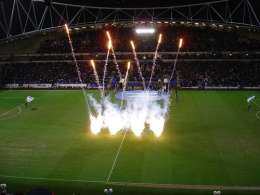 Sports fans are in shock following the death of The Beautiful Game. The Game has been followed for decades by millions of soccer fans across the globe, all eager to gather in front of their newspapers, radios and television screens for details of the latest transfers of players from club to club and of money from sports agent to football manager.
The Beautiful Game was born in the 1860's when, only months after the Rules of Association Football were first laid down by the FA, the manager of the N.N. (No Names) Club, Kilburn was offered his weight in Millingtons Unfiltered Gaspers to agree to the transfer of dashing, young centre-forward Aloysius "The Flying Cad" Formby from Blackheath Proprietary School.
Over the following decades The Beautiful Game was to make little progress, confining itself to building the odd manager a cheap patio or installing an avocado bath suite in a chief coach's home. This was due partly to the rectitude of those involved in football and mainly to the fact that all the money in British soccer at the time was insufficient to maintain a single sports agent. All was to change in the early 1990's, when hundreds of millions of pounds were diverted to the game from Rupert Murdoch's War on Culture to set up the Premier League.
Soon The Beautiful Game was advancing apace and developing exciting new moves, including the bung, the backhander, the sweetener, the tap-up and the illegal approach. Followers of The Game frequently marvelled at displays of extraordinary skill as the most outrageous bribes were explained away with straight faces, their enjoyment heightened all the more by the comic ineptitude of the governing authorities. Indeed all agreed that The Game was at its very peak when, only this week, it was brought low by a series of inquiries, investigations and a tragic outbreak of football.
The Beautiful Game is survived by diving, professional fouling, lousy refereeing, numerous assault allegations, hundreds of kiss-and-tell-stories and David Beckham.
25 August 2006
| [+/-] |
Cricket Umpiring: A Correction |
Relatives of the recently deceased Cricket Umpiring have asked the staff at As A Dodo to inform all those wishing to commemorate Umpiring's sad passing that the deceased asked that no flowers be sent. Those wanting to see cricket umpiring quietly buried are instead requested to send $500,000 in unmarked bills.
21 August 2006
| [+/-] |
Cricket Umpiring 1646-2006 |
 The cricket world was today mourning the sad demise of umpiring following the self- immolation of Australian umpire Darrell Hair during the fourth test match between England and Pakistan at the Oval. In the early hours of the evening, Mr Hair decided to pour petrol over himself and international cricketing relations before setting light to it in protest over an alleged ball-tampering incident. Whose balls were allegedly tampered with, or why, we shall now never know, though friends of cricket umpiring have suggested that someone had attempted to "grab Pakistan by the googlies". Already the incident is being compared to the notorious "Bodyform" Ashes series, in which England decided to target the brilliant Australian batsman Donald Bradman by bowling sanitary towels at him.
It was in 1646 that the cricket umpire first made his tentative appearance in the world, calling "play" on a limited-overs match between two Kentish sides which sadly had to be abandoned almost immediately when bad light and the English Civil War stopped play. This was just the beginning of a troubled childhood: only two years later the whole game of cricket was banned by the new Puritan parliament, who regarded it as liable to induce ungodly merriment and impious consumption of cucumber sandwiches. Happily the game, and umpiring along with it, returned to favour following the Restoration, when the newly-crowned King Charles II was informed that bowling a maiden over was a highly-prized feat in any cricket match. After this difficult youth, cricket and umpiring soon grew to prominence on the world stage, bringing to the remotest parts of the Empire the deeply-held British values of decency, fair play and utter self-delusion, not to mention official incompetence.
Following its cremation on Sunday, the last remains of cricket umpiring have been laid to rest in a small urn, whose ownership will be contested in a bi-annual contest between England and Pakistan, represented by ex-England captain Mike Gatting and the late Pakistani former umpire Shakoor Rana.
16 August 2006
| [+/-] |
David Beckham's England Career 1996-2006 |
The sad demise of David Beckham’s England Career, which passed away this week at the tender age of ten, while not unexpected has left a gaping void in the England midfield, the pages of the tabloids and several multi-million pound sponsorship deals.
Friends of David Beckham’s England career say the end came quickly, following the announcement by new England manager, Steve McClaren, that he hoped to take the national football team “in a different direction”– namely forward, towards the opposition’s goal.
David Beckham’s England career began in 1996, when the young David Beckham faced an agonising choice – to give up his lucrative career as a Joe Pasquale sound-alike and part-time model for a Leytonstone tattoo parlour or to play his first match for England against Moldova.

Having taken the plunge into international underachievement, David Beckham went on to win 96 caps for his country – while designing 3,174 under his own label, mostly for sale in the expanding Far East market where, ironically, many of the caps were made.
The England career went on to even greater heights, with Beckham wearing the Captain’s armband 56 times – sometimes on his arm, sometimes as a fetching thong and throughout most of the 2006 World Cup in Germany, as a blindfold.
Famed for his tattoos, wearing sarongs in public and having haircuts, Beckham initially managed to find time for other pastimes, including football. Sadly, this sideline quickly foundered due to his difficulty in deciding whether to play on the left or right wing or whether to play home or away.
The highlight of David Beckham’s England career arrived in 2004 with the signing of a £40 million sponsorship deal with Gillette which finally banished bitter memories of his petulant quarter-final outburst against Argentina which shattered England’s 1998 World Cup dream for most England fans.
David Beckham’s England career was laid to rest in a moving ceremony attended by the leading lights of England International Football along with Frank Lampard, Michael Owen, Jamie Carragher, Joe Cole, Gary Neville, John Terry, Rio Ferdinand, Ashley Cole and Wayne Rooney, Steve McClaren and Sven-Goran Eriksson, while Theo Walcott was left to mind the umbrellas. Also in attendance were the brightest stars in the celebrity firmament along with Beckham’s wife Victoria, Elton John, Max Clifford and the footballer’s voice-coach for many years, Sweep.
The ceremony was briefly marred when undertakers struggled to lower Beckham’s career into the grave. But in the dying minutes of the service substitute pall-bearer Aaron Lennon made a dazzling dash down the right-wing of the cemetery, beating three mourners and the paparazzi defence, before slotting David’s career square across the box. Frank Lampard was on hand to receive but blazed it clean over the open grave.
Beckham’s England Career is survived by his sponsorship and merchandising career at Real Madrid, where his solid work and hard graft has boosted sales of team shirts by over 27%.
David Beckham's England career was pre-deceased by Victoria Beckham's career which passed away in November 2000.


