19 October 2007
| [+/-] |
BBC Television Centre 1956-2012 |
The news of the long, slow death of BBC Television Centre - the home, over the years, to many of Britain's favourite television programmes (not to mention quite a few of Britain's least favourite programmes as well) - is unlikely to come as a surprise to those who have known and loved it during its long life, and will be particularly unsurprising to all those who are aware of the vast amounts of asbestos to which the building has provided a home for more than five decades.
The story of TV Centre's design is an unusually apt one, involving as it does - like so many a BBC project - great cost, vast layers of bureaucracy, government interference, a lengthy planning document and, in the end, a lonely creative left with no alternative but to come up with something in ten minutes while knocking back a couple of pints in the pub. Even more appropriately, architect Graham Dawbarn was to draw his inspiration for the building's design from doodling a question-mark, the act of doodling anticipating the activity many future BBC employees would spend their time engaged in while senior management banged on at length about "vertical integration", "360-degree vision", "trimediality" and making joy through work, and the question-mark design anticipating the many viewers wondering why the hell they were paying their licence-fee for repeated editions of Tittybangbang. More appropriately still, the project displayed the BBC's legendary swiftness of foot: having been commissioned in 1950, the foundation stone for TV Centre was not laid until 1956 with building only being finished in 1960.
When the building was, eventually, completed, many were amazed - not to say utterly bewildered - by its unique design, with its central rotunda's circular corridors set out over seven identical floors and its signage apparently arranged by a group of drunken medical students as part of a rag week prank. Indeed it is rumoured that last year a tattered figure, dressed only in the shredded paper waste removed over the decades from the innards of the BBC's many malfunctioning photocopiers, was discovered, having been wandering the building for over 20 years, surviving on curly-edged sandwiches left behind in empty green rooms and the water dripping from the malfunctioning air conditioning(1)
Yet somehow thousands upon thousands of programmes - from such well-loved gems as The Wednesday Play, Morecambe and Wise, Monty Python's Flying Circus, Tomorrow's World, I'm Alan Partridge and Dr Who to such well-loathed dross as Noel's House Party, National Lottery Stars, He's Having a Baby and Dick and Dom in Da Bungalow - were created within TV Centre's walls. The building was filled with designers, builders, make-up artists and wardrobe departments as well as all the lighting, sound and camera units needed to provide entertainment to the nation. It echoed to the sounds of fierce political debates on election nights, the sussurus of silken underthings being removed in hundreds of costume dramas, the tapping of thousands of record-breaking feet led by Roy Castle and the croaking of Daleks bent on extermination (not all of those Daleks being John Birt), not to mention the frequent hissy-fits of luvvies, screaming of irate directors, flopping of elephant dung on Blue Peter studio floors and the constant banging, hammering and drilling from thousands of technicians ... usually in the middle of a live broadcast.
Such great days, however, are gone. Now the make-up, wardrobe and design departments are closed, much of the camera, sound and vision work outsourced. Studio-based drama has passed away. The news operation - much of which was moved to the building in 1998 - is to be sent back to central London, following the discovery that nobody actually in the news had any desire to make the lengthy journey to be interviewed in a part of London with all the charm, character and cultural facilities of a defunct urinal block in Salford (which, by happy coincidence is the new location for the BBC's Sports and Children's Departments)
With TV Centre a hollow shell of its former self and the BBC eager to grab a bit of cash to fund vital services like news and drama (and not-so-vital services such as BBC3's low-rent factual output and patronising "youth" TV), it was inevitable that it should be quietly put down.
BBC TV Centre will be buried in the Blue Peter Garden, next to the statue of Petra and just above the Blue Peter time capsule. It was pre-deceased by thousands of BBC jobs and Lord Reith's Legacy.
(1) So Byzantine is TV Centre's design that many people have been astonished to round an unfamiliar bend only to bump into Dr Who's Tardis lurking in a darkened corner.(2)
(2) Although not as many people as have been astonished to bump into Dead Ringers' Jon Culshaw lurking in a darkened corner doing an impression of Tom Baker as Dr Who ... especially as Mr Baker ceased to play the role more than 20 years ago.
NB the author of this obituary wishes to acknowledge his huge indebtedness to the excellent "Unreliable and Wholly Unofficial History of BBC Television Centre", which interested readers (of whom we are sure there must be at least one ... surely) can find here.
17 October 2007
| [+/-] |
Analogue Television c. 1936-2007 |
Analogue Television has begun its long journey to the great decommissioning centre in the sky as Whitehaven in Cumbria became the first town in Britain to switch off its old-fashioned, analogue, cathode-ray "idiot boxes" and replace them with smart, new, digital, widescreen, LCD and plasma idiot boxes instead.
It was was back in the mid-1920s that John Logie Baird(1) pioneered TV in this country, inventing a mechanical means of broadcasting almost-impossible-to-see pictures of a dummy's head (a practice still much in favour with TV stations across the country). Sadly, like so many British inventions, his system - while brilliantly inventive - was utterly useless, meaning that an alternative means of broadcasting had to be invented in America. Thus it wasn't until 1936 that the BBC began broadcasting from Alexandra Palace. Thousands of middle-class(2) Londoners were able to dress up in black tie and gather around their mahogany-hewn television sets to watch up to four hours a day of programming devoted to dancing, loveable cockneys and Bruce Forsyth.
Discontinued during the war for fear that the Nazis would discover the secret of light entertainment and develop a terrifying new weapon, the LE-bomb(3), normal service was resumed following the death of Hitler(4).
Although it remained rationed until 1954, millions of Britons saved up their coupons to watch the coronation of Queen Elizabeth II - beginning the golden age of Analogue Televison. Sofa manufacturers and spam-and-powdered-egg pizza delivery companies rubbed their hands with glee as those millions of Britons sat, night after night, glued to dramas, sitcoms, documentaries and Bruce Forsyth.
Throughout the 60s, 70s and 80s Analogue Television had the nation enthralled(5), but by the noughties it was facing competition from a new rival. Digital Television was young and slim and able to woo the nation with the promise of hundreds of new television channels (admittedly generally showing exactly the same programmes) and the government with the prospect of flogging off the old analogue broadcasting spectrum to the highest bidder. Analogue TV began to look about as fresh and original as Bruce Forsyth and thus a plan was mooted to pull the plugs across the whole country by 2012 - enabling us all to press the red button and select not just the Olympic Mens' 100m Final, but also the race to complete the Olympic Stadium itself and the ceremonial resignation of Lord Coe.
The people of Whitehaven, Cumbria were chosen to pioneer the great switchover (even though many argued for a complete and utter switch off) and so, in the early hours of this morning, the slow euthanasia of Analogue TV began as Analogue BBC2 had a pillow held over its face(6) and the people of Whitehaven watched the white dot disappear from their screens for the last time.
Analogue Television will be buried at St John Reith of the Spinning Grave's Kirk. The service will be conducted by Justin Lee Collins and Tess Daly and, after a cross-platform, interactive, phone-in competition the congregation will sing Bruce Springsteen's 57 Channels (And Nothin' On) whether that was the true result of the phone-in competition or not.
Analogue BBC1, BBC2, ITV, Channel 4 and Five are survived by Digital BBC1, BBC2, ITV, Channel 4 and Five... and Men & Motors, Nuts TV, The Horror Channel and Bruce Forsyth.
(1) and his assistant Boo Boo.
(2) only the middle-classes had space in their homes for the newfangled television sets which were the size of a small room - normally belonging to the servants, who, from then on, had to sleep in the garden but were allowed to watch television through the window, provided they wore black tie.
(3) which is why Bruce Forsyth spent 1935 to 1945 under armed guard deep in a Welsh mine.
(4) which was broadcast live on UKTV History after viewers voted to evict the Fűhrer and Reichschancellor from Der Grosse Bruder Bunker.
(5) some say hypnotised - especially those in the advertising industry.
(6) something that anyone who has watched The Egghead Challenge has been dreaming about for some time.
30 July 2007
| [+/-] |
The Truth c. Time Immemorial-AD2007 |
The Truth, that nebulous concept that has exercised the minds of everyone from the greatest philosophers to the lowliest politicians(1), has passed away – crushed under an endless succession of fake phone-ins, cheating teachers, sexed-up dossiers, re-edited documentaries, alternative therapeutic nonsense, political spin, ridiculous advertising claims, dodgy journalism and wholly unreliable obituaries.
The Truth was a controversial concept from the moment it first cleared its throat and proclaimed itself a necessity of human interaction, an asseveration which was challenged in around 100,000BC by Ug the Estate Agent - who felt it could do real harm to his offers of centrally-heated caves with a wonderful view of the dormant (‘no, really’) volcano - and has been under continual challenge by his descendants ever since.
It was not long before the formerly-simple Truth came to be regarded as a complex and heavily-nuanced thing. Even as Aristotle stood up to announce that ‘To say of what is that it is not, or of what is not that it is, is false, while to say of what is that it is, and of what is not that it is not, is true’ other philosophers were gathering round him to "spin" his simple statement into something so complex it would require several hundred more years of reasonably-well-paid philosophising to explain.
Despite such difficulties, The Truth soon became extremely popular. Among its early fans were many religious groups, all of which claimed to have direct access to The Truth, which turned out to be available in manifold, mutually-incompatible forms. Indeed, so keen on The Truth were its religious devotees that many of them proved willing to die for The Truth or - even better - cause other people to die for The Truth, preferably by being roasted over a stake for witchcraft, stoned to death for adultery or blown into thousands of pieces thanks to a disturbed teenager's desire to become a martyr and cop off with 72 virgins.
Scientists, meanwhile, were also industrious in their pursuit of The Truth – happily disabusing us of the notion that the Sun revolved around the Earth or that apples floated upwards, and questioning religion’s view that the Big Bang was just God hitting himself on the thumb with a hammer and that the Earth and its creatures were created in both of the two mutually incompatible ways set out in the Bible at the same time. During the 20th Century the popularity of The Truth was to become even greater with some scientists after they discovered that if you came up with the right sort of Truth you could become extremely sought after... and very well paid. Soon several scientists were happily proclaiming all sorts of Truth, such as the non-existence of global warming to the existence of "Intelligent Design", via the remarkable rejuvenating powers of extremely expensive cold-cream to the validity of homoeopathy.
Followers of the Arts too had become enamoured of the truth, with the great poet Keats claiming that all one needs to know on earth is that ‘beauty is truth, and truth beauty’ (an argument which impressed many of his friends and followers but has still failed to fool even the most indulgent examiner come GCSE time). Great authors sought to illustrate profound Truths by their fictions, with writers such as Jeffrey Archer skilfully proving how much truer fiction can be than reality. Great composers sought to touch on truth in their music, with the works of such as JS Bach capable of uniting all humanity by their beauty ... and the work of such as James Blunt capable of uniting all humanity in a desire to tear their own ears off.
By the 20th Century the Truth, truth be told, was in a poor state. We were promised the war to end all wars, peace in our time and told that we had never had it so good - yet all turned out to be false. We were promised that chocolate bars would help us work rest and play but just got fat, we were promised mascara could make our lashes more beautiful by digitally enhanced actresses wearing falsies, we were promised endless channels of quality entertainment and got repeats of old Star Trek Voyager episodes on Sky One. Even our parents, it turned out, had been lying to us: Father Christmas smelled of dad’s whisky, the Tooth Fairy kept a surprisingly good eye on the level of inflation for an inhabitant of Fairieland and that man you saw mum kissing wasn't really your uncle after all.
The Truth became a mere commodity to be bought and sold on the open market, preferably as a completely made up kiss-and-tell story "ghosted" by a tabloid hack for a low-achieving teenager with bleached hair, a fake tan and artificial boobs.
Finally it could stagger on no longer. Attacked by everyone and everything from the Controller of BBC1 to the woman from Russia who emails you every day promising ‘sexy good time’, The Truth shrugged its shoulders, took a job in advertising and was no more.
The Truth will be A) buried at St Jeffrey Archer’s Church of the Blessed Perjuror; B) cremated at the National Rail Enquiries Cathedral of the 'No, That's The Cheapest Ticket I Can Find, Honest'; or C) terminated before the phone lines have closed at the Chapel of St Richard and St Judy. Calls will cost £1.50 a minute and your integrity may be at risk if the caller is a member of your own production team.
(1) not to mention builders preparing estimates and couples arguing about whose turn it was to put the cat out.
13 July 2007
| [+/-] |
The Queen's Loss of Sang Froid 11 July 2007-12 July 2007 |
A worried nation was today gathered before the gates of Buckingham Palace, awaiting news of The Queen's Loss of Sang Froid, which is understood to have passed away yesterday during an official statement from the British Broadcasting Corporation.
The Queen's Loss of Sang Froid was born on 11 July 2007 in front of a select gathering of journalists in a small screening room at the BBC. The birth was overseen by BBC1 Controller Peter Fincham. Sadly - perhaps owing to a brief flashback to his terrible time taking fire in the BBC trenches after his decision to commission a chat show starring Davina McCall - it appears that Mr Fincham became distracted during the birth and failed to notice that a large section of questionably edited videotape, appearing to show Her Majesty storming out of a photo-session with the acclaimed photographer Annie Leibowitz after being asked to remove her tiara, had become wound round the baby's neck.
All present were so horrified by the result - which seemed to reveal Her Majesty the Queen acting in a manner more befitting of a mere human being than a head of state(1) - that they immediately ran off to their editors and producers demanding that front pages be cleared and tops of the bulletins be emptied to make space for their astonishing and vital news story.
And yet, despite the eagerness of the press, The Loss of Sang Froid was too sickly to live. By the time Mr Fincham at last discovered the presence of the deceptively edited videotape and informed the nation of his error The Loss of Sang Froid had already passed away and The Queen's Sang Froid - that calm, determined and unsmiling manner so beloved of the British people and press (save when they are all threatening to rise up and destroy the monarchy unless she shred her clothes and beat her breasts in memory of Diana, Princess of Wales) - was restored.
The Queen's Loss of Sang Froid will be buried in St Tabloid's Church of the Low Media Standards between the grave of the Unknown Fact-Checker and the rapidly revolving tomb of Lord Reith. At the same time the BBC will enact the Ceremony of the Rolling Heads, in which an utterly blameless producer in BBC radio and a couple of low-paid writers will be fired for the delectation of the media, while the mysterious figure at the independent production company who thought it would be a good idea to sex-up their dull royal documentary by splicing together a dodgy edit will be granted a £500K bonus and three new commissions for BBC1.
The Queen's Loss of Sang Froid is survived by a media that thinks it is a scandal to suggest Her Majesty might have a hissy fit but sees no problem whatsoever with suggesting that MMR causes autism, global warming is not manmade, wi-fi technology can cause allergies and that the best solution to illness and disease is a couple of drops of water from a homoeopath or a diet based solely on walnuts and chinchilla droppings.
(1) Our American readers are at this point advised that the British still retain the quaint custom of believing, however erroneously, that the head of state should not conduct themselves in the manner of a belligerent chimpanzee.(2)
(2) or indeed, given William Jefferson Clinton's performance in the role, a sex-starved bonobo.
02 April 2007
| [+/-] |
Lord Reith's Legacy 1938-2007 |
The legacy of former Director General of the BBC John Reith, the belief that the purpose of the British Broadcasting Corporation was to "inform, educate and entertain" passed away this weekend after suffering an apoplectic fit while reading that the BBC considers itself "too upmarket".
Lord Reith's Legacy was born in 1938 when the Director General quit his former BBC home for pastures new1 leaving behind him a broadcasting organisation imbued with the, perhaps naive, belief that sometimes people deserve more than they want and that, by producing a broad range of programming including material that might occasionally be in danger of stretching viewers' and listeners' minds and exposing them to new thoughts and ideas, the Corporation could perform a great service to the nation.
For decade after decade, Lord Reith's Legacy saw the BBC building its reputation as one of the world's most respected broadcasters, cleaving to such traditional values as tolerance and respect for others and to its belief that the communication of knowledge is a noble goal, while seeking to bind together the whole nation even in the face of the blight of war, national disaster and the birth of Noel Edmonds.
Year after year the BBC went about its business of informing, educating and entertaining the nation, showering it with the plays of John Osborne, David Hare, Willy Russell, Mike Leigh and Dennis Potter, ground-breaking series like Jacob Bronowski's Ascent of Man and Kenneth Clarke's Civilisation, the satire of That Was The Week That Was and Not the Nine O'Clock News, comedy like Hancock's Half Hour and and the genius of Morecambe and Wise, popular science programming like Tomorrow's World and QED, innovative and penetrating arts programming like Monitor and Arena, films by Ken Russell and Ken Loach, popular dramas from Troy Kennedy Martin, Nigel Kneale, Alan Bleasdale et al. And all this in the face of unending attack from left, right and middle, whether as a "slave of the establishment" or a "member of the politically correct subsidariat".
Despite threats from elected leaders as diverse as Harold Wilson and Margaret Thatcher (not to mention unelected ones like Alastair Campbell), John Reith's legacy soldiered on, willing to fight for some semblance of quality programming, encouraging ITV to follow suit with such excellent programmes as World in Action, Survival, The Jewel in the Crown and Brideshead Revisited and moving Channel 4 to heights of radical invention as it sought out new ways to speak to the less represented members of the nation.
As the years passed, however, the old lion of broadcasting began to age. As its mane became shaggier and its claws less sharp, so a young rival began to bare its teeth. Roaring out a cry of "Foul" at the BBC's license-fee funded programming (whilst making no mention of its own ability to cross-fund itself from the profits - barely taxed by any country - of News International) BSkyB leapt in to make its challenge. Bellowing its buzzwords of "choice" and "diversity" (and keeping absolutely schtum about "low quality" or "expensive subscriptions") it offered a new kind of leadership to the broadcasting pride, a leadership built on the desire to lay one's paws on the largest possible audience, whatever the price. Unhindered by any duty to public service broadcasting, proudly boasting a flagship channel built solely around repeats of The Simpsons and imported sci-fi and backed by the furious might of The Sun, The Times and The News of the World, Sky assaulted Lord Reith's Legacy again and again. Unchallenged by a spineless and spavined regulator, enslaved by an unthinking love for a market most free, or by an eternally prostrate government, desperate to be anointed by the blessed Murdoch, Sky's ascendancy was unstoppable. Soon the other channels fell into place, shuffling their documentaries off to the outer boundaries of the schedules, quietly murdering their arts programmes in their sleep, bludgeoning their science programming with voyeuristic tales of freaks masquerading as sensitive explorations of medical problems.
At last, even the BBC itself - Lord Reith's great gift to the nation - was to fall. Beaten into submission by the unceasing attacks of the press, the vindictiveness of a government unable to forget the BBC's temerity in questioning its desire for war in Iraq, a Chancellor eager to sit at Mr Murdoch's right hand and the cack-handedness of its leader, Mark "Bite Your Arms Off" Thompson, the ageing Corporation at last buckled at the knee and bowed its head. Its concession in an official report that it provided too much "Today" programme and too little Chris Moyles was too heavy a burden for Lord Reith's legacy to bear: on reading the news, the Legacy was stricken by both a heart attack and the massive electro-magnetic forces generated by Lord Reith himself revolving in his grave.
Lord Reith's Legacy will be buried at All Souls Church, Langham Place opposite Broadcasting House. It was predeceased by foreign language films on terrestrial TV, intelligent science programmes on TV, original plays on TV, high-quality arts programming on TV, probing celebrity interviews on TV, intelligent documentaries unrelated to the Nazis or Al Qaida on TV and any kind of programming which might - however briefly - force the viewer to do anything beyond sitting slack-jawed on their sofa and letting the last of their atrophied brain cells drool out onto the floor from their limp lips whilst watching Graham Norton scouring the internet for transsexual Alsatians and alfalfa farmers who dress up as Wonder Woman.
Lord Reith's Legacy is survived by an unmitigated diet of soap opera, cop shows and hospital shows, endless Big Brother, a half-hour Panorama, Horizon presented by Tinky-Winky, Fearne Cotton, Celebrity Fame Academy and Chris Moyles's jackboot stamping on the face of humanity - for ever.
1 (and, admittedly, the chance to write extensive diary entries praising Adolf Hitler)
20 March 2007
| [+/-] |
The VHS Tape 1976-2007 |
The VHS Tape has unspooled for the last time, its glossy surface ripped from its plasticky exterior by economists at the Office of National Statistics, who have extracted it from the shopping basket of goods and services used to judge the rate of inflation and thrown it into the bin alongside brie, vegetable oil and sprouts.
The Vertical Helical Scan System, known to millions simply as "the VHS" or (every time it unaccountably failed to record the whole of one's favourite programme) "that bloody thing" - was born in 1976. From birth it was to have a hard life. Even as it emerged from the womb of the JVC corporation it was to find rival mother Sony standing over it, pillow in hand, as it prepared to smother the child in favour of its own offspring, Betamax. Fortunately, the errant Japanese corporation was dragged away to a quiet room and, despite its inferior picture, VHS was ultimately to triumph over its rival after impressing the public with the size of its recording capacity. Thus began VHS's popularity as millions marvelled at their ability to record TV programmes while they were out… and then leave them unwatched until they were taped over a few days later.
The VHS was to prove a major stepping-stone in the life of many a child. Not only did it give the average 5-year-old their first opportunity to triumph over their parents by being able to tape hour after hour of Battle of the Planets while the adults could only manage a recording that ended halfway through Bullseye, it also gave millions of impressionable adolescents the chance to broaden their cultural education by watching fifth generation pirate copies of Driller Killer and recording subtitled films on BBC2 or Channel 4 in the hope of a fleeting glimpse of arthouse nudity (hopes which, thanks to the technological precision of the pause function, were inevitably crushed).
With the birth of its younger sibling, the VHS camera, the Tape enjoyed amazing commercial success enabling people to video their own weddings and birthday parties – and then send the oh-so-hilarious results to Jeremy Beadle’s You’ve Been Framed - and later allowing unknown micro-personalities such as Abi Titmuss to become very-well-known micro-personalities when recordings of their most intimate moments somehow found their way to the desks of every newspaper and PR agency.
It was the introduction of digital technology which saw the Tape facing its final rewind. Its binary relative, The DVD, stole the show and viewers’ affections by being able to provide movies with a sharper picture, surround sound and a commentary from the director’s chauffeur’s uncle’s sister at the push of a button.
The Tape deteriorated rapidly – stretching and distorting the picture and losing its sound quality in a gale of white noise – at which point the ONS consultants agreed that it no longer had a sustainable quality of life and, for the last time, gently untangled it from the playback heads and replaced it in its tired and worn-out cardboard sleeve.
The VHS Tape will be buried at car boot sales and charity shops across the country. It is survived by The DVD-RW, Hard-Disk Recorder and accidentally recording over that episode of The Persuaders on ITV4 you really wanted to watch.
08 March 2007
| [+/-] |
Those Who Knew Them: John Inman 1935-2007 |
In the latest in our series of tributes to those who have passed away by those who knew them best, we at As A Dodo hand over our columns - barely pausing for the requisite juvenile snigger as we do so - to one of Mr Inman's frequent pantomime co-stars, Dick Whittington's cat.
When they told me that John Inman was dead I'm afraid my instant reaction was a full-throated "Oh no he isn't". For, however well he was known for his light-footed work as the eternally "free" and extraordinarily camp Mr Humphries in "Are You Being Served?", John's true place was undoubtedly on stage and costumed (in one of the incredible creations he himself put together) as a pantomime dame.
John having starred in more than 40 pantomimes during his life I'm sure many of your readers will have had the chance to witness his genius at work on stage. I certainly know many whose life was forever altered by a sight of his extraordinary Twankey. Indeed his very first role saw him unleashing it on the Blackpool stage when he was just 14 years old.
From then on, John and panto were inseparable. I had the privilege of appearing with him many times in Dick Whittington and - having been caught in the rain before one performance - can honestly say that his Sarah the Cook took the best possible care of her soaking pussy, outdoing even Are You Being Served's Mrs Slocombe. Whether the script required Sarah to polish up the Lord Mayor's baubles or sort out King Rat's ballcock, John always rose to the occasion with alacrity. I would that we had been able to work together more often but sadly on his last outing as Sarah I was on another stage, giving my all to the Student Prince.
Whatever anyone may think of the role of Mr Humphries, as a dame John was one of the true greats, a walking encyclopaedia of panto lore. If only, like Peter Pan's Tinkerbell, we could wish him back to life. For now though, I must leave his memory and your readers: this little pussy's got 12 miles to London and there's still no sign of Dick.
06 March 2007
| [+/-] |
ITV's Premium-Rate Phone-Ins 1987-2007 |
Students, drunks and the long-term unemployed are today huddled on their sofas , their fingers mashing the buttons of their TV remote controls as they search in vain for ITV's Premium Rate Phone-Ins, which died last night.
Born in 1987, Premium-Rate Phone-Ins was the younger sibling of the notorious Premium-Rate Chatlines. Having seen its elder family member gain its dubious reputation after thrusting itself (along with a number of semi-clad, gyrating women with unlikely breasts and improbable tans, plus several gym-addicted young men in overtight T-shirts, all keen to "make new friends on the telephone") into tabloid newspapers, softcore magazines and the advertising breaks on TV's "James Whale Radio Show" in the mid-1980s, Premium-Rate Phone-Ins quickly realised what it would take to let it push through the crowd in the heavily shoulder-padded world of Thatcher's Britain.
Soon Phone-Ins found itself hanging around in Soho alleyways near the Groucho Club, offering the prospect of good - and extremely lucrative - times to red-eyed media types who seemed more interested in the pressing business of finding a lavatory cistern with a nice flat top, a good lock on the door and no draughts. It was not long before, like a modern day Lulu, it was mixing with the nation's leading figures: hanging on Terry Wogan's arm as he hungrily urged the nation to get its collective wallet out and spend its wad on charitable causes, sidling up to Richard Madeley on the sofa as he took time off from the endless task of revealing the vastness of his wisdom to the country to urge his viewers to start fingering their buttons and dial in to the latest premium quiz, standing by to answer (extremely expensive) calls from a voyeuristic audience as an endless parade of the desperate and untalented prostituted themselves before the nation on Big Brother, X Factor and their ilk.
All this was as nothing, however, compared to Premium-Rate Phone-Ins' greatest coup, persuading the doddering old gentleman that was ITV to give it a whole TV channel to itself. ITV Play was the zenith of Phone-Ins' achievement, filled as it was with hour after hour of former Big Brother finalists, ex quiz-show warm-up men and shiny-toothed blonde women in their early twenties all doing nothing but singing Phone-Ins' praises. And all the while viewers across the land were falling over themselves (admittedly this was, in many cases, due to having imbibed enough Bacardi breezers to stun a herd of wildebeest) to pay 75p a minute to attempt to answer impossible quizzes in which the answers to the question "What would you find in a woman's handbag?" included "rawlplugs", "dog biscuits" and "balaclavas" and all despite their belief that the call centre they were ringing probably only possessed one, broken telephone manned by a profoundly deaf monkey.
Such an exercise in hubris could not go unpunished. Soon the very gods themselves, not to mention journalists eager for a rip-off Britain story to fill up their pages on a slow news day, were crying out for Premium Rate Phone-Ins' demise. With even the slumbering, not to say comatose, media-regulation giant Ofcom giving signs of being roused, senior officials at ITV led by Michael Grade last night visited Premium-Rate Phone-Ins' ITV Play home bearing a thank you note for all the millions it had brought ITV in one hand and a sock filled with wet sand in the other.
ITV's Premium Rate Phone-Ins will be remembered in a special service at the Lord Reith Church of Revolving-in-his-Grave. It will be (a) buried, (b) cremated or (c) shot from a purpose-built rail-gun into orbit around Saturn(*). Those wishing to leave their condolences are asked to repeatedly dial an 090 number despite having absolutely no prospect of getting through.
(*) Ofcom regulations require that As A Dodo advise readers that (c), being the least likely answer, is, of course, correct.
19 January 2007
| [+/-] |
Celebrity Big Brother 2001-2007 |
Celebrity Big Brother's place in the nation's affections died this week, live on national television, following a massive public protest against the bullying of Bollywood superstar Shilpa Shetty by the trio of luminaries that is Jade Goody (reality TV show loser), Danielle Lloyd (second string glamour model and footballer's girlfriend) and Jo O’Meara (dog breeder and former S CLub 7 member).
Born in 2001, Celebrity Big Brother was the fruit of an unholy attempt to meddle with nature by knitting together the lowest forms of reality TV - together with a collection of talentless Z-listers, has-beens and sociopaths ... and Jack Dee - to create a monster capable of milking credulous couch potatoes entertaining the British public.
Over the next seven years, Celebrity Big Brother was to corral a series of increasingly-desperate and publicity-hungry non-entities in its televisual zoo in a horrendous spectacle not seen since the closure of the public gallery of Bedlam. So-called celebrities such as Les Dennis, Germaine Greer, Michael Barrymore and George Galloway eagerly debased themselves on national television in a desperate bid to boost their public appeal. Sadly for anyone with faith in the British public, the plan succeeded.
It was with this year’s crop of intellectual heavyweights and entertainment superstars that the programme reached an all-time low as producers signed up Jade Goody: a woman whose fame is based on the solid foundation of not knowing the location of “East Angular”, national guilt brought on by a campaign of tabloid villification and the failure to win a past series of Big Brother. Faced with the psychological torture of being placed in close proximity to a woman from another country with a posh-sounding accent and a greater chance of stringing two words together without either involving an Anglo-Saxon monosyllable than her own, Ms Goody, along with acolytes Ms Lloyd and Ms O'Meara, was understandably left with no choice but to resort to a campaign of petty-minded and foul mouthed-abuse unworthy of a playground spat.
The ailing programme's demise came with the decision of sponsor Carphone Warehouse to withdraw Channel 4’s vital supply of sponsorship cash after a suggestion that the company change it's name to Freakshow Warehouse failed to win favour.
News of the programme's demise was greeted with enormous sadness by those lined up to take part in the next programme, believed to include Jim Davidson, Bernard Manning and Adolf Hitler. Celebrity Big Brother is survived by Channel 4's premium rate eviction line, Endemol’s enormous bank balance and the worst period in Anglo-Indian relations since the Raj.
08 January 2007
| [+/-] |
Those Who Knew Them: Magnus Magnusson 1929-2007 |
For the latest in our series of personal tributes from those closest to the recently deceased, we at As A Dodo are honoured to have been granted an audience by one of Magnus Magnusson's most famous co-workers, the Mastermind Chair.
I doubt there can be anyone in Britain over the age of 20 for whom the death of Magnus Magnusson will not cause a moment's pause as they ponder the passing away of a significant period in their past. As host of Mastermind - a programme in which I am proud to have played a significant, though non-speaking, role for 25 years - his was one of the faces that stared out from the screen at a whole nation. He was a significant star in the televisual firmament at a time when all of us would gather before it to gaze at its wonder. As host of Mastermind throughout the seventies and eighties he belonged to that curious pantheon of on-screen figures - Morecambe and Wise, Tom Baker as Doctor Who, The Two Ronnies, Jack Warner's George Dixon, newsreader Kenneth Baker - who were worshipped by families sitting on their sofas on dark winter evenings, tucking into tea and biscuits as they bathed in the glow from the cathode-ray tube. Such was his fame that he was even to stand alongside Harold Wilson, Frank Spencer and assorted members of the cast of Coronation Street as one of the people 1970s comedians really couldn't do an impression of.
What was he like? Ask any of the Mastermind contestants and they will tell you he was charming, courteous, humorous, kind. It was a side, I regret to say, I was not to see myself until our joint retirement from the programme in 1997. Before that I could only sit opposite him - usually more than a little encumbered by the bottom of some obsessive tax-office worker, local council accountant or other person with too much time on their hands and too few social skills in their personality - and watch his magnificent performance as the programme's quiz master. Introduced by the lumbering, threatening tones of "Approaching Menace", Magnus asked his questions in a manner more usually associated with Laurence Olivier plunging a dentist's drill into Dustin Hoffman's premolars. As inquisitor he was dour, unsmiling, intolerant of error and more than a little surly, somehow succeeding in giving the impression of being beyond such petty human concepts as pity or mercy. Not only did this brilliant charade help to give the programme its bite and attract an audience of up to 22 million, it was also to prove the inspiration for Gordon Brown's on-screen appearances.
It was as the programme came to a (thankfully temporary) end on terrestrial television in 1997 that I was finally united with the man I had for so long admired from a distance, when he freed me from my BBC shackles and allowed me to join him in Scotland. Over the years I have been sat on by many rears, the rears of winners and losers, brewing technology supervisors and polytechnic lecturers, barristers and bus conductors, but out of all of them there has only been one set of buttocks by which it has been a pleasure to have been graced.
18 December 2006
| [+/-] |
Open University Broadcasting 1971-2006 |
Open University Broadcasting made its last broadcast in the early hours of Saturday morning surrounded by friends and family including nightshift workers, insomniacs and party-goers on a come-down too addled to change the channel.
Conceived at the height of the Summer of Love by Harold Wilson as a “university of the air”, Open University Broadcasting was born on January 3rd 1971. It was a precocious and preternaturally gifted child – within seconds of its birth it uttered its first words: “Welcome to Maths M001: Problems in Practical Calculus.” Almost literally overnight, OU Broadcasting became a firm favourite of a new breed of students and lank-haired, kipper-tied, polyester-shirted hippies who were “totally blown away by the theme tune, man”.
Throughout the 70s, Open University Broadcasting gave thousands of sartorially-challenged misfits the opportunity to partake in higher education without suffering the embarrassment of actually leaving their homes. In a time when only three channels were available on UK televisions, and before the great cultural leap forward of 24-hour broadcasting, Open University Broadcasting provided square-eyed viewers with the chance to stay up past the national anthem and enjoy thrilling night-time programmes such as History H233: Italian Renaissance Cheesecloth Manufacturing, Biology B176: Asexual Reproduction in Milton Keynes and Polyesterology P034: The Semiology of the Tie in Post-Capitalist Society.
In the mid 70s OU Broadcasting became embroiled in controversy following its decision to broadcast in colour, partly due to the expense of the move but mainly due to the fact so many viewers were stricken blind by the combination of paisley shirts and kipper ties so hideous that no man could view them without risking insanity.
By the 1990s the advent of the internet and DVDs led socially-inept night owls to rely less on OU Broadcasting. Desperate attempts to sustain its academic career with scraps of work for Coast and Lenny’s Britain plunged OU Broadcasting into a deep depression. And it was this, in conjunction with 35 years of late-nights and early mornings, which caused producers to take the decision to pull the plug at 5.30 am on Saturday morning.
OU Broadcasting was buried in the early morning schedules of BBC2. It was predeceased by Intelligent Science Programming on British Television and is survived by ITV Play, The Hits, BBC News 24 and the Big Brother Live Feed.
21 November 2006
| [+/-] |
OJ Simpson's If I Did It 2006-2006 |
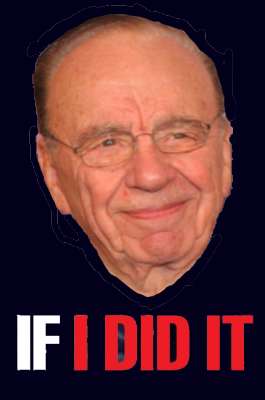
A wave of shock and revulsion has swept over America following the Fox Television Network's decision to screen an interview with the infamous Rupert Murdoch, in which the man whom many still believe to be responsible for notorious crimes such as the Fox Television Network appeared to confess to the brutal killing of OJ Simpson's If I Did It
In an interview condemned by those on both the left and the right - the latter including Fox's self-decorated Gulf War hero Geraldo Rivera and well-informed, highly unbiased, non-sexual-harasser Bill O'Reilly - Mr Murdoch gave a blow-by-blow account of what would have happened had he been the man responsible for the blood all over the floors of Fox TV and HarperCollins, following his decision to cut down their young ratings-grabber before their very eyes.
In the face of Fox's lengthy publicity campaign for the Murdoch interview, friends of OJ Simpson's If I Did It were quick to point out the distress it would cause to the relatives of Mr Murdoch's victim, including publisher Judith Regan who gave birth to If I Did It after conceiving it in a brief moment of passion and unbelievable cynicism with a Mr Rupert Murdoch.
From the moment it emerged into the world, OJ Simpson's If I Did It was the apple of its mother's eyes. Lavished with praise and attention, not to mention multi-page spreads in every News Corporation- owned publication, in the weeks up to its tragic death OJ Simpson's If I Did It was regularly shown off to friends, neighbours and anyone with access to Fox TV - all of whom showed their pleasure at its antics by reaching for sick buckets and bewailing the depths to which portions of the American media had sunk. Despite this, all was not happy in the young If I Did It's life. Before the babe had even had a chance to talk, it became clear that relations with its father were far from good. Rumours began to circulate of Rupert returning home, drunk on power, and attacking the child for its failure to provide. Soon OJ Simpson's If I Did It was being hawked around major advertisers, required to make ever more demeaning confessions in a desperate attempt to bring in a few million cents for Daddy. When even the most hard-bitten of advertisers turned away, If I Did It's days were clearly numbered. On Monday night it was slain in a frenzied press release by a balding Australian media tycoon whom we now know to be Mr Murdoch.
OJ Simpson's If I Did It will be buried alongside grisly reconstructions of the Jack The Ripper Murders, several lengthy interviews with serial killers and a large number of police documentaries which look suspiciously staged. It is survived by Rupert Murdoch, who is expected to undergo a lengthy trial by media, after which he will be let off thanks to possessing a clear conscience, a noble demeanour and a legion of very expensive lawyers.
18 November 2006
| [+/-] |
The Milky Bar Kid 1961-2006 |
Oversized, sweet-fixated children and lovers of 1970's advertising are today united in mourning the Milky Bar Kid, who passed away on Friday.
The Kid, perhaps the only 10-year-old, bespectacled albino ever to make a living in America's Wild West, burst into a nation's consciousness in 1961: a rough, tough, specky cowboy, who would lasso young children and force feed them with his sugary treats - thus providing the inpiration for both Chitty-Chitty-Bang-Bang's Childcatcher and innumerable paedophiles. Despite such questionable behaviour, the Kid and his stunningly banal catchphrase "All the Milky Bars are on me" became an instant hit with the youth of Britain, inspiring millions of boys to spice up their games of "cowboys and injuns" with fantastically incompetent demonstrations of lasso technique and fragile-family-heirloom-damaging skills.
Times were changing, however, and the Kid was slow to change with them. As a new generation of children began to swap their cap-guns for lightsabres (thus affording even greater opportunity for damaging fragile heirlooms) the Kid's spinning-circle-of-rope-based antics began to look increasingly passé. When he did finally make the leap into space his efforts were - as even his closest friends were later to admit - somewhat embarrassing. Deserted by his public, the Kid followed many other one-time stars into obscurity. No longer under pressure to preserve his image, he gave in to his sickly-sweet-chocolate-style-substance obsession, sitting alone at home and mainlining bar after bar. In the following years he fell completely from the media's gaze, save for a brief - balding and bloated - appearance in the tabloids during the early noughties "paedo" scares, when he was forced to deny ever having asked his old pal the Cadbury's Lad to show him his finger of fudge.
Earlier this year the Kid was admitted to St Ofcom's Hospital where, along with other hawkers of fattening foodstuffs, he underwent a series of investigations. It soon became apparent that he was unfit for the modern age and did not have much longer to live. It came as little surprise when, on Friday, Ofcom doctors announced the Kid's death, which they attributed to a massive overdose of a powdery white substance believed to be sugar.
The Milky Bar Kid will be buried in an oversized coffin on Monday. The service will be televised although, under new advertising regulations children will only be able to watch it after the watershed ... if their chubby fingers aren't too large to mash the buttons on the remote control.
10 October 2006
| [+/-] |
YouTube 2005-2006 |
As A Dodo can today confirm reports that the 18-month-old videosharing website YouTube has died after being swallowed up by a giant Google whale while paddling in the lawyer-infested waters.
Born in February 2005, from the outset YouTube had a simple mission, to carry video communications from person to person across the waters of the interweb, allowing anyone anywhere in the world to share a little piece of their lives with others by placing their videos on the internet. Few could have predicted how successful YouTube would be in its mission, while even fewer could have predicted that the bits of their lives people wanted to share were bad kung fu demonstrations, dodgy lightsaber work-outs and lip-syncing demonstrations that would shame Milli Vanilli. Even more shocking was the fact that so many people's home videos bore an eery, some would say exact, resemblance to old TV episodes and the latest music videos.
It was as the young internet company was plunging blithely through the notorious sea of Digital Rights Management, Copyright and Trademark Infringements that, laden down with episodes of Lost and Madonna videos, it found itself surrounded by a school of great white media lawyers, eager for the scent of huge litigation dollars. With its attempts to struggle on hampered by several rare episodes of The Six Million Dollar Man and Knight Rider, it seemed certain that YouTube would soon be devoured by the vile creatures but fortunately it was able to swim to what appeared to be a nearby island while the lawyers argued over fee structures. Sadly, however, it appears that the island was in fact merely a killer Google whale. YouTube was swallowed whole.
YouTube was buried in the early hours of this morning, the officiant being a 72-year-old Japanese gentleman who lip-synced to Green Day's American Idiot whilst wearing a Darth Maul costume. It is survived by a vast amount of litigation.
05 October 2006
| [+/-] |
Intelligent Science Programmes on British Television 1936-2006 |
The As A Dodo editorial team wish to apologise for the following obituary. We were unaware at the time of commissioning that the staff member assigned to the task had, in fact, worked for BBC television's "Horizon" programme. It is hoped that, given the importance of the obituary, our readers will forgive the style in which it has been drafted. We have left the author's notes in the text, on the grounds that they supply full explanation for his dismissal.
Scientists in Britain have made a discovery that will transform life across the planet. More than seventy years after they first appeared, Intelligent Science Programmes have died-out across the country. By the end of 2006 scientists predict that they will all be dead, wiped out by a cataclysm that we have done nothing to prevent ... and the world as we know it will come to an end.
Intelligent Science Programmes first appeared on Earth in the time of the dinosaurs in about 1936. The terrible lizards (amphibians?), especially the mighty Tyrannosaurus Reith dominated the television world with their dreadful mission to "inform, educate and entertain", forcing the tiny Intelligent Science Programmes to find an ecological niche (term a bit complex for our audience?) where they had to make difficult things understandable to people without patronising them. Little did they know that only seven decades later they would be facing extinction ... and the possible end of the world.
Thanks to the "selective pressure of their environment" (got this from a text book, should we just say Intelligent Design?), Intelligent Science Programmes soon spread throughout the televisual ecosphere (not sure this means anything but it sounds good) to any place where a spark of brightness could be found: QED on BBC1, Horizon and The World About Us on BBC2, Equinox on Channel 4 and Coronation Street on ITV. Vast Intelligent Science Programming beasts soon arose, with giants such as Dr Jacob Bronowski's Ascent of Man and David Attenborough's Life on Earth battling for the attention of the public and The Royal Institution Christmas Lectures threatening to devour the public's children. But already the Programmes' existence was facing a challenge, a challenge that would see Intelligent Science Programmes wiped out ... and the fate of the world in the balance.
By the mid 1980's a new breed was beginning to dominate the tellysphere (there, that's even better). With the fundamental rules of commissioning science destroyed by light regulation, increasing TV channels and people with media studies degrees (smug bastards, what's wrong with film and design courses?), soon Intelligent Science Programmes were facing competition from new Stupid Science Programmes, such as "The Boy Whose Anus Ate His Brain", "Could Superman Beat Dracula In A Fight?", "Why Cookery Is Dead Clever", "Science Suntan Holiday" and "Da Vinci's Bible Alien Code: The Truth". Scientists across Britain were worried ... could it mean the end of the world?
By the early noughties (ooh-er, sounds rude!) Intelligent Science Programmes were dying out. Many were wiped out completely, while others found themselves evolving (could put off the Creationists?) into new forms. By 2006 confirmation that the last Intelligent Science Programme had dumbed down came with the news that the latest edition of Horizon would feature a comedian and TV personality talking to chimpanzees ... and the end of the world.
Intelligent Science Programmes were buried in a late night slot on some obscure channel where they will never be seen. They are survived by the world ... which will be utterly destroyed ... ... in about 7.5 billion years when it is swallowed by the expanding Sun as it becomes a red giant star. (Too clever, dumb down second draft)
22 September 2006
| [+/-] |
Jeremy Clarkson 1960-2006 |
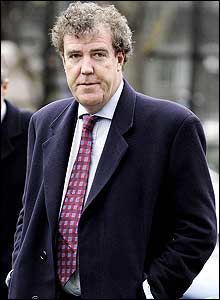
It is difficult to relay the impact that the sudden and unexpected death of journalist, broadcaster, motoring expert and professional loud-mouthed know-it-all Jeremy Clarkson will have upon the world.
Jeremy Charles Robert Clarkson was born in 1960 to a long line of Yorkshiremen and exhibited the virtues of his home county, namely forthrightness and plain-speaking (or "being loud" and "being rude" as they are known outside Yorkshire). He learnt the craft that was to bring him fame as a child when - allowed into the pub to collect the crisps and coca-cola he would be imbibing in the family car while his parents chatted with friends in the snug - he spotted his first pub know-it-all, holding forth at length on why Richard Nixon would beat Leonid Brezhnev in a fight and how all Italians smelled suspiciously of garlic. As he watched the frankly terrified expressions on the faces of the know-it-all's audience, Clarkson knew he had found his ideal job.
After spending many a night hunched under his bedcovers with the Big Boy's Book of Facts and The Hitler Youth Guide To Everything (not to mention several mysteriously soiled copies of Health and Efficiency) young Jeremy was ready to find the perfect tool to display his burgeoning skills. After realising that the perfect tool was himself, he went on to search for the arena in which to express his art and was soon to find himself among the tedious, mileage-and-torque-obsessed men of motoring journalism. With his ability to deliver outrageous and ill-thought-through opinions by means of heavily-prepared and overwrought metaphors, Clarkson soon found himself promoted to television where he became a hugely successful presenter of the BBC's Top Gear programme and a hugely less successful presenter of the chatshow "Clarkson".
Friends believe Mr Clarkson was deeply affected by his friend and co-presenter Richard Hammond's recent, appalling, high-speed accident and - unable to cope with being second best in any area - was driven to outdo Mr Hammond's near-death experience by going "just that little bit further". This, at least, is the only reasonable explanation anyone can come up with for his decision - aided only by a BBC camera crew, a large collection of over-extended similes and extensive gurning to camera - to break into Her Majesty's Naval Base Clyde, Faslane and smuggle himself aboard nuclear submarine HMS Vanguard. Once inside the sub, Mr Clarkson strapped himself to a Trident nuclear missile and - having acquired the launch codes from a senior Naval official after reducing him to a quivering wreck with a three-hour tirade on the obnoxiousness of the French - launched himself at the nearest Greenpeace headquarters with a cry of "Eat atomic death, treehugggers" and a few pithy remarks about the lack of leather or walnut trim on the latest Inter-Continental Ballistic Missiles. As a result of his actions, it is understood several of Mr Clarkson's remaining atoms now hold the British water, air and land speed records.
Jeremy Clarkson is survived by a long-suffering family and a note reading "In your face, Hammond".
04 September 2006
| [+/-] |
Those Who Knew Them: Steve Irwin 1962-2006 |
Welcome to the first in an occasional series, in which we at As A Dodo throw our columns open to the family, friends and acquaintances of the recently deceased. For the first in the series, we approached someone who worked for many years with the famous Australian naturalist Steve Irwin, his old sparring partner Mr Bruce Crocodile.
'Jeez mate, Steve Irwin, what can you say? I know a lot of people across the whole ruddy world are gonna miss old Stevie. A lot of people. Not quite so many animals mind you. Take me for instance, there I was one arvo lying around in a creek up near Kookamularatawatimadingo waiting for a couple of tourists to decide to have a skinny dip (I hate to get sidetracked, but I love it when that happens: "I say, Davina, have you seen this funny log? - It looks just like a crocodile", "Yes it does, doesn't it Anthony? Anthony? I say Anthony, where are you?", "Awwwlllfggfggsgdfgs get it off me, oh Christ get it off my rawlf arrgle, crunch" - it's great, mate, and tasty too). Anyway, there I was in the creek minding my own bizzo, next thing you know there's some sunbleached ocker with a noose around my gob, pointing me at a ruddy camera and telling everyone about my mating habits. I ask you, how would he have liked it if I'd done that to him? Not that I reckon he got round to doing much mating himself - not with shorts that tight.
Fair do's, I admit I had a bit of a grudge against old Steve from that day on. Especially when he upped and stuck me in his ruddy zoo. He looked after us pretty well though. Sure there was always the risk he'd try and stick a finger up your freckle to make you smile for the camera, but the accomodation was pretty decent and the tucker was ace. Once he even offered me his baby. Fair play to him: he might have spent the last ten years giving me the raw prawn but serving up your firstborn as a mid-morning belt-loosener makes up for most things in my book. The bugger of it was the press was there, so he had to take the little ankle biter away before I even got a taste.
Anyway, Steve Irwin. Decent bloke. And anyone who denies it doesn't know Christmas from Bourke Street. At least he got off his fat date and did something with his life - even if that something was buggering around with animals who just wanted a quiet life and the odd pommie tourist to snack on. Go on, raise a tinny to him. And if you're ever down here in Oz, come over to the zoo and look me up, I won't bite ... honest.'