As we at As A Dodo board the speedy interstellar craft we knocked up in the potting shed this morning and prepare to launch ourselves towards a new life on a new planet, we wish to mourn The World As We Know It, which is expected to end at 7.30 GMT this morning, not with a whimper but with a mini-Big Bang, following the official start-up of the European Organisation for Nuclear Research (CERN(1))'s Large Hadron Collider (LHC) on the Franco-Swiss border near Geneva.
The World As We Know It was born when a large rotating cloud of dust, rocks and gas coalesced in the frozen wastes of space(2). It was just one of a family of nine planets, though sadly its smallest sibling Pluto, passed away in 2006 after a run in with a gang of astronomers hopped up on research grants and expense accounts.
A precocious child, it was not long before The World As We Know It was outshining its fellow planets, taking only half a billion years or so to develop life(3). Soon The World As We Know It was filled with more life than the six-month-old yoghurt in a student's fridge, while its brothers and sisters were either hanging around being gassy, dropping their magnetospheres at the first sight of the solar wind or, in the case of Venus, experimenting with lethal cocktails of sulphuric acid clouds, a greenhouse effect that would melt lead and the kind of crushing pressures normally only felt by teenage boys about to *gulp* go out on their first proper date.
It would be wrong to suggest that The World As We Know It didn't have its own ups and downs. In its youth it was a heavy smoker, indulging in major periods of vulcanism, it had numerous run-ins with gangs of marauding asteroids and, at the age of 3 billion, dabbled for a long time with vast amounts of snow - a practice still enjoyed today by many Groucho club regulars. Yet, despite all this, The World As We Know It managed to struggle on and life struggled along with it. Eventually - after numerous experiments with ediacara, early synapsids, dinosaurs and more bacteria than you could shake an enormously large and pointy stick at - The World As We Know It gave rise to humans.
In the brief span of their existence, humans were to give rise to many wonders. In the past they created the Great Pyramids, the works of Shakespeare and the music of Mozart. In more recent years they created Donald Trump's hair, Deal or No Deal and the Lindsay Lohan upskirt shot.
Yet it was by the hand of man that all these wondrous things, along with The World As We Know It, would be destroyed. As part of mankind(4)'s eternal quest for knowledge, he sought to plumb the darkest secrets of the universe, creating the 27-kilometre long LHC in attempt to validate the Standard Model of particle physics, reveal the nature of Dark Matter and perhaps even recreate a Higgs Boson, the so-called "God particle". Such hubris could not go unpunished.
Despite the warnings of some of the finest scientific minds(5) that the vast energies involved, as the LHC accelerated protons to near the speed of light and then smashed them together to see what they're made of, would create black holes capable of swallowing up The World As We Know It, the scientists at CERN insisted on pressing on, their only defence of their actions being years of painstaking scientific study, careful calculation and the belief that - in the words of Manchester University's Professor Brian Cox - "Anyone who thinks the LHC will destroy the world is a twat". Thus it was that they prepared to doom The World As We Know It.
The end of The World As We Know it will be marked by the wailing of the Rapture Ready suddenly conscious that they have not been mysteriously spirited from the face of the Earth but rather that the Earth has suddenly been spirited from under their feet and a gleeful REM celebrating a sudden upsurge in iTunes sales.
(1) Yes, we know the acronym doesn't work but when everyone tried explaining that to the French they just shrugged their shoulders, said "Bouf" and took another puff on their Gitanes.
(2) By weird coincidence, if you omit the words "of space" from the previous sentence and add in "fundamentalist Christian beliefs, danger red lipstick and a sassy attitude" to the dust, rocks and gas, you pretty much have the origin of 2008 Republican Vice Presidential candidate Sarah Palin.
(3) which arose either from the so-called "primordial soup" or through "Panspermia", which is the theory that the building blocks of life arrived from outer space and is wholly unrelated to what your elder brother used to do every time Pan's People came on Top of the Pops.
(4) or at least that part of mankind not wedded to the fatuous notion that all the answers are contained in a 2,000 year old book.
(5) by which we mean the same Daily Mail correspondents who insist on dividing everything in the universe into either a cause of or cure for cancer.
10 September 2008
| [+/-] |
The World As We Know It c. 4,567,000,000BC - 2008AD |
10 December 2007
| [+/-] |
Those Who Knew Them: Karlheinz Stockhausen 1928 - 2007 |
 A tribute to the pioneering German composer, by his close personal friend, popular band leader* James Last.
I first met Karlheinz at summer school in Darmstadt in the early 50s. I was working in the canteen serving up the schnitzels to the serious and spotty-faced youths hell-bent on bending the musical world to their serialist will, but there was something I liked about young Karly. When he dropped his metal tray on the floor spilling cutlery, crockery and sauerkraut everywhere he didn't do what every other student would do - ignore it and leave me to clean up the mess - he immediately took out his notebook and transcribed the sound. It later formed the basis of his ground-breaking work, TrayStucke.
Musically we were poles apart. He liked cutting up recording tape and reassembling it in a fashion that wowed critics and confused audiences across the Western world, while I dreamed of the day I could give up jazz to lead my own orchestra playing covers of light popular music that sounded as though they were recorded very far away at the bottom of a mine. But we had a lot in common: we were both German and we played the piano - I played it with my hands and my heart; Karlheinz played it with a tape recorder and a bratwurst. What a wunderkind!
While I was touring the bierkellers and airforce bases of West Germany, Karlheinz was spending days on end in the new electronic music studio at Westdeutscher Rundfunk in Köln. I would turn up from time to time to see how my great pal was getting on, but, of course, I understood he was too busy forging new musical directions to see me.
I'd met Paul McCartney in a nightclub in Hamburg and we'd hit it off immediately - especially when he confessed to me in the small hours of the morning his love for "a German composer, you've probably never heard of him, like... Karlheinz Stockhausen..." Well, imagine his reaction when I was able to introduce the two of them. They loved him so much they put him on the cover of Sgt Pepper's Lonely Hearts Club Band, and he returned the compliment by writing Drumwerks - a 24-hour cycle of percussion and tape loops for Ringo in 3/4, 4/4, 5/4, 9/8 and any other time signature Ringo felt like playing.
Though he was critically acclaimed, a big hit still eluded Karlheinz. I begged him to just once compose something a little lighter, something a little more accessible like Burt Kaempfert's A Walk Through The Black Forest. He nodded, and then retired to his study to fast for seven days. I paved the hallway like an expectant father - back and forth, back and forth, my footsteps growing heavier and heavier. Sure enough, seven days later, Karlheinz emerges, leaner, paler, with that mystical look in his eye which always said he had composed something extraordinary, something exciting... He beckoned me into his inner sanctum and played me his latest work, Man Pacing Expectantly. I listened mesmerised for the whole of the seven days it took him to play it!
In the 70s, while film producers and directors were starting to exploit the potential of contemporary compositions for scoring horror films, Karlheinz would have no truck with it. My good friend, Stanley Kubrick wanted him to score The Shining, but Karlheinz was not worldly enough to see the potential for promoting his work and making enough money to keep him in quarter-inch tape for the rest of his life. Instead, I had to step into the breach and knock out the score in under a week. Still, I cannot tell you how proud I was that Karlheinz said it was the scariest film he'd ever heard!
He continued to tread his own path. he was a spiritual man but he understood worldly matters - as anyone who heard Helikopter-Streichquartett would know. Four string quartets in four helicopters hovering over the audience. It requires no explanation from me, naturlich, and was enjoyed all over the world - particularly by General Noriega - who listened to it broadcast by the American military for three weeks - transfixed, he never left his home.
Like every true musical genius - like myself, Burt, Ringo - Karlheinz was often misunderstood. So when he commented after 9/11 that it was a work of art, naturally, the reactionary media pounced on him and the premiere of his new opera Twin Towers Falling (based on Noh theatre and sung in Welsh over the course of two months... without a break...!) was cancelled. But they did not know the Karlheinz I knew. He was a fun guy, a party guy. He would stay up for days on end - just listening to the opening movement of Licht. He was echt, I was ersatz. But he was my friend. And I know he would have wanted me to play at his funeral. Which is why my orchestra will be performing Gesang der Junglinge on Stylophones in a jaunty upbeat tempo. It's what he would have wanted I am sure. Auf wiedersehen, mein freund, und ein, swei, drei, vier...!
* Not the James Last, you understand.**
** And not that popular either.***
*** In fact, he was bloody awful.
28 November 2007
| [+/-] |
Reincarnation, Time Immemorial - AD 2007 |
 As A Dodo can confirm that Reincarnation has died and not passed on to a better place, and most certainly isn't coming back as a worm, a lottery-winner or a cute ginger cat called Mr Fluffykins, following the news that the Dalai Lama has decided to end the 600-year-old Buddhist tradition of selecting his successor by a series of spiritual tests and replaced it with a ballot of monks across the Himalayas and Mongolia.
Reincarnation was first recorded in the Hindu scriptures, the Upanishads, around 800 BC and quickly became popular with Sikhs, Buddhists, Jains and anyone else keen to escape a life of grinding poverty by dropping dead and returning a few rungs up the social ladder, or eager to see the utter git who kept lording it over them come back as a slug.
Meanwhile, when they were not pitting tortoises against hares in metaphysical races or eyeing up the pool boy, the Ancient Greeks were also busy pondering the subject. Even that great thinker Socrates said he was "confident that there truly is such a thing as living again, and that the living spring from the dead" - a concept much discussed over subsequent millenia and only recently proved with Tony Blair's escape from his scandal-plagued government without a scratch.
Over in the Middle East, Reincarnation was also proving popular with Judaism, with some rabbis giving each soul three chances to make it in the world - a belief the truth of which many believe is evidenced by the careers of Peter Mandelson and Noel Edmonds. With the arrival of David Blaine-wannabe, Jesus of Nazareth, the coming-back-after-your-death-thing really took off. (Although Jesus blew it when, after being taken down from the cross and banged up in a cave for three days, he came back as himself rather than anything more exotic - we have it on good authority, for instance, that Judas wanted to come back as "a bird ... maybe a nightingale ... or even a heron")
Later many Britons (particularly peasants) would dream of a quick release from a hard life and the chance to enter the spiritual lottery that was Reincarnation, though there was very little proof to substantiate the theory other than the occasional pig that bore a passing resemblance to Cardinal Wolsey or a sideboard that, in a certain light, looked just like Anne of Cleves. Indeed, by modern times thousands of people were claiming to have lived previous lives as Joan of Arc or Julius Caesar (but somehow hardly ever as Ned the manure-carrier or Wat the turnip-minder)
Not satisfied with the mere transference of a gone-before soul to a new-found body, Reincarnation did exactly what it said on the tin and reinvented itself. Concepts that were thought to be long-dead, such as putting innocent people in jail and throwing away the key, were resurrected under the new guise of the "war on terror", nations that were thought to have faded from power and influence, such as Russia, began to flex their muscles in London sushi bars and, astonishingly, the British Conservative Party saw itself reincarnated as a group of people who actually could organise a piss-up in a brewery ... though not necessarily a very enjoyable one
The move away from spiritual reinvention to cynical old re-treads left Reincarnation a shadow of its former self, forcing it to admit that it had little hope of coming back as something more profoundly meaningful to the modern mind than belief in the rejuvenating powers of plastic surgery, a big lottery win or a much younger girlfriend. With even the Dalai Lama suggesting that a form of election might be a better way to find a leader than seeing if that kid in the corner liked to play with the old Dalai Lama's walking stick, it was plain that the wheel of life had become wonky and worn bald. Reincarnation gave up the ghost for the last time and headed off to permanent retirement in Nirvana.
Reincarnation will be buried at the Status Quo Church of the Just One More Farewell Tour. It will be cremated and sealed in a lead-lined casket before being encased in cement - just in case it tries to come back as something else.
09 November 2007
| [+/-] |
Belgium 1830 - 2007 |
 Belgium, the European country which has done so much to enliven so many dinner parties as couples vie to name six interesting things about that sovereign state before the cheese goes off, is believed to have fallen apart after nearly six months without a government.
Formed from the remnants of the Low Countries in 1830 following a, frankly, hard-to-believe Belgian revolution, Belgium quickly found its place in Europe as it inherited none of the flair and flamboyance of its southerly neighbour, France, nor any of the edginess and excitement of its northern neighbour, Holland, instead promoting itself as the national equivalent of a pair of sensible shoes or a wet weekend - or, preferrably, both.
With King Leopold I installed at the head of its constitutional monarchy, the people of Belgium - whether they be Flemish, Walloons or confused travellers who stopped off before reaching Paris or London - settled down in the traditional trades of brewing, chocolate-making or the burgeoning waffle R & D sector based around the capital, Brussels.
Having been invaded by Germany in 1914 (innocently letting the Kaiser's troops across the border to "retrieve a mislaid bratwurst...") Belgium made sure that before the kick-off of the next world war everyone knew it was neutral and "would be taking no part whatsoever in any future conflicts" only to be interrupted by Hitler's troops rolling across the border in order to take the rat-run to France.
Culturally Belgium was best known for the works of surrealist painter Rene Magritte and his most famous painting Ceci N'est Pas Un Waffle. To the surprise of many, several of France's best-loved musicians were in truth Belgian, though, less surprisingly, Django Reinhardt and Jacques Brel preferred to spend most of their life in France.
But without a doubt Belgium was most famous when it was most fictional. Made-up detectives Hercule Poirot, Tintin and... er... Snowy all raised the profile of Belgium abroad and for a brief instant made readers think it was a hotbed of international intrigue when, in reality, it was a country so dull that M. Poirot had to find work in London to escape the tedium of being asked to investigate yet another mysterious case of the disapperaing waffle.
When the Flemish Christian Democrats won last June's general election no one foresaw that they would fail to establish a ruling coalition. Despite the absence of a government in Belgium for nearly six months the country did not descend into anarchy, instead waffle prouduction at EU and NATO waffle mills exceeded projected targets month-on-month and the people of Belgium continued to drink beer, eat chocolates and look down on the unruly Swiss.
With the realisation that the 150-day run without a government was not an attempt to get into the Guinness World Book of Records (as that had been banned in Belgium since 1967 for fear of over-exciting the populous) talks between the 11 political parties became more protracted. But a split began to develop between the Dutch-speaking Flems and the French-speaking Walloons, and a move to end the right of French speakers in Flemish suburbs of bi-lingual Brussels to vote for French candidates proved so boring that the country shrugged its shoulders and returned to its jigsaws of giant waffles as the country split asunder in utter silence.
Belgium will be buried in two separate ceremonies at La Maison du Waffle and at Den Wafflehaus.
29 October 2007
| [+/-] |
Royal Scandals c. 8000 BC - AD 2007 |
 It is impossible to exaggerate the sadness at the death of Royal Scandals, which have passed away following news that the best our monarchies can manage these days is some relatively uninteresting sex 'n' drugs allegations about "a minor royal" with "a low public profile". They will be fondly remembered for all the good works they did down the years, keeping millions enthralled and entertained and providing much useful work for paparazzi, indifferent journalists willing to swallow their pride and make a living reporting the antics of a bunch of men and women whose generations of inbreeding have left them with the noble chin, intellectual weight and dignified bearing of one of Wimpy's "Benders in a Bun", and dimwitted aristocratic offspring in desperate need of a family to marry into after failing the entrance exams for floristry and kindergarten assistant.
Rather than dwell on their sad and ignominious end - begging for a headline in the Sunday Times after overhyping in the company of members of the press - we at As A Dodo much prefer to remember Royal Scandals as the great things they once were: hanging around with kings and queens, empresses and emperors, pharaohs, shahs, rajas and ranis from the moment monarchy was first thought of, capable of altering the history of nations and the destinies of millions.
Oh what great times Royal Scandals once had - appalling whole nations even as ancient spin doctors tried to cover them up. Who can forget the quick-witted Egyptian priest who informed a shocked nation that the young pharaoh had only been pleasuring himself out of the palace window in order to fertilise the Nile, or the Greek sage who told the Macedonian troops that what they had seen was merely Hephaestion polishing King Alexander's sarissa before the battle?
Despite such attempts at suppression, by the time of the Romans Royal Scandals had assumed their rightful place in society - keeping comics and clowns, playwrights and players, hecklers and historians in business as they chronicled Emperors happy to entertain their people by marrying their sister before breakfast, murdering them by lunchtime and hopping into bed with their horse by tea.
With the rise of monarchies across Europe, Royal Scandals' opportunities multiplied. Strange sexual preferences, killings and overfamiliar meetings between the species were commonplace - it was not long before those in the know were reporting everything from Phillipe I, Duc d'Orléans's habit of wandering the docks in female attire blowing kisses to the sailors, through Pope Alexander VI's first murder (carried out at the age of 12) all the way to Queen Catherine the Great's stable relationship with Bruno the carthorse. Matters such as King Henry VIII of England's serial marriages and lethal divorce settlements were small beer, even though they helped found a new church.
Ah yes, those were the great days! Yet even in decline, Royal Scandals still had the power to shock. Tales of Marie Antoinette's excess helped to feed the flame of revolution, tales of King George III's madness and the dissolute George IV's divorce threatened the monarchy in England. But it was all downhill from here. Where once a true scandal would have required at least a few deaths or a dangerous liaison with a llama, by the 20th century the best that could be offered to shatter the world's peace was Edward VIII's decision to marry an American divorcee.
The decline continued apace as minor Royals across Europe took to sucking toes and slipping off their bikinis to whip up a whiff of naughtiness, while the best their more senior colleagues could manage was Princess Diana's liaisons with a string of well-heeled dimwits and Prince Charles's fondly-expressed desire to grow up one day to be a tampon(1). Even young Prince Harry found his Bad Boy Reputation almost impossible to maintain.
Royal Scandals' final hour came when, following allegations that two men had attempted to blackmail a royal with an envelope of cocaine and a sex video, the whole of the internet was filled with precisely five people trying to find out who the Royal was, while everyone else turned over the pages of their newspapers to read the soccer scores.
Royal Scandals will be buried at St Catherine's Church of the Hole-y Harness. A minor royal will snort several lines from the Bible and the congregation will sing Hymn 365 "All things bright and beautiful, all creatures great and small, all things wise and wonderful, the royals have had them all".
(1) which would, admittedly, be more useful than being Prince Charles.
06 September 2007
| [+/-] |
Those Who Knew Them: Luciano Pavarotti 1935-2007 |
 A tribute to the late, great, tenor by one of those who knew and loved him best, restaurateur Luigi Stereotipo- Nazionalo.
Che posso dire? The maestro is no more. I cry, I tear my clothes. Caro amico mio, I miss you. Luciano, I know you since you are little boy here in Modena. Always you love three things: the music, the football, the food ... but not necessarily in that order. I remember when you are nine or ten you want to be great footballer. I see you play as keeper. You are so good - the quick hands, the great football brain and - of course - the fact you take up quite a lot of the goal.
But is the singing that take you. Always you listen to you papa's records - Gigli, Schipa, Caruso - all the greats. I see you covered in flour from papa's work in the bakery, listening to Giovanni Martinelli record with a faraway look in you eye ... and the remains of a basket of focaccia in you hand. Then there is time you get up in my little ristorante and climb on the table and sing you heart out. Is bring tears to my eyes even now ... and not because you break my table. It is because you have the great voice.
You study, you work hard and that voice he take you everywhere. You sing at La Scala, you sing in London, you sing in Australia, you sing in New York. They say you reach nine high C's when you sing at The Met. They make you take 17 curtain calls -it even make you give up you after-performance, pre-meal-snack nibble. Such dedication.
Ah, you voice. I can hear it now. So flowing, so beautiful. Always I remember the words you say to me when you come into the restaurant, "Luigi - I have the calamari , the caponata, the fritatta, the prosciutto, the alici, the bruschetta, the gamberi, the bresaola, the pepperoni, the carciofi, the melanzane, the funghi, the lampascioni ... and once I've finished the starters come back to me and talk about the mains".
You were the greatest star. You bring music to millions. When you sing Nessun Dorma at the World Cup you make everyone cry (especially Domingo and Carreras when they realise how much better you sing it than them). The whole stadium it fill with tears and for once is not because Gazza is there.
Ah Luciano, I know you have you problems. I know you have little difficulty with you tax. I know they say you no act. I know they say is wrong to sing with popstars. But I know you have great appetite for life, for music (and, si, for food) and I know you have voice of gold. Arrivederci Luciano.
31 July 2007
| [+/-] |
Those Who Knew Them: Ingmar Bergman 1918-2007 |
 Following the passing of Ingmar Bergman, one of the greatest figures in European cinema, we at As A Dodo are extraordinarily proud to be able to present an exclusive interview with someone who not only inspired many of Mr Bergman's works but is also, we are happy to say, one of our closest collaborators - Death. (Readers should be aware that Death is a very busy personification of the termination of life and appears to have been somewhat distracted during our conversation with him, which we here transcribe in full.)*
AAD: Who's that?
Death: I am Death.
AAD: Cor, you didn't half give me a fright. You shouldn't go round sneaking up on people like that.
Death: I have been walking by your side for a long time.
AAD: Well, I never noticed you. You'd've thought I'd've heard something ... what with all the pebbles on this beach. You must be wearing crepe souls ... geddit? Ah well, suit yourself ... Anyway, I take it you're here for the Bergman obituary.
Death: Are you prepared?
AAD: For the obituary? Well, I've had a quick glance on Wikipedia.
Death: Well, there is no shame in that.
AAD: Cuh! Tell that to the readers. But I could do with a bit more time to tell the truth ... I wasn't expecting you right now.
Death: That's what they all say. I grant no reprieves.
AAD: Right ... better get on with it then. To sum up - Bergman will go down in cinematic history as one of the greatest stars in the Hollywood firmament, perhaps best known for her role as Ilsa Lund in Casablanca opposite Humphr ... oh, wait a sec, that's Ingrid isn't it? What I meant to say was that Ingmar Bergman was one of those who, alongside directors such as Godard, Truffaut and Fellini, helped to define modern European cinema. From early comedies like "Smiles on a Summer Night" to sombre masterpieces like "The Seventh Seal", "Winter Light" and "Persona" to reflective pieces such as "Wild Strawberries" and "Fanny and Alexander" he reflected on the really big issues - life, love, sex, death and God - and helped his audience to struggle with them even as he struggled himself. With his regular company of actors such as Max von Sydow, Ingrid Thulin, Bibi Andersson and Gunnar Björnstrand, his taut scripts spare of dialogue and his careful framing of beautifully realised images he created a truly unique oeuvre.
Death: How did you know that?
AAD: Er ... like I said, Wikipedia. Makes research a doddle - 5 minutes and you can have a slapdash and only haphazardly accurate article on anything you fancy. You must know about it! Haven't you even got a computer?
Death: Yes, in fact I'm quite a good chess player.
AAD: Ooh! I prefer Minesweeper or Spider Solitaire myself. But if you're online I'd be happy to give you a game some time.
Death: Why do you want to play chess with me?
AAD: Well, partly as a metaphor for the way humanity as a whole arrogantly struggles against Death even though it knows that Death must eventually win and that an ever-distant God will not intervene but mainly because it's not everyone who gets to play chess with Death - unless they're Max von Sydow.
Death: That is your privilege.
AAD: Nice one Mr D! I always thought you were decent sort - great turn of yours in Woody Allen's "Love and Death" by the way ... and that bit playing Battleships in "Bill and Ted's Bogus Journey" - genius! Great stuff! ... And now here we are with a board and here I am ending a piece about the passing of Ingmar Bergman by playing a game of chess with Death himself. Who'd've guessed?
Death: Very appropriate. Don't you think so?
* AS A DODO UPDATE - we are now advised that the above is not in fact a true record of a conversation between our correspondent and Death but is merely some of Death's lines from "The Seventh Seal" interspersed with a series of facetious remarks. We can only apologise to our readers ... again.
15 June 2007
| [+/-] |
Those Who Knew Them: Kurt Waldheim 1918-2007 |
 The As A Dodo Team must confess that it has had more than a little difficulty in obtaining the following tribute to the controversial former Austrian President and UN Secretary General Kurt Waldheim. Having had considerable trouble in tracking down Mr Waldheim's former associate, Don Diego Alfonso von Martin Bormann, in his delightful landhaus in Argentina, we felt it best to publish his responses - such as they were - to our questions, verbatim.
"von Martin Bormann ... ach ... ¿Bueno?"
"Si, senor, yes I speak English a little. Is it safe?"
"Oh I am sorry, I must have confused you with someone else. I am a simple Argentine dentist."
"Waldheim? ... Waldheim? ... no it does not ring a bell."
"Now, when you say you are not from the police ... can you prove that?"
"And the diamonds will be passed to me via New York? ... Very well, the interview may proceed."
"Oh yes, I knew Kurt very well. We were just two little Austrian kids together before the war, you know. We would play games together. Kurt always loved Pelmanism ... you know, the 'Pairs' game mitt cards? Kurt was superb ... we once went three days without matching a single pair. Such bad memories we had! I swear we would have forgotten our own names .... particularly if they appeared on any party papers."
"No, no, it was a terrible time the glorious liberation of ... I mean, the invasion of Austria ... by Hitler and his Nazis. Terrible. All those crowds of joyous people welcoming their new leader, all those bands, all those spiffy uniforms and marching. Absolutely terrible."
"Yes, it was so terrible that me and Kurt immediately joined the Nazi party and signed up for the Sturmabteilung. I always thought the brown shirt suited Kurt very well."
"The Wehrmacht? Well, we was drafted in, you know. Served on the Eastern Front. Of course, we was both given medical discharges in 41."
"Oh ... you have got the papers there have you? Well, it was a long time ago, you know ... the memory it plays tricks."
"Well, maybe we weren't disharged."
"Yes, it is possible we did serve a little time mitt General Löhr. Honestly, we thought he was called the Butcher of the Balkans because he did a great Wiener schnitzel. I tell you, he may have been a war criminal but the things that man could do with a bit of veal."
"Jews? There were Jews killed in the war?! No! I had no idea. I'm sure Kurt had no idea."
"So? ... We lived next door to a Konzentrationslager, did we? ... We thought it was just a simple holiday camp ..."
"We signed papers did we? No ... I can't remember that ... 'They ordered the deportation of Jews, execution of British commandos and bloody suppression of the partisans'. You see I'm sure I'd remember something like that ... or my name's not ... er ... whatever my name is."
"No, no ... these things are best forgotten, you see. Kurt knew that. I know that. I mean ... if we'd remembered them, he would never have become UN Secretary General and President of Austria, would he? And I wouldn't be a simple Argentine dentist with no fear of being extradited."
"Ja ... si ... I'm afraid I must end it there. I have a tooth extraction I must be doing. I must remember to forget the anaesthetic."
"Wiederhören ... ach ... Platicamos."
Kurt Waldheim will be buried at St Adolf's Church of the Blessedly Short Memory. The celebrant will be an innocent South American dentist in an SA uniform. The hymn will be number 666, The Horst-Wessel-Lied.
04 June 2007
| [+/-] |
Freedom from The Fear of World War III 1991-2007 |
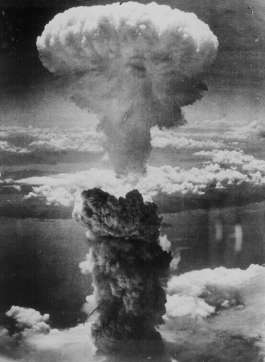 The peoples of Europe were today stocking up on tinned goods and shotguns, converting their brand new wine cellars back into fallout shelters and laughing mordantly at the contents of old "Protect and Survive" leaflets as they bewailed the sudden death of Freedom from The Fear of World War III, that astounding - yet disturbingly brief - epoch when it was possible for citizens across the Northern Hemisphere to go to bed at night without fearing that some
trigger-happy idiot senior military official in Russia or the USA might mistake a flock of seagulls1 for a missile attack and initiate a nuclear conflict.
Freedom from The Fear of World War III was the product of the long but stormy relationship between the United States of America and the Union of Soviet Socialist Republics. From the USSR's birth in 1917 right up to the early 1940s the pair had eyed each other suspiciously across the global dance-floor, only kept apart by the fact most of it was occupied by a lot of ageing Europeans in silly uniforms dancing the Imperialist Frug with impressionable young African and Asian nations overwhelmed by the ageing Europeans' wealth, savoir-faire and tendency to slap around any young African or Asian nation that didn't want to put out on a first date. All this was to change in the mid-1930's with the rise of a new type of European in Germany, possessing all the anti-social tendencies of the old Europeans with the addition of a psychotic devotion to racial theories, a tendency to see the presence of other peoples in the world as a mere engineering problem and much, much snazzier uniforms.
The USSR had been initially attracted by the new Germany, with whom it shared such interests as watching lots of soldiers marching as if auditioning for Monty Python's "Ministry of Silly Walks" sketch and a real enthusiasm for pogroms, but ended the relationship in the early 1940s after Germany turned up drunk on several bottles of extra-proof Blitzkrieg and attempted to beat it up. Hurt - both physically and emotionally - by Germany's behaviour, the USSR turned for comfort to both the macho young USA and the once-debonair but now ageing United Kingdom, the three states indulging in a brief ménage-à-trois during which they cut up the dancefloor and, indeed, most of Europe.
The relationship could not last: as the USA and UK spent more and more of their time alone together, the USSR began to feel left out. Soon it was to quit the relationship altogether, preferring to hang around behind an iron curtain with like-minded (if they knew what was good for them) countries, winning their absolute loyalty by beating them up if they got out of line giving them generous gifts of aid and assistance when they needed help. Thus the Cold War was born and with it the global fear of a new World War.
For more than 40 years the USSR and the USA returned to eyeing each other across the global dance-floor, hanging around at its edges while buying drinks for all their pals and trying to impress the other nations by setting up puppet dictatorships in third world countries and amassing massive nuclear arsenals. Such displays were not without their costs, both for the superpowers themselves - who had to pay for enormous numbers of drinks, plentiful puppet dictatorships and vast nuclear arsenals - and for all the other countries, who had to pay the price of sucking up to their superpower friends and having their governments subverted or countries invaded by their "best mates" not to mention forking out billions on Valium to help their inhabitants cope with the fear of imminent nuclear destruction.
Eventually the costs were to prove too great for the USSR which - despite putting on a brave face - was down to its last rouble and had been living off a diet of boiled beetroot and state propaganda for years. Unable to afford even the tanks necessary to put down a popular uprising in a satellite state, in 1991 it fell apart. In doing so it gave birth to Freedom from The Fear of World War III.
For 16 years, Freedom from The Fear of World War III led a happy life - spreading peace dividends across the globe, freeing billions from the dread of another World War and forcing James Bond scriptwriters to try and come up with new baddies. During its life, the world (or at least that part of it which hadn't been right-royally ballsed up by all those ageing Europeans and their empires) enjoyed unprecedented growth and wealth as well as a lot of fun laughing at the antics of Boris Yeltsin. It was all the sadder, then, that Freedom from The Fear of World War III should be struck down in its prime, set upon by none other than those some-time lovers and some-time sparring partners, the USA and Russia as America - its military muscles inflated, its testosterone levels sent into overdrive and its brain shrunk by daily injections of Neocon steroids - insisted on deploying a nuclear defence shield on Russia's borders and Russia - having pumped up its own muscles on a regime of new-found oil and gas wealth, the smack (not to mention cattle-prod, enforced detention and nuclear-tipped salmon sushi) of firm government and a blithe disregard for democratic norms - threatened to kick sand in America's face by pointing missiles at the US's best buddies in the European Union. With detente getting wound up and TV producers blowing the dust off old videotapes of "Threads" and "When the Wind Blows", Freedom from The Fear of World War III passed away.
Freedom from The Fear of World War III will be buried at St Oppenheimer's Church of the Mutually Assured Destruction. The service will be conducted by the Reverend Dr Strangelove and the hymn will be number 462 "Come, sound His four-minute warning abroad".
1 or any other early 80s synth-pop band.
18 May 2007
| [+/-] |
Jose Mourinho's Cool 1963-2007 |
 The football world has, for one day, abandoned its ridiculous pay demands, nightclub punch-ups and three-in-a-bed after-hours entertainments to mourn the passing of Jose Mourinho’s Cool, that air of tanned European style, tactical flair and a self-confidence that lesser mortals interpreted as arrogance, which in recent weeks has slipped away to be replaced by a grizzled figure in a tracksuit, much given to ridiculous declarations about opposing teams and claims that Mr Mourinho’s pet Yorkshire terrier, Gullit, was a better finisher than Shevchenko.
From the moment of its birth in Portugal in 1963, Jose Mourinho’s Cool was evident to all, as it held its first press conference (in both Portuguese and English) casually acknowledging the skill of the midwife, protesting at the failure of the referee to book the attending doctor for an obvious slap and, chiefly, praising Mourinho's skill in choosing to be born.
After a childhood of dismissing inferior teachers with a snappy putdown and enlarging upon the magnificence of Mourinho's innate talent, The Cool saw its charge gain a degree in Physical Education without breaking a sweat, or even once shouting at other students that they’d have to do the class in their pants.
Too assured of itself to need to chase a ball up and down the park for 90 minutes, Jose Mourinho’s Cool contented itself with hanging around the stands delivering withering looks to opposition players or admiring itself lovingly in the changing room mirror at half-time, whilst pointing out the manager’s tactical mistakes.
Word of The Cool began to spread, in no small part thanks to Jose Mourinho himself taking every opportunity to remind all and sundry of his superior intelligence, fashion sense and god-like footballing nous. Catching the eye of a desperately unfashionable Bobby Robson, languishing in purgatory in Portugal following England’s comically inept penalty shoot-out in the 1990 World Cup semi-final, The Cool accepted the offer to act as Robson’s interpreter at Sporting Lisbon, Porto FC and at FC Barcelona – where it learned Catalan overnight whilst redesigning Gaudi’s Sagrada Familia to make it more “tasteful” and playing an eight-hour sax solo with Miles Davis.
The Cool's self-confidence and personal magnetism drew players to Mourinho, as they sought alternatives to Robson’s tactical advice to “just hoof it up the field for the big lad to knock it in the back of the net”, alternatives which The Cool was able to provide by offering tips on dead-ball situations, physical fitness advice and clear directions as to where to get a really first-class suit.
It wasn’t long before a stammering and awed Benfica sidled up to The Cool and tugged on its four-button sleeve, shyly asking if Mourinho wouldn’t mind managing their team. Leading them only long enough to realise they were far too lacking in charisma or savoir faire for Mourinho to be their chief, after just nine games The Cool grew bored, shrugged nonchalantly and walked away – clicking its fingers at an adoring Uniao de Leiria who eagerly accepted his kind offer to turn them into a well-groomed outfit – and teach them something about football. A stint at FC Porto, where The Cool won the 2003 Super Liga all by itself after dismissing the team for turning out on the pitch with too much product in their hair, and a triumphant 2004 UEFA Cup final in which it easily outclassed Celtic by mocking their oh-so-last-season shorts and boots, led, ultimately to The Cool’s greatest role.
In 2004, Jose Mourinho’s Cool announced itself to a hushed and adoring world of English football as “The Special One”, immediately eclipsing third-rate purveyors of Hello! magazine ersatz cool like David Beckham. Over the next three years Roman Abramovich’s money The Cool’s superior footballing skills and know-how propelled its new club, Chelsea, to trophy after trophy. Yet worrying signs of stress were already beginning to show, with The Cool occasionally melting in heated verbal assaults attacking referees and fellow managers alike. With year after year passing and failure after failure to win The European Cup, questions began to be asked ... chiefly questions from Roman Abramovich like "Oi, Jose! What is happen to my billions of roubles?" Under greater and greater pressure from club board and fans alike, Jose Mourinho's Cool began to falter, its image tarnished as it battled on in the face of the disastrous decision to buy Andriy Shevchenko, Frank Lampard’s ever-greater delusions of midfield mastery and John Terry's "Village Idiot at Milletts" sense of style.
According to reports from eye-witnesses, The Cool passed away when animal welfare officers called at Jose Mourinho's Belgravia home to put his Yorkshire terrier, Gullit, into quarantine, leaving the once-adored manager to shout “No, please don’t take my lickle-wickle Gullit away!" while stamping on his pipe with his Marks & Sparks slippers and sobbing uncontrollably into the sleeve of his beige Primark cardigan.
Jose Mourinho’s Cool will be buried at the new Wembley Stadium. It is survived by Jose Mourinho’s new range of polyester cardigans and slacks with elasticated waists and Jose Mourinho Dog Biscuits – “For Your Special One”.
14 May 2007
| [+/-] |
The Eurovision Song Contest 1956-2007 |
 As A Dodo regrets to inform its readers that the following obituary for the much-loved Eurovision song contest was compiled for us by our popular music correspondent, who has now been invited to make use of the pearl-handled revolver we gave her or, even worse, apply to be Britain's entry in next year's competition.
The Eurovision Song Contest has met its Waterloo, warbling its last “boom-bang-a-le-boop-boop “ and fielding its final trans-gendered contestant dolled up in the kind of spangly costume not seen since Space 1999, after tactical voting saw Serbia snatch victory from more deserving musical talent ... and Britain’s Scooch.
The Eurovision Song Contest was born in the post-war years to foster European co-operation and unite a continent torn asunder by the First World War (started after Bosnian would be pop-idol Gavrilo "the artist formely known as" Princip assassinated Austria's Arch Duke Franz Ferdinand over the rights to their single "Take Me Out" [might need checking]) and the Second World War (when Germany and Britain fell out again over Nena's failure to use a razor and/or depilatory cream before making her video for "99 Luftballons" [Hmm ... might need checking too]).
It was in 1956 that Eurovision first chose to abandon the continent's vast musical heritage and take up the mittel-European oompah-oompah beat and the nonsensically onomatopoeic lyric in a seven-nation tussle in Switzerland – a contest won by the Swiss (thanks to strong support from a grateful German jury) with their enchanting rock ‘n’ yodel number “The Laughing Gnomes of Zurich”.
In its early years, winners of the Eurovision Song Contest were guaranteed to go on to even greater success as mature, ground-breaking songwriters and performers. The cream of popular musicians fought to take part in the contest with, for example, The Beatles proudly representing their country in 1969 with “All You Need Is Boom-Bang-A-Le-Boop-Boop Ob-La-Di, Love”. Although, sadly, they finished second to France who romped home with Jacques Brel’s up-tempo number “La Vie Est Mort” – thanks to douze points from his home country Belgium, and most of the permanently depressed Scandinavian nations. [Actually, I'm not too sure about this bit either]
Slowly, the sweet music of a harmonious musical competition began to be drowned out. The complex harmonies, sublime melodies and profound lyrical subtexts of the early Eurovision performers soon gave way to simple Euro-disco rhythms, grating vocals and inane choruses lifted from Esperanto greetings cards. Baltic states and former Soviet satellites shared out their votes in a collective fashion, Greece and Cyprus supported each other through thick and thin and everyone voted for Ireland time and time again in order to avoid the crippling financial burden of hosting the contest.
It was in Helsinki, however, that the once-great competition was finally reduced to a mockery. Throughout the evening, plucky Western European band after plucky Western European band was felled in its prime by the massed texted votes of the Eastern Voting Bloc. Even Scooch, Britain’s plucky band of crapck musicians, cunningly disguised as a bunch of Butlins redcoats dressed up as cabin stewards on Air Latex, received nul points after nul points, leaving Serbia to snatch the laurel crown. Thus was the death knell sounded (in the wrong key) and so Eurovision was no more.
The Eurovision Song Contest will be buried at the European Broadcasting Union Church of St Jude the Pointless. The service will be conducted by two perma-tanned celebrities you’ve never heard of, with a mocking audio commentary on their performance provided by the Reverend Wogan. The congregation will sing Hymn number 278 "Oobie-Shalala-Bim-Bam-Bom-De-Doo-Doo-Doo-De-Dah-Dah-Dah-
Awopbopaloobop-Doobie-Tra-la-la", accompanied by Mr Harris on the Church Souzaphone..
The Eurovison Song Contest is survived by Coldplay, U2, James Blunt, ringtones, advertising jingles, singing in the shower and laryngitis.
07 May 2007
| [+/-] |
The French Presidential Elections 2007-2007 |
 The As A Dodo Editorial Staff would like to thank noted man of French letters French man of letters Jacques Derigueur for penning the following obituary for this year's French Presidential Elections, which passed away yesterday. Sadly, having read the piece, we feel unable to do so.
Ah oui. Today la belle Marianne, symbol of our great country, lies back in her bed, exhausted, satiated, as she ponders the deep mystery that has passed between her and the French Presidential elections.
Where did it all begin? Let me, like Proust, savour for a moment a tea-soaked morsel of madeleine and be invaded by the sudden pleasure of memory. I can picture the scene even now: it was but a few weeks ago that Marianne found herself in peril. While perfidious John Bull sunned himself in the light of his economic stability, poor Marianne was left to skulk in the shade, afflicted by high unemployment and sporadic rioting, with only the consolation of her appallingly high living standards, her superb health service, her generous pensions, her thriving intellectual culture, her low divorce rate, her good food, her shorter working hours but higher productivity, her still-extant automotive industry, her extensive support for the arts, her excellent education system not yet wholly devoted to utilitarian ends and her football team capable of reaching World Cup Finals.
Can we be surprised that Marianne was feeling a certain ennui? Oh yes, she had a lover, but Jacques Chirac was not the man he once was. No longer was he the smooth-talking former Mayor of Paris with a devilish look in his eye and an impressively large amount of funds in his pocket. Now he was bent by age (not to mention the prospect of some interesting times ahead in the courts to deal with that impressive trouser bulge) and no longer capable of satisfying Marianne's needs. What could she do but look elsewhere?
Soon she found herself being courted day and night by her would-be lovers. Swiftly she rejected the attentions of Jean Marie Le Pen, having tired of his far-right ways (not to mention his chat-up line "Vous avez des origines françaises? Pourquoi pas une descendance français?"(1)) during their last dalliance in 2002. Next she refused the protestations of desire from stolid centrist farmer François Bayrou ... largely due to his being so boring that she continually fell asleep while he stolidly made love to her.
And so the people of France waited with bated breath as Marianne was forced to make her choice between her two remaining suitors: the dashing Nicolas Sarkozy, eager to open Marianne's eyes to the dark and sensual pleasures to be found in fiscal fetters and a firm hand, and the striking Ségolène Royal, keen to spend her way to Marianne's heart. In the end there could be only one choice, with Marianne unable to bear the thought of her new love not being able to get half-way through a treaty-signing without all the assembled French men attempting to pinch her bottom, she had no alternative but to turn away from Ms Royal and settle down to make love, tout fou, tout passionné with M. Sarkozy and his mighty water cannon.
And so, my English friends, the deed is done and L'Élection Presidentielle Françaises 2007 have passed away. Marianne has her new lover and only one question yet to decide: who will be doing the screwing and who is about to get screwed?
The As A Dodo Editors add: The French Presidential Elections 2007 passed away on 6 May. They will be buried, along with Jacques Chirac's political career, just as soon as the funeral cortège can make it through the traffic jam at the Arc de Triomphe and the attendees end their strike calling for increased crematorium regulation and a minimum three bottles of 1982 Chateau Lafite per mourner.
(1) "Do you have any French in you? Would you like some?"
02 May 2007
| [+/-] |
Democracy c.508BC-2007AD |
 As polling stations open across Britain today, it is hard to exaggerate the sadness that will be felt (outside political circles) at the death, confirmed today by a group of senior psephologists, of Democracy in Britain and America.
Democracy, or "force of the people", was born some time around 508BC in the Ancient Greek City State of Athens, where it granted power to all the people - at least insofar as those people weren't unreliable types like slaves, women, children or foreigners - to govern themselves. The Athenians established several important democratic traditions, including the practice of ballots, the separation of the legislature, executive and the courts and, during the Peloponnesian war, the tendency to try and suspend the whole idea of Democracy at the first sign of trouble.
Assailed on all sides by those who felt that letting the people govern themselves was about as wise as leaving your wife alone with Zeus for more than a picosecond, Democracy was to become distinctly unfashionable due to its tendency to fall to whoever could pay their soldiers the most. Throughout the Ancient world it was replaced by the rule of Emperors, who at least tended to dress in chic purple outfits and have the kind of social lives that could keep a whole empire's worth of people gossiping for centuries. Unfortunately for the togated-types, they too fell out of fashion. In Europe they were largely replaced by Kings, who were quite like Emperors apart from having much worse table manners, a tendency to go round in armour all the time and a preference for beheading and burning at the stake as opposed to crucifixion and throwing to the lions.
Despite such attitudes Democracy was content to bide its time, sure in the knowledge that the tide of fashion would turn once more in its favour. Gradually it crept back into the public gaze in such places as the Polish-Lithuanian Commonwealth and Iceland's Althing. In England it gave rise to the creation of Parliament, for which all people were allowed to vote, at least insofar as they weren't unreliable types like women, children, foreigners, the landless, the poor or anyone the King wasn't keen on. Soon democratic institutions were emerging elsewhere, reaching their finest flowering in the institutions set up under the Constitution of the United States of America, whose aim of preventing the good people of the USA from being ruled over by dubiously-installed, hereditary leaders named George was achieved for the next 200 years.
It was at the turn of the twentieth Century that it became apparent that Democracy was beginning to suffer signs of ill health. The first of these was the fact that, despite its frequently proclaimed popularity, many countries continued to show no interest in it whatsoever, even when that interest was invited at gunpoint. The second was the realisation that, thanks to a combination of first-past-the-post elections, the ever-greater sophistication of pollsters and political machines and ever-greater emphasis on attracting so-called "swing voters" politicians had increasingly concentrated on ever smaller parts of the electorate. Indeed, by the early Twenty-First Century, throughout Britain and America Democracy found itself dependent on just two people. In Great Britain the one person upon whom it depended was a man called Dave who had 1.2 kids, had recently upgraded his Vauxhall Vectra to a BMW 3 series and bought the Daily Mail each day - despite being scared witless by Melanie Phillips's columns - because his wife liked the human interest pieces and faddy diet tips; in America, it was a guy called Bud from the Mid-West who drove an SUV, believed the best way to stop people killing each other was to buy more semi-automatic weapons and who watched anything with Ann Coulter on because his wife thought she talked a lot of sense and he had a bit of a thing about dominant blondes. Having realised the enormous power Dave and Bruce wielded, the pair were instantly crowned rulers of the Anglo-Saxon world, after which they dropped bombs on Canada, Australia and New Zealand just to prove they meant business.
Democracy will be buried at the Church of St Tony the Straight Kinda Guy. Bud and Dave have requested that no flowers be delivered, only oil (Bud) and Marmite (Dave). Democracy is survived by US Plutocracy, Russian Oligarchy, British Cronyism, Chinese Corporatism, Iranian Theocracy, Iraqi Anarchy and assorted Despotisms, Tyrannies and Kleptocracies.
06 April 2007
| [+/-] |
The Veil of St Veronica c.33-2007 |
 Members of the Catholic church, along with the veil-sellers of Abruzzo, are today mourning the passing of St Veronica's Veil, following the decision of Pope Benedict XVI to remove any reference to it from the Stations of the Cross.
The tale of St Veronica's Veil begins in the 6th century AD, at a time when churches across Europe were all letting it be known that they were stuffed to the rafters with holy relics, which they would be more than happy to allow pilgrims to gawp at or fondle for the price of a small, "well, I say small but, let's not beat about the bush, we're talking about improving the chances of avoiding your soul's eternal confinement in the lowest pits of Hell here" donation to the Church restoration fund.
It was surely a happy coincidence that at exactly this time the tale of St Veronica, a pious woman of Jerusalem in 33AD who wiped the face of Jesus with a cloth as he struggled under the weight of the cross, instantly imprinting a perfect image of Jesus's face upon the cloth ("only three groats a touch, keep the queue moving please"), arose.
The tale of the Veil soon spread throughout Christendom. By now hundreds were willing to asseverate that Veronica had travelled to Rome and used her Veil to heal the ailing Emperor Tiberius (a particularly miraculous event given the fact the Emperor was living on Capri at the time). Veronica's Miraculous Veil was now said to be able to quench thirst, restore sight and even resurrect the dead, though unlike Jamie's Magic Torch it was unable to create a magical helter skelter allowing one to go "over and over, faster and faster to Wonderland".
By the early 8th Century the shroud was so popular that it was given its own Chapel at old Saint Peter's in Rome by Pope John VII. For centuries it moved about Rome (presumably with human aid but who can tell with miraculous objects) until it was brought to Saint Peter's in 1297 by order of Pope Boniface VIII, who was outraged that the Chief site of the Western Church should be facing competition in the relic stakes from several hundred saints bones, enough splinters from the one true cross to build a fleet of ships and all three "one true" holy grails.
During reconstruction work on the basilica in 1506 the Veil disappeared, causing outrage in the Vatican and ensuring the Pope would never use that firm of cowboy builders ever again, however low their quote for the work be. Happily there were on hand many artists with an amazingly exact memory of the appearance of the Veil, all of whom were willing to make copies of it for the Church to sell. Unfortunately the industry reproductions of the Veil for the use of sincere pilgrims soon got out of hand, with so many copies being made that by 1616 Pope Urban V was forced to ban the practice altogether ... unless made by a canon of St Peter's Basilica, of course.
For centuries, the whereabouts of the miraculous Veil remained in question. In 1999, however, Father Heinrich Pfeffer announced that he had rediscovered it in a Capuchin monastery in Manoppello in Italy. All who saw the image were immediately struck by its miraculous nature - particularly as none had expected the true image of their Lord to look so exactly like a bog-standard Mediaeval forgery. Even more miraculous was the fact that St Peter's in Rome, Jaen and Alicante in Spain and the basilica of Sacré Coeur in Paris all claimed that they had the one true version of the Veil locked up in their own churches. Indeed, Pope Benedict was so moved by the sight of the Manopello Veil in 2006 that he went off straight away to have its role in the commemoration in the sixth station of the cross expunged as part of a move to remove the apocrypha from the "authentic" story of the Gospels.
The Veil of St Veronica was buried on Good Friday. It is survived by a new set of Stations of the Cross stripped of their Mediaeval traditions, a modernising Pope who speaks in Latin and thousands of distraught sellers of genuine reproduction Veils of St Veronica (guaranteed 100% natural rayon).
07 September 2006
| [+/-] |
The European Playstation 3 2006-2006 |
In darkened bedrooms across Europe, millions of gamers are sitting, unwashed and ashen-faced, hardly able to contemplate the grim reality of the newly-dawned day. Although this is completely normal behaviour, experts believe that at least some of them will be mourning the European Playstation 3, whose death was announced in Japan on Wednesday night by staff at the Premature Consoles Unit of the once prestigious St Sony's Hospital.
Born before its time after its mother received a terrible shock - it is understood she was almost crushed by a herd of gigantic Xbox 360's while on safari in the United States - the European Playstation 3 struggled almost from the moment of its birth. Ugly and misshapen, "the elephant console" as it became known - spent its short life being exhibited to carefully selected crowds of prurient gaming journalists and spotty teenage boys with fake passes, all eager to thrill at its monstrous form and ungainly blu-ray drive. Forced to perform tricks - balancing millions of pixels on screen at a time, waggling its motion sensitive "joypad" - for the amusement of the crowd, even as it was being prodded and gawped at by the curious, the console's already weak health was failing. Soon, medics at St Sony's were hiding it from sight altogether, while they struggled night and day to save its life. Finally, with several of its organs failing or missing altogether, the doctors had no alternative but to cease treatment and pronounce "Game Over" on their patient.
The European Playstation 3 was buried on Thursday, in a very large, shiny black coffin which was laid to rest under a gigantic widescreen TV while the choir sang an a cappella version of the Crash Bandicoot theme. It is survived by an Italian plumber with a gorilla fixation and Bill Gates.
03 September 2006
| [+/-] |
Smart-1 2003-2006 |
 Smart-1, the European Space Agency's lunar probe, ended its life this morning by crashing into the Lake of Excellence on the Moon, having rejected the Bay of Averageness and Pond of Pillinger as its last resting place. Friends at ESA claim the probe had always wanted to die in this fashion, smashed into a million pieces on the barren surface of another world, which was lucky given so many of ESA's projects end that way.
The washing-machine shaped probe was launched on September 27th, 2003 and took nearly three years to reach the Moon, leading many to speculate it was designed by the combined efforts of members of The Apprentice and Dragon's Den and launched by Richard Branson.
Propelled by a solar-powered ion thruster instead of a chemical combustion engine, Smart-1 made its way to the moon after a complex series of spiral orbits, enabling the tiny but constant thrust from its engine to accelerate it to enormous speed and also allowing it to avoid the London Congestion Charge. Once in orbit round the Moon the probe took thousands of photographs, mapping the Lunar surface and conducting an exhaustive survery of its mineral composition for the benefit of science, mankind and Exxon, BP and Shell.
As well as studying the Moon, Smart-1 also spent the last 16 months of its short life testing innovative technologies of microscopic size, giving hope that it will one day be possible to crash Prince, Paul Daniels or Tom Cruise on the Moon.
The probe smashed into the surface of the Moon at 05:42 GMT, September 3rd, at 5,000 mph, throwing up a dust cloud visible from the Earth and scattering its broken remains over a 10 m crater which has already been named the Lake of Discarded Rubbish, and caused Lunar officials to issue ESA with an Anti-Social Behaviour Order for fly-tipping.
Smart-1 is survived by Nasa's Orion shuttle project, which hopes to put a man on the Moon by 2020 thus fulfilling President George W Bush's $230bn pledge to construct a base on the Moon - a vital part of his administration's War on Cheese.
18 August 2006
| [+/-] |
Albert Camus's "The Outsider" 1942-2006 |
Albert Camus's novel The Outsider ("L'Etranger") died today. Or maybe yesterday. The world-famous absurdist novel, about a man who shoots an Arab for no reason and then refuses to feel guilty for what he has done, was wounded in a fatal explosion of irony at the weekend when it was revealed that the book was at the heart of President George Bush's summer reading. The Outsider was born in 1942 to a union of absurdist philosophy and the retired goalkeeper of the University of Algiers second XI. A precocious child, by the late 1940's it was already to be seen hanging around with the likes of Jack Kerouac, its habit of wearing black polo-neck sweaters and chain-smoking Gauloises cigarettes, along with its habitual cry of "Je suis l'étranger, daddio" making it easy to spot on its trips outside the smoke-filled interiors of bebop jazz clubs.
Tiring of its dim surroundings, The Outsider soon found itself migrating to university campuses across the globe. It came to Britain in the 1950's where it soon became famed among duffel-coated male students as the key to French philosophy, to the coolness of alienation and to copping off with female students. With its influence ever-increasing, by the late 1960's The Outsider was to be found at the head of protests and sit-ins across the globe, from the riot-torn streets of Paris to the slightly disordered desks of the Pinner College Upper VIth Form Geography Class.
As both it and its friends drifted into middle age, The Outsider began to abandon its radical past, eventually being persuaded to appear on A-level syllabuses, where it was to confuse generations of teenagers. Despite this it was occasionally to be found, looking a little tattered, hanging around in coffee bars with would-be intellectuals, a cigarette dangling from its lips, still trying to impress young women.
Albert Camus's The Outsider will be buried in a student flat, beneath several posters of Che Guevara, some Leonard Cohen CD's and a rucksack full of dirty washing due to be taken back to mum next weekend. Anyone who does not cry will be hanged.


