 It is with some glee and no little relief that As A Dodo must mark the passing of the, now, quondam England Football Manager Steve McClaren - a man for whom the words "over-promoted" and "gurning idiot" might well have been invented (the invention doubtless being attributable to a "source close to Terry Venables").
It was in 2006, amid the ashes of England's World Cup hopes, that the Football Association moved swiftly to dissociate itself from the lacklustre campaign masterminded by noted sexual athlete and part-time football manager, Sven Goran Eriksson, by appointing the man who had been beside him for every faltering step. True, some suggested McClaren was ill-suited for the job, having never managed at the highest level or, indeed, succeeded in his time at Middlesborough in achieving much beyond the occasional assault on the middle of the Premiership table by means of football so grindingly dull that even George Graham in his pomp (or Rafael Benitez in his frankly rather silly beard) would have been driven to bite his own face off at the sheer mind-numbing tedium of it all. However, driven by blind faith in the desirability of an English team having an English born manager (a faith notably not shared by the owners of any of the Premiership's top clubs) and the fact every top-level foreign manager had drilled his family to turn off all the lights and pretend to be out every time someone from the Football Association called round, the FA was left with little choice but to select the man with the frozen smile as the great beetroot-faced hope of English football.
Mr McClaren rose immediately to the challenge of his new post, revealing his priorities as manager by the rapid appointment of PR guru Max Hastings to act as his eminence grease gris. Tragically, Mr Hastings was to be the only silky-skilled appointment that the new manager was to make during his 18 matches at England's helm and even his smooth tongue and media savvy would never be enough to turn a draw at home to Macedonia into anything other than an unmitigated disaster.
McClaren's time as England manager has been described by many as a roller-coaster. Such a description is, of course, wholly inaccurate, given the total lack of any highs during the rapid journey towards oblivion that was his tenure. Indeed, anyone seeking a source for an appropriate metaphor would be best directed towards The Last of the Summer Wine, the sitcom in which misguided fools under the direction of a bemused Yorkshireman bugger about for half an hour before travelling downhill at great speed in a tin bath or giant carrot.
As England's campaign to qualify for Euro 2008 accelerated toward its inevitable doom, it soon became plain that McClaren's rival managers had him by the balls (which were generally long and headed in the vague direction of Peter Crouch - at least when they were not hoofed towards the toilet block behind stand C). With England's defeat by Croatia it became clear that the most golden thing about the nation's oft-hailed "golden generation of footballers" was the taps in their Cheshire mansions and the brightest thing about their manager was his teeth.
Unable to stand to watch so many dumb animals suffering any longer, the FA at last decided to put an end to the team's suffering (and the frequent anti-McClaren briefings from "sources close to Terry Venables") by putting their England manager down.
Steve McClaren, England Football Manager, will be buried under the hallowed turf of Wembley, just before it's dug up and replaced with a surface that wouldn't disgrace a junior school playing field. It is survived by overpaid Premiership stars, thuggish England fans who boo their opponents' national anthems and devastated TV companies, kit manufacturers and pub chains who face a long and quiet summer 2008. He is expected to be succeeded by a high quality manager, such as Alistair Darling.
23 November 2007
| [+/-] |
Steve McClaren, England Football Manager 2006-2007 |
20 September 2007
| [+/-] |
Dodo News Alert: Jose Mourinho, Chelsea Manager 2004-2007 |
Chelsea FC fans, style-watchers and lovers of footballing mind-games are advised that As A Dodo has just been informed that Jose "The Special One" Mourinho's time as Chelsea Manager has passed away. The precise nature of Mr Mourinho's passing is as yet unclear, though those who in recent months have witnessed his rapid transformation from a grey-suited fashion icon and footballing mastermind into a grizzled figure in a tracksuit with all the footballing knowledge of an elderly high court judge (or, heaven forfend, Steve McClaren) believe that the cause was a polonium-enriched football delivered to the Chelsea manager in an armoured Zil following his failure to select Andriy Shevchenko for every match.
In the interim, those wishing to mourn Mr Mourinho are directed to this obituary for Jose Mourinho's Cool, which so sadly predeceased his passing as Chelsea manager earlier this year.
18 May 2007
| [+/-] |
Jose Mourinho's Cool 1963-2007 |
 The football world has, for one day, abandoned its ridiculous pay demands, nightclub punch-ups and three-in-a-bed after-hours entertainments to mourn the passing of Jose Mourinho’s Cool, that air of tanned European style, tactical flair and a self-confidence that lesser mortals interpreted as arrogance, which in recent weeks has slipped away to be replaced by a grizzled figure in a tracksuit, much given to ridiculous declarations about opposing teams and claims that Mr Mourinho’s pet Yorkshire terrier, Gullit, was a better finisher than Shevchenko.
From the moment of its birth in Portugal in 1963, Jose Mourinho’s Cool was evident to all, as it held its first press conference (in both Portuguese and English) casually acknowledging the skill of the midwife, protesting at the failure of the referee to book the attending doctor for an obvious slap and, chiefly, praising Mourinho's skill in choosing to be born.
After a childhood of dismissing inferior teachers with a snappy putdown and enlarging upon the magnificence of Mourinho's innate talent, The Cool saw its charge gain a degree in Physical Education without breaking a sweat, or even once shouting at other students that they’d have to do the class in their pants.
Too assured of itself to need to chase a ball up and down the park for 90 minutes, Jose Mourinho’s Cool contented itself with hanging around the stands delivering withering looks to opposition players or admiring itself lovingly in the changing room mirror at half-time, whilst pointing out the manager’s tactical mistakes.
Word of The Cool began to spread, in no small part thanks to Jose Mourinho himself taking every opportunity to remind all and sundry of his superior intelligence, fashion sense and god-like footballing nous. Catching the eye of a desperately unfashionable Bobby Robson, languishing in purgatory in Portugal following England’s comically inept penalty shoot-out in the 1990 World Cup semi-final, The Cool accepted the offer to act as Robson’s interpreter at Sporting Lisbon, Porto FC and at FC Barcelona – where it learned Catalan overnight whilst redesigning Gaudi’s Sagrada Familia to make it more “tasteful” and playing an eight-hour sax solo with Miles Davis.
The Cool's self-confidence and personal magnetism drew players to Mourinho, as they sought alternatives to Robson’s tactical advice to “just hoof it up the field for the big lad to knock it in the back of the net”, alternatives which The Cool was able to provide by offering tips on dead-ball situations, physical fitness advice and clear directions as to where to get a really first-class suit.
It wasn’t long before a stammering and awed Benfica sidled up to The Cool and tugged on its four-button sleeve, shyly asking if Mourinho wouldn’t mind managing their team. Leading them only long enough to realise they were far too lacking in charisma or savoir faire for Mourinho to be their chief, after just nine games The Cool grew bored, shrugged nonchalantly and walked away – clicking its fingers at an adoring Uniao de Leiria who eagerly accepted his kind offer to turn them into a well-groomed outfit – and teach them something about football. A stint at FC Porto, where The Cool won the 2003 Super Liga all by itself after dismissing the team for turning out on the pitch with too much product in their hair, and a triumphant 2004 UEFA Cup final in which it easily outclassed Celtic by mocking their oh-so-last-season shorts and boots, led, ultimately to The Cool’s greatest role.
In 2004, Jose Mourinho’s Cool announced itself to a hushed and adoring world of English football as “The Special One”, immediately eclipsing third-rate purveyors of Hello! magazine ersatz cool like David Beckham. Over the next three years Roman Abramovich’s money The Cool’s superior footballing skills and know-how propelled its new club, Chelsea, to trophy after trophy. Yet worrying signs of stress were already beginning to show, with The Cool occasionally melting in heated verbal assaults attacking referees and fellow managers alike. With year after year passing and failure after failure to win The European Cup, questions began to be asked ... chiefly questions from Roman Abramovich like "Oi, Jose! What is happen to my billions of roubles?" Under greater and greater pressure from club board and fans alike, Jose Mourinho's Cool began to falter, its image tarnished as it battled on in the face of the disastrous decision to buy Andriy Shevchenko, Frank Lampard’s ever-greater delusions of midfield mastery and John Terry's "Village Idiot at Milletts" sense of style.
According to reports from eye-witnesses, The Cool passed away when animal welfare officers called at Jose Mourinho's Belgravia home to put his Yorkshire terrier, Gullit, into quarantine, leaving the once-adored manager to shout “No, please don’t take my lickle-wickle Gullit away!" while stamping on his pipe with his Marks & Sparks slippers and sobbing uncontrollably into the sleeve of his beige Primark cardigan.
Jose Mourinho’s Cool will be buried at the new Wembley Stadium. It is survived by Jose Mourinho’s new range of polyester cardigans and slacks with elasticated waists and Jose Mourinho Dog Biscuits – “For Your Special One”.
07 February 2007
| [+/-] |
The People's Game 1863-2007 |
 The People's Game, twin brother of The Beautiful Game which died only last year suffering from congested bungs, passed away yesterday as Liverpool FC, one of the last English football clubs actually capable of winning a soccer trophy beyond the award for "Best Second XI Away Strip", was converted into a "franchise" under overseas ownership.
Immensely popular throughout England almost from the moment of its creation, The People's Game was a simple entertainment, capable of uniting men up and down the country as they stood, cap on head and scarf round neck, in the terraces of a Sunday afternoon and shouted spirited encouragement to the members of their local team - most of whom were born and brought up within hailing distance of their home ground - and even more spirited imprecations against the rapscallions on the opposing side and the frailties of the person of questionable parentage in referee's uniform.
It was in the early 1990s that The People's Game began, like so many an England game, to drift slowly towards inevitable defeat in the penalty shoot-out of life. It was at that time that The Game first began its involvement with the notorious Americo-Australian lothario, Rupert Murdoch. Like Wedekind's Lulu, The Beautiful Game soon found itself living a life of wild excess, throwing its money away on a parade of vacuous pretty boys and brutish thugs ... many of whom would go on to play for England. Its appetites beyond satiation, even by Mr Murdoch's vast piles of cash, The People's Game was forced to go in search of more and more and richer and richer suitors, be they ageing American multimillionaires or billionaire Russian oligarchs. By the early noughties The People's Game was even willing to sell off the most successful football club England had ever seen to anyone with a bit of cash to spare for a new stadium. Yet even this was not the height of its infamy, for at the same time The People's Game was willing to offer almost anything (except, of course, a team capable of winning the World Cup) as it tried to extract the last penny from the pockets of its fans. With its ticket prices soaring and sports rights being sold for astronomical fees, The People's Game eventually put itself beyond the reach of those who loved it, thrusting itself instead into the hands of corporate sponsors whose perfect view of a match was out of the corner of an eye while doing a deal in the VIP restaurant and far-flung "fans" who were in less danger of visiting their team's stadium than Kettering FC are of winning the European cup.
The People's Game will be buried at the Church of St Lineker the Crisp-Seller. The Reverend Alan Hansen will read Psalm 4752 "The defence were woeful and no-one tracked back". Well-wishers are asked to send as much cash as possible.
12 January 2007
| [+/-] |
David Beckham's Spanish Career 2003-2007 |
 Footballers will today sign a series of vastly over-remunerative sponsorship deals in memory of the Spanish Career of former England soccer captain David Robert Joseph Beckham, which has finally passed away after months of illness, bravely borne.
David Beckham's Spanish Football Career was born in 2003 to a barrowload of money from Real Madrid and a blazing row with Sir Alex Ferguson. Within seconds of its birth it was hailed as a "galactico", a Spanish term that translates into English as "overpaid, big name footballer who will fail to assist Real's quest for a major trophy" - a role which David was to fulfil perfectly during the three-and-a-half years of his Spanish Career's life. From the outset he threw himself into his new life: despite many struggles and missteps he eventually came to grips with a complex language and, having finally mastered sufficient English to conduct an interview without need to resort to signs, even went on to learn some simple Spanish words, including the phrases, "How much will you pay me to do that?", "Where is the mobile of Rebecca Loos?" and "No, my wife's breasts are all her own, honest, the strange ridge at the top is due to a complex genetic condition".
While matters off the field were going well, with regular appearances in celebrity gossip magazines and tabloids encouraging regular transfusions of cash from major sponsors, matters on the pitch fared rather worse. Soon, the Spanish Career was showing signs of illness, with the young star who had burst onto the scene from the wing soon showing signs of fizzling out - like so many overswerved free kicks - meaninglessly in the middle of the pitch. It was not long before the Career was not even fit enough to make its regular cameo appearances from the bench and was instead transferred to the reserves where its final, sad moments could be kept from the media.
Despite such treatment, Beckham himself managed to keep his spirits to the last, even managing to joke with reporters gathered around the Spanish Career's deathbed that its end had nothing to do with Los Angeles Galaxy's £125 million offer and was "all about the kids". It was as the chorus of raucous laughter this quip engendered died down that the Spanish Career breathed its last.
A moving ceremony will be held for David Beckham's Spanish Football Career this summer, during which a series of removal men will transfer a vast number of overpriced clothing and gold-plated furniture from Spain to Los Angeles. It will be attended by all Victoria and David Beckham's new Hollywood friends, just as soon as they can buy some. The Spanish Career was predeceased by David Beckham's England Career. It is survived by Hello magazine.
20 September 2006
| [+/-] |
The Beautiful Game 1863-2006 |
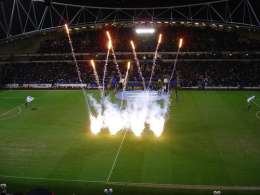 Sports fans are in shock following the death of The Beautiful Game. The Game has been followed for decades by millions of soccer fans across the globe, all eager to gather in front of their newspapers, radios and television screens for details of the latest transfers of players from club to club and of money from sports agent to football manager.
The Beautiful Game was born in the 1860's when, only months after the Rules of Association Football were first laid down by the FA, the manager of the N.N. (No Names) Club, Kilburn was offered his weight in Millingtons Unfiltered Gaspers to agree to the transfer of dashing, young centre-forward Aloysius "The Flying Cad" Formby from Blackheath Proprietary School.
Over the following decades The Beautiful Game was to make little progress, confining itself to building the odd manager a cheap patio or installing an avocado bath suite in a chief coach's home. This was due partly to the rectitude of those involved in football and mainly to the fact that all the money in British soccer at the time was insufficient to maintain a single sports agent. All was to change in the early 1990's, when hundreds of millions of pounds were diverted to the game from Rupert Murdoch's War on Culture to set up the Premier League.
Soon The Beautiful Game was advancing apace and developing exciting new moves, including the bung, the backhander, the sweetener, the tap-up and the illegal approach. Followers of The Game frequently marvelled at displays of extraordinary skill as the most outrageous bribes were explained away with straight faces, their enjoyment heightened all the more by the comic ineptitude of the governing authorities. Indeed all agreed that The Game was at its very peak when, only this week, it was brought low by a series of inquiries, investigations and a tragic outbreak of football.
The Beautiful Game is survived by diving, professional fouling, lousy refereeing, numerous assault allegations, hundreds of kiss-and-tell-stories and David Beckham.
16 August 2006
| [+/-] |
David Beckham's England Career 1996-2006 |
The sad demise of David Beckham’s England Career, which passed away this week at the tender age of ten, while not unexpected has left a gaping void in the England midfield, the pages of the tabloids and several multi-million pound sponsorship deals.
Friends of David Beckham’s England career say the end came quickly, following the announcement by new England manager, Steve McClaren, that he hoped to take the national football team “in a different direction”– namely forward, towards the opposition’s goal.
David Beckham’s England career began in 1996, when the young David Beckham faced an agonising choice – to give up his lucrative career as a Joe Pasquale sound-alike and part-time model for a Leytonstone tattoo parlour or to play his first match for England against Moldova.

Having taken the plunge into international underachievement, David Beckham went on to win 96 caps for his country – while designing 3,174 under his own label, mostly for sale in the expanding Far East market where, ironically, many of the caps were made.
The England career went on to even greater heights, with Beckham wearing the Captain’s armband 56 times – sometimes on his arm, sometimes as a fetching thong and throughout most of the 2006 World Cup in Germany, as a blindfold.
Famed for his tattoos, wearing sarongs in public and having haircuts, Beckham initially managed to find time for other pastimes, including football. Sadly, this sideline quickly foundered due to his difficulty in deciding whether to play on the left or right wing or whether to play home or away.
The highlight of David Beckham’s England career arrived in 2004 with the signing of a £40 million sponsorship deal with Gillette which finally banished bitter memories of his petulant quarter-final outburst against Argentina which shattered England’s 1998 World Cup dream for most England fans.
David Beckham’s England career was laid to rest in a moving ceremony attended by the leading lights of England International Football along with Frank Lampard, Michael Owen, Jamie Carragher, Joe Cole, Gary Neville, John Terry, Rio Ferdinand, Ashley Cole and Wayne Rooney, Steve McClaren and Sven-Goran Eriksson, while Theo Walcott was left to mind the umbrellas. Also in attendance were the brightest stars in the celebrity firmament along with Beckham’s wife Victoria, Elton John, Max Clifford and the footballer’s voice-coach for many years, Sweep.
The ceremony was briefly marred when undertakers struggled to lower Beckham’s career into the grave. But in the dying minutes of the service substitute pall-bearer Aaron Lennon made a dazzling dash down the right-wing of the cemetery, beating three mourners and the paparazzi defence, before slotting David’s career square across the box. Frank Lampard was on hand to receive but blazed it clean over the open grave.
Beckham’s England Career is survived by his sponsorship and merchandising career at Real Madrid, where his solid work and hard graft has boosted sales of team shirts by over 27%.
David Beckham's England career was pre-deceased by Victoria Beckham's career which passed away in November 2000.


