 The death of Gordon Brown's Political Vision has come as a grave shock to all those who knew it and as a particular cause of grief to those members of the Labour Party who once held it up as a beacon of hope in a world of political ennui.
It would be impossible to recount the stirring tales that have been told of the Political Vision, many of them by the Prime Minister himself. It was a vast and noble thing, encompassing everything from the fate of the planet, nay the universe itself, all the way down to the tears of a single child born in poverty and even taking in the complex machinery of post neo-classical endogenous growth theory on the way. Thanks to its prodigious strength and mighty intellectual force, those who walked beside it - or perhaps it were better to say, "those who walked in its shadow" - could do so without fear that any harm might come to them.
The Political Vision was born on the knee of Mr Brown's own father, the Church of Scotland minister Dr John Brown, who lectured his son even as he dandled him in his hands, reminding the wee Gordon of his duty to his fellow man, to remember that many a muckle makes a mickle and - as the Prime Minister himself recalled - "to treat everyone equally" (whether Dr Brown added that "everyone" did not include either young Muslims suspected of terrorism or the super-rich is sadly unknown).
Throughout his time at university, and on into his early life in politics, Gordon was to cleave to his Political Vision. He was often seen parading it in public, whether as editor of The Red Paper on Scotland or as a rising young star of the Labour Shadow Cabinet of the 1980s and early 1990s. Gordon Brown's Political Vision took in all it surveyed: it was for fairness to all, hard work and duty, it stood for the poor against the rich and the downtrodden against the privileged.
It was in 1994 that the Political Vision was to suffer the tragic accident that would affect it for the rest of its life, running into the sharp end of Tony Blair's butter knife in the dim lighting of a fashionable North London restaurant. This accident, it would appear, left the Political Vision so hideously scarred that it fled the political stage, leaving it to the rival - we are assured inferior - vision of the young Tony Blair.
For years, Gordon Brown's Political Vision haunted the Labour Party - only bursting from the shadows at Budget time or during the party conference season, when its shocking appearance served both to remind the Labour party of the glories it had once been promised and to send a shiver down the spine of Mr Blair. Indeed, it was only with Mr Blair's own political death - tragically crushed under a large political machine that had somehow worked itself loose - that Mr Brown, and his Political Vision - emerged once more.
The years of isolation had clearly taken their toll. The Political Vision - so long masked from view - turned out to be a pale and paltry thing, little different from the vision of Mr Blair or - indeed - Tory leader David Cameron. As it stepped fully into the light with its first Queen's Speech, Gordon Brown's Political Vision crumbled into a ragbag of bills to detain people without trial, build on green belt and a bit of fiddling round the edges with school leaving ages, waste disposal charges and parental leave, all wholly ununited by any overarching theme.
Gordon Brown's Political Vision will be scattered by a light breeze. Mourners are asked to send donations to offshore tax havens.
07 November 2007
| [+/-] |
Gordon Brown's Political Vision mid-1950s - 2007 |
08 October 2007
| [+/-] |
The Prospect of an Early General Election 27 June 2007 - 7 October 2007 |
 Friends of Gordon Brown were today weeping into their glasses of puritanical water and Conservatives laughing into their jubilant champagne following news of the death of The Prospect of an Early General Election, which slipped under the psephological waters over the weekend with the Prime Minister's confirmation that he will not be seeking a mandate(1) from the electorate until 2009 at the earliest.
Despite having been born so recently and having spent so much of its time in the eye of the media, the parentage of The Prospect remains uncertain to this day. Those close to the Prime Minister insist that it was the child of a series of drunken liaisons between political journalists eager for a story and a few overenthusiastic Labour MPs intoxicated by Mr Brown's enormous success in looking dour but responsible while plague, pestilence, famine and death chose the first hundred days of his premiership to visit the country. The dark mutterings of others(2), however, would suggest that The Prospect was actually the child of Mr Brown himself, born on the wrong side of the bedsheets after Mr Brown's attempts to screw the Conservative party and get his own supporters to toe the line by making a General Election seem - like an object in the wing mirror - to be much closer than it really was.
Whatever the truth of its origins, The Prospect certainly grew quickly. With political correspondents tired of their stories only appearing as the third item on the news bulletins, below shark sightings off the British coast or the latest prurient and unfounded speculation about a child abduction, it was soon being touted around as the great hope of political journalism. Before long it was impossible to turn on a news programme without having to face a twenty minute dissection of The Prospect's prospects. Soon discussion of The Prospect was drowning out all other news (save in The Express which continued to deal at length with the most important news of the day, though the day in question was usually 31 August 1997).
Though once closely associated with Mr Brown, The Prospect now seemed to be electrifying everyone. At the LibDem party conference Sir Menzies Campbell became so excited he was seen by at least one witness to twitch his left eye briefly before slipping back into his habitual coma. At the Conservative conference, young Dave "David" Cameron was moved to bounce around on stage calling for Mr Brown to "bring it on" - causing alarm to local hoteliers and restaurateurs who remembered that, in his Bullingdon Club days, such a phrase was normally the preface to thousands of pounds worth of damage being done to a local hostelry or eating establishment.
Mr Brown, meanwhile, found himself increasingly enamoured of The Prospect. Impressed by the attention granted to it by the media and assured of his own performance after an injection of good polling returns, he sought to woo the Prospect - bringing forward announcements he had promised would be made to Parliament, demanding that TV stations prepare for a major statement to be made and (in no way cynically) attempting to upstage Mr Cameron by (in no way cynically) rushing off to Iraq to double count (in no way cynically) the troop reductions he was planning there. The Prime Minister's amour fou for what many believed to be his own child was now obvious to all.
Such a liaison - straight out of the worst 19th Century melodrama as it was - was, of course, doomed. No sooner had the Prime Minister's enormous desire for an early election become clear than The Prospect itself was set upon by Shadow Chancellor George Osborne with a loaded Inheritance Tax cut. Severely wounded by the Tories' plan to enable feckless children to inherit up to a million pounds tax-free from their hard-working parents, The Prospect became a mere shade of its former self. Where once it had been attractive to all, now it was an embarrassing, shambling figure, capable only of inspiring pity. Thus it was that, horrified by what had happened to his former love, Mr Brown chose to steal out of Downing Street at the weekend and drown The Prospect under a sea of unfavourable opinion polls.
The Prospect of an Early General Election will be buried at the Church of St Bob Mckenzie of the Broken Swingometer. Conservatives, LibDems and Labour MPs in southern marginal seats will celebrate loudly into the night, while Mr Brown himself will stand silently at the graveside, a much-diminished man.
(1) younger readers are advised that "mandate" here means the commission as to policy granted by electors to their elected representatives and is in no way a suggestion that the Prime Minister was looking for a romantic liaison with a member of the male gender.
(2) not to mention "the facts".
05 October 2007
| [+/-] |
Political Speechwriters ????-2007 |
 The death of Political Speechwriters is today being reported in blogs, in newspapers and on the television - but not in any political speeches - following the barnstorming, "unscripted" performance by Conservative leader David Cameron at the end of his party conference.
There have long been disagreements between the experts over the dating of the birth of the first Political Speechwriter. Some have suggested that speechwriting goes back to the very dawn of humanity itself, with Ug the Chieftain's brilliant "Ug smash!" oration(1) actually being written by Ug the Speechwriter - though the fact that Ug the Speechwriter could not, in fact, write anything at all and usually contented himself with trying to rub two rocks together in a futile attempt to create fire admittedly militates against this theory.
Others claim the Political Speechwriter was born during the Roman Republic, suggesting that Julius Caesar could not have "come, seen and conquered" without considerable help from his favourite Greek slave - though whether this theory refers to Caesar's famous "Veni, vedi, vici" report to the Senate following his battle with Pharnaces at Zela or merely to the Roman leader's activities at a particularly eventful orgy is still disputed.
There have, of course, been suggestions that the first Political Speechwriter was born during the time of the Tudors. Many believe that Queen Elizabeth I's announcement that she had "the body of a weak and feeble woman(2); but ... the heart of a king, and of a king of England too" was in truth ghost-written by William Shakespeare ... though given that many believe that Shakespeare himself was ghosted by Francis Bacon, Christopher Marlowe, William Stanley, 6th Earl of Derby, Edward de Vere and/or Dr Who mean this theory advances debate very little.
What is certainly true is that even by the middle of the 20th century, many politicians still felt it incumbent on them to write their own speeches. Any doubts as to Churchill having dictated his most famous speeches to his secretary were recently allayed by the discovery of the first draft of his first speech to the Commons as Prime Minister, which reads "I have nothing to offer but blood, toil, tears and ... oh bloody Hell! I've knocked over the Johnnie Walker".
By the Presidency of John F Kennedy however, the Political Speechwriter had come to the fore. Without the work of his Special Counsel and Adviser, Ted Sorenson, the President would never have asked the Americans to "Ask not what your country can do for you (3), ask what you can do for your country(4)" or informed the people of Berlin that he was a doughnut(5).
Soon Political Speechwriters were informing us that Margaret Thatcher was "not for turning", Ronald Reagan wanted us to "win one for the Gipper" and John Major wanted to "get back to basics" (such as losing elections). At the same time the dangers of not employing a Speechwriter were also being made clear, not least in the notorious speech by former Labour leader Neil Kinnock, which reached its second day before it closed its first sentence(7). So it was that the Speechwriter came to dominate the political scene. Brilliant words and phrases were focus-grouped and honed before being permitted to issue forth from the lips of great communicators such as Bill Clinton and Tony Blair. Verbs were abandoned, "people's Princesses" were born. All seemed to augur well for the Speechwriters.
And yet, and yet. Some time in the noughties, people across the globe began to tire of the slick and well-honed phrase and began to question the sincerity of those who delivered them. Matters came to a head in Britain in September 2007, when - during his scripted speech to his party conference - Prime Minister Gordon Brown seemed to have been taken over by dark forces, calling for "British jobs for British workers" and the instant deportiation of "newcomers" who "sell drugs to our children or use guns" ... though, fortunately, he managed to stop himself before mentioning that, "like the Roman, I seem to see 'the River Tiber foaming with much blood'".
Political Speechwriters might perhaps have limped on even after this debacle, had it not been for the arrival of that knight in shining armour, David Cameron, who sought at one stroke to do away with political spin and deception by delivering his speech to the 2007 Conservative Conference unscripted and aided only by a few notes and an arcane process known only as "learning by heart" - a process which enables any politician to bestride the political stage like a colossus, exhibiting unspun sincerity and deep engagement with the issues of concern to the British people even as they dole out the same bland platitudes, feel-good-phrases and dog-whistle buzzwords that they have studiously workshopped with their presentation teams for the past three weeks.
With the country enraptured by Mr Cameron's performance and the new "learning by heart" process becoming all the rage, there was no more room for Political Speechwriters. They passed away, unloved and unmourned, with not even a single memorable phrase to mark their departure.
Political Speechwriters will be buried at the Church of St Soapbox on the Speakers' Corner. The funeral oration will be entirely spontaneous and unrehearsed, which is to say ill-thought-through and rambling and the congregation will sing Hymn 117 A Little Bit of Politics (Music: Andrew Lloyd-Webber; Lyrics: Ben Elton).
Political Speechwriters are survived by a bounce for the Conservatives in the polls and a worried Gordon Brown.
(1) Later shamelessly plagiarised by The Incredible Hulk during a stump speech to a large number of tanks he was, er, smashing.
(2) believed to be Mary, Queen of Scots
(3) definitely not provide affordable medical care, for one thing.
(4) if you are poor, this will conventionally involve dying in a foreign country of which you know little.
(5) Ich bin ein Berliner(6)
(6) There is, of course, no truth in the myth that the phrase translated in context into "I am a doughnut" but, dammit, it's funny.
(7) Though cf. John Prescott, for whom Speechwriters did their best best but were sadly thwarted by Mr Prescott's insistence on trying to read out a minimum of three separate lines of his prepared text at the same time.
22 August 2007
| [+/-] |
Dave “The Windmill” Cameron 1966–2007 |
 Dave “The Windmill” Cameron, “the upper class twit with the upper cut hit”, has finally met his match in the bare-knuckle fighting world of politics after his latest political bout to settle an argument about the poor performance of NHS hospitals ended in a fatal knockout delivered by one of his own backbenchers.
Born in the middle of that most peaceful decade of modern history, the Sixties, young Dave (or “David” as he was nicknamed by his peers(1)) turned his back on the Summer of Love when he won his first trophy, a silver spoon, after returning his midwife’s slap.
His reputation as a belligerent baby preceded him as Dave enrolled at the School of Hard Knocks – or Eton as his peers(2) preferred to call it. Whilst there Dave dealt severely with any challengers, eschewing the Marquis of Queensbury’s rules, saying “hold my tailcoat, mate” and directing his fag - a shadowy figure known only as "Big Boris" - to affix the unfortunate opponents' testicles to the floor of the junior common room with his crumpet toasting fork.
At university Dave's bare-knuckle career continued as he and his famous “Band of Scrapping Toffs”, "The Bullingdon Club", frequently challenged dining rooms, public houses and restaurants to go mano-a-bricko.
After graduating, Dave began throwing his weight around for the Conservative Party. Rapidly establishing a reputation as a quick-footed and handy fighter he rose through the rankings and, despite being tarnished by mentor Norman "Black Eye" Lamont’s defeat in the big-money Black Wednesday prize fight, young Dave eventually fought his way, in 2005, to replace Michael “Bite Yer Neck Off” Howard as all-Conservative champion.
However, a number of high-profile wins against Tony “Fist of God” Blair were followed by a string of defeats - often at the hands of his own MPs - which left the once-proud champion in desperate need of a big win. Staking everything he had, including what was left of his once unassailable authority as Conservative Party leader, he threw down the gauntlet to the NHS. Some mocked Dave for picking an opponent that was already on its last legs and as he stepped into the ring accusing the Government of planning to cut emergency and maternity services in 29 hospitals, all expected the NHS to throw in the (unwashed and blood-stained) towel. Instead it called for its second, Tory backbencher Henry Bellingham MP, who felled Dave with the news that - contrary to Dave's claims - his local hospital had no plans to cut services. Stunned and bloodied, Dave fell to the floor.
Even after so bruising a defeat, however, Dave refused to give in. His characteristic belligerence held out to the last as, bloodied yet unbowed, he accused the Human Rights Act of spilling his pint and looking at his wife, challenging it to fisticuffs "just as soon as I get my breath back". Fortunately for the Human Rights Act, the ambulance from the local NHS hospital was delayed as the driver had been asked to demolish the maternity ward during his tea-break, and so Dave passed away amidst the boos and jeers of his former supporters and the chuckling of David Davis.
Dave “The Windmill” Cameron will be buried at St "Iron" Michael Tyson's Church of the Bitten Ear. As a mark of respect his family have asked that all should fly their solar-powered windmills at half-mast.
13 August 2007
| [+/-] |
Red Tape c 100,000BC - AD2007 |
 Red Tape, the bureaucratic binding that has for millennia tied up the people of Britain in rigid rules and regulations, has today been pronounced dead by Conservative MP and multilingual karaoke star John Redwood.
Red Tape was born in around 100,000BC following Ug the Bureaucrat's decision to insist that Ug the Hunter fill in a twenty-seven page risk assessment form before building his new smilodon trap ... sadly resulting in Ug the Hunter's death after he was savaged by a sabre-toothed tiger whilst still trying to work out what to put in section 3(b)(iv)(aa). Very quickly it became an important part of Neanderthal life and local government, providing a common evil for the community to grumble about yet, at the same time, providing health and safety conditions which proved vital – especially following Ug the Inventor’s discovery of fire.
Throughout history nothing got done without Red Tape: King Harold had to file a claims form following his accident with William the Conqueror’s arrow, Henry VIII’s divorce papers ran to so many volumes that he had to build Windsor Castle to house them (but only after a 12-year legal battle with local peasants who claimed it would spoil their panoramic views of the Slough plague pits) and even Neville Chamberlain wasn’t allowed to appease Hitler without having in his hand a piece of paper.
Always controversial, by the 20th century Red Tape had become the Marmite of the political and economic world: beloved of faceless bureaucrats, trade unionists and anyone who didn't fancy being sacked on the spot for failing to come in to work after losing their head in that unfortunate accident with the defective electric fire their boss ordered them to use to dry the toxic lead paint with which he'd insisted they cover over the cracks on the cut-and-shut job for the new kiddies' school bus, whilst loathed by industry, employers who didn't see why the loss of an arm should prevent someone working the rest of their 20-hour shift on the meat-packing line and politicians of all stripes eager to find an easy way to promise billions of pounds of savings.
Down the years politicians of all stripes - provided such stripes had been properly applied in accordance with the Political Stripes Act of 1937 as amended by the Journalistic Cliche (Amendment) Order of 1993 and the EU Striping Standardisation Regulations of 2004 - sought to win over the public by promising to do away with unnecessary bureaucracy and liberate the people from the tyranny of Red Tape and somehow free up vast amounts of money without ever having to mention tax cuts. Thus it was perhaps unsurprising that in 2007, with the Conservatives lagging behind Labour in the polls for the first time since the election of David Cameron as party leader, Mr Cameron contacted John Redwood - one of the Tories' most feared Vulcans senior figures and invited him to do away with Red Tape, ushering in a new era guaranteed to free ordinary Britons from the kind of petty-minded governmental meddling that had stopped kids happily climbing up chimneys and pensioners licking dustbins for sustenance.
Eager for the kill and belting out his battle cry of "Easing the restrictions on data protection, employees’ hours and health and safety conditions will provide the equivalent of a £14 billion tax cut and incentive to businesses", Mr Redwood levelled his trusty nuclear laser pistol at Red Tape and doubtless would have blown it halfway across the universe had he not been asked to fill in the necessary forms for his nuclear laser pistol licence first.
Red Tape will be buried at St Kafka’s Church of the Bureaucratic Nightmare following production of docket Z678907/34/X/iv, stamped by the relevant authorities and countersigned by the deceased. On its final, duly certified, expiry and interment it will be survived by As A Dodo's newly hired six-year-old asbestos sweeper, chimney cleaner and chainsaw juggler ... though probably not for long.
18 June 2007
| [+/-] |
David Cameron "Heir to Blair" 2005-2007 |
 Political commentators are today snorting into their third bottle of that rather decent red and ordering up a couple of decent brandies to wash it down in memory of David Cameron's oft-proclaimed status as "the heir to Blair", which has passed away this weekend after being crucified in the press and by the Conservative party faithful.
Until 2005, few suspected Mr Cameron's true nature. To all intents and purposes he seemed merely to be a simple direct descendant of William IV and his mistress, happy to toil his way through Eton and Oxford (via the odd bit of genteel thuggery at The Bullingdon Club). Whereas in previous generations the landed classes were given to sending their less obviously distinguished scions into the Church of England, changing times forced the young David instead into the Conservative Party, where he was later to distinguish himself by acting as special adviser to Chancellor Norman Lamont during the Black Wednesday fiasco. From here, his journey towards a safe seat as a Tory MP was assured. Yet still there seemed nothing particularly special about the man who would eventually be hailed as the Tories' new Messiah.
It was in the Garden of Gethsemane of Winter in Blackpool at the Conservative Party Conference of 2005 that Mr Cameron's closest political friend and honorary life-president of the Eton Tuck Shop Debating Society, George Osborne, first proclaimed his ally's rebirth as "the heir to Blair". Given that Mr Cameron was at this time a rank-outsider to succeed Michael "I don't drink ... wine" Howard as Conservative leader and Mr Blair was marginally less popular with the public than a severe genito-urinary infection or a Davina McCall chatshow, Mr Osborne's announcement seemed both ill-timed and ill-advised. Nonetheless, the signs of Mr Cameron's new incarnation should have been clear for years: he was, after all - and just like Mr Blair - a glibly charming public schoolboy with - again, like Mr Blair - all the deeply-held political conviction of a stick of bubble-gum; he had - just like Mr Blair before his journey to the leadership - wholly endorsed a general election manifesto pandering shamelessly to his party's more extremist members without believing a word of it; he did - like Mr Blair - see presentation as superior to policy; he was - like Mr Blair - eager for power.
Mr Cameron's new status was confirmed within days of Mr Osborne's proclamation, as he manifested on TV and radio, eager to deny his Messiah-hood thrice before John Humphrey's crowed, whilst equally eager to fill the airwaves with vacuous, policy-free statements about hope, opportunity and how nice it is when things are nice. Soon he was performing miracles, casting out the monomaniacal obsession of his party with Europe, resurrecting the Conservatives' position in the polls and appearing to the faithful in visions(1).
Yet this was not enough to satisfy the Pharisees and Sadducees among the Tories. When he sought to cast the Grammar Schools out of the Conservative Temple he was turned on by those he had thought his disciples and dragged before the court of the righteous to be examined before the high priests of the Conservative press, who demanded that "the heir to Blair" be put to death.
David Cameron "Heir to Blair" will be formally buried in a speech to the party faithful. Mr Cameron himself is expected to be resurrected in a few days as "The Niece to Heath", unable to stick with any policy and unsure of exactly who should be governing Britain. The Heir to Blair is survived by a smile flitting over the face of Shadow Home Secretary David Davis and by Gordon Brown.
(1) well, on webcameron.
23 April 2007
| [+/-] |
The Bullingdon Club c.Mid-19th Century-2007 |
 Waiting staff, pub landlords and other inhabitants of the city of Oxford are today breathing sighs of relief and downgrading their insurance policies, following news that The Bullingdon Club, Oxford University's most notoriously irresponsible "dining club", is expected to pass away after calls by its most celebrated member, Conservative Leader David Cameron, for a new "responsible society".
Born in the mid-19th Century (the details are, like so many members of the society, a little hazy) the Bullingdon Club was a late flowering of Regency irresponsibility in a more sober Victorian age. Though originally conceived as a sporting society, before its first year was out the club was already establishing for itself a reputation for drunkenness and debauchery previously only held by the Hellfire Club and now rivalled only by Premiership footballers and British under-30s on their summer holidays. It is understood that it is in order to distinguish themselves from the last two groups that the Club's members insist to this day on wearing an eccentric uniform of blue tailcoats (though, sadly for the club, this has led to many claims that former boxer and present-day oddball Chris Eubank is an honorary life member).
So irresponsible was the Bullingdon, indeed, that to this day those invited to join the Club's 20-strong membership are welcomed by having their rooms trashed (something which, admittedly, many students are capable of achieving without the aid of some chinless types in dinner dress) and then required to book a private room at a local establishment where the Club's members can drink themselves into near insensibility before reducing the room to a state where it would look far from out of place in Central Baghdad.
Down the years the Club's reputation grew and grew. Lampooned by Evelyn Waugh as the Bollinger Club and attracting such (usually only briefly) upright members of society as bad artist and zookeeper Lord Bath, fraudster and thug Darius Guppy, gleefully caddish former minister Alan Clark and er, David Dimbleby, the Club spent its time in glorious irresponsibility, throwing bikes through windows, smashing street lights and carrying out assorted other activities which lead lesser mortals to criminal charges and Club members to throw large amounts of daddy's money at the victims.
With members such as Shadow Chancellor George Osborne, Shadow Minister for Higher Education Boris Johnson and Mr Cameron himself all poised to take power, a future of untrammelled irresponsibility seemed assured. Who could have predicted that one of the Club's own offspring would forsake his vows and turn against it, using a speech to the Royal Society of Arts and an article in The Guardian to espouse the virtues of social responsibility and condemn those who cause wreck and ruin in their failure to offer others the respect that they deserve?
The Bullingdon Club will be buried at a secret dining event at St Alan Clark's Church of the Extended Wine Tasting. The Vicar will read from The Book of "Dear Lord You Can't Really Be Doing That In The Font Can You? Oh, 'Here's £500 For The Church Roof', You Say? Just Carry On". The church itself will be condemned as structurally unsound tomorrow.
15 March 2007
| [+/-] |
The Death of the Cold War 1989-2007 |
 The Death of the Cold War died last night when MPs voted by a majority of 248 to renew Britain's Trident nuclear submarines, thus bringing the country kicking and screaming into the 1950s, prepared at any moment to deter the threat of a massive nuclear attack by the forces of the USSR, the Eastern Bloc and Red China with the prospect of mutually assured destruction, despite the fact that the USSR no longer exists, the Eastern Bloc's forces are already working over here as plumbers and the biggest invasion threat from China is from a large amount of extremely cheap T-shirts.
The Death of the Cold War began in 1989 with the fall of the Berlin Wall which left that once divided city vulnerable to unscrupulous capitalists determined to (literally) smash communism - charging $10 a throw for a piece of grafittied rubble and leaving the city wide open to the horror of an invading army of Pink Floyd fans.
Soon Eastern Bloc countries - sick of suffering under the yoke of communist oppression and the occasional visit by Sir Paul McCartney - were demanding the right to hold their own concerts featuring 70s rock dinosuars, elect democratic governments, eat quarter-pounders with cheese and yearn for the days of communist oppression.
Thanks to the Death a generation raised on a constant diet of Cold War paranoia - including Invasion of the Body Snatchers, When the Wind Blows, Red Dawn and Noel's House Party - breathed a collective sigh of relief as the superpowers stepped back from the brink of nuclear annihilation. At last ordinary citizens could go about their business safe in the knowledge that the man in the park whispering "the red squirrel flies low over the Volga tonight" wasn't a Soviet agent trying to start World War Three but an alternative comedian filming an ironic lager commercial.
All seemed well with the Death of the Cold War until yesterday when, urged on by our Great Leader and his predecessor Comrade Blair, Britain chose to follow the examples of such great nations as Iran and North Korea and commission itself some nuclear weapons to prove to the world that, for all it seems to be a crumbling state unable even to care for the health of its people, it is in truth a powerful player on the global stage. The great leader's success was due in no small part to the work of the official opposition and its leader Comrade Cameron, whose only request was that all the new missiles be fitted with windmills so they can generate gigaWatts of environmentally-friendly electricity as they hurtle towards Minsk at several thousands mile per hour.
The Death of the Cold War will be buried on May Day at Whitehall at a ceremony witnessed by Comrade Brown, who will stand on the newly erected balcony at Ten Downing Street, smile grimly beneath his Homburg, and stiffly salute a march-past of the missiles of the Glorious People's Republic of Britain... before personally executing the 95 Labour rebels who voted against him.
It is survived by the memory of a time when Tony Blair supported CND, the four-minute warning and shooting your irradiated grandmother with a 12-bore to stop her getting her crazed, mutated hands on your last tin of Alphabetti Spaghetti.
12 March 2007
| [+/-] |
Cheap Flights 1985-2007 |
 Cheap Flights reached the end of their short but lucrative runway this weekend following the announcement that the Conservatives plan to introduce a tax on frequent flyers with a green air miles scheme designed to limit damage to the environment - particularly if that environment is anywhere in the vicinity of a hen party with £1.00 tickets to Dublin.
Cheap Flights took off for the first time in 1985 when Ryanair went into competition with British Airway and Aer Lingus, flying from Waterford to London, and providing a much cheaper alternative by economising on "fancy frills" such as customer service and leg room for anyone taller than The Seven Dwarves.
By the early 90s Cheap Flights had become a popular and cost-effective way of enjoying what felt like a near-death experience at a fraction of the cost of Alton Towers. With EU deregulation of the air industry in 1997, the skies over Britain were filled with planes carrying passengers to weekends in such romantic European destinations as Stuttgart, that strange bit of Paris that is actually 50 miles from the city itself and is only used by cheap flights and the crop dusting plane from "North by Northwest" and the Stansted Travelodges that are the only alternative when you've been unexpectedly bumped off a flight despite having booked it several months in advance.
With growing concern over the environmental impact of Cheap Flights during the noughties, the 21st century equivalent of the Battle of Britain began. In the early days of the conflict, Ryanair and EasyJet prevailed, but despite increased demand for short-haul flights (so-called because the passengers were often called upon to haul the plane from the terminal concourse to the runway) environmentally-aware politicians and Conservatives looking for an image change soon began to inflict heavy losses.
The last post was sounded when Shadow Chancellor, George Osborne, dared to speak out on behalf of the environment in a brave move to protect our beautiful planet in no way connected with the opportunity to embarrass a Labour government with all the green credentials of Jeremy Clarkson. When David Cameron - who had joined the Mile High club as a teenager despite never having boarded a plane - came flying out of the sun with all environmental policies blazing, Cheap Flights were riddled with holes, took a sudden nose-dive and crashed and burned... something many passengers had been predicting would happen for years.
Cheap Flights will be buried at St Leslie Nielsen's Church of Airplane! Mourners will be flown to East Midlands airport, 120 miles from the service held in the duty-free concourse of Luton Airport. Admission will be £0.50 (inc. wake taxes £75.00), a 100cl bottle of Lithuanian red wine £4.00 and complementary nuts £12.50. Passengers will be asked to join in the singing of Cheap Flights favourite hymn "There is an airport far away".
Cheap flights are survived by unseasonably warm weather, a load of lonely raffia donkeys and a massive increase in day-glo fake tans.
09 March 2007
| [+/-] |
Patrick Mercer's Conservative Front Bench Seat 2003-2007 |
 Conservatives across the country are today singing the blues for the Front Bench Seat of Patrick Mercer MP, which has died at the age of four in what is being reported as an unsavoury racist incident.
Patrick Mercer's Front Bench Seat was the lovechild of former Tory leader, ex-Scots-Guardsman and professional mute Iain Duncan Smith's need for a shadow cabinet member who didn't look as if he belonged in an 18th Century lunatic asylum and former army officer and ex-BBC Defence Reporter Patrick Mercer's desire to find a position where, if he bided his time, he could really shoot his mouth off.
It was a sign of the regard in which Mr Mercer was held that he retained his Front Bench Seat under three successive Conservative leaders - though this may have been due in part to the fact that in recent years the Tories have rarely given their chiefs enough time to put their lucky gonk on the leader's desk, let alone get round to reshuffling their shadow cabinet. Given the high degree of sensitivity and intelligence which has traditionally been displayed by British Army officers (only some of whom like to attend "natives and colonials" parties dressed in Nazi uniform) many were surprised when Mr Mercer failed to say anything outrageous at all for many years, preferring instead to leave foolish generalisations and ill-thought-through off-the-cuff remarks to Boris Johnson.
Mr Mercer's great moment - and his Front Bench Seat's darkest hour - finally came in March 2007 when his mouth took the opportunity of an interview with Times Online to begin channelling the spirit of Ron Atkinson, suggesting that during his time in the army he had come across "a lot of ethnic minority soldiers who were idle and useless, but who used racism as cover for their misdemeanours" and that, in the army, a "chap with red hair" would get a "far harder time than a black man".
From the moment that Conservative leader David Cameron became aware of Mr Mercer's remarks (or at least from the moment he became aware that they'd been made publicly and to a journalist) the death of Mr Mercer's Front Bench Seat was inevitable. Confirming The Seat's passing, friends of Mr Cameron told reporters that to claim he had overreacted was "utter rot" and that in his time as Tory leader he had known "a lot of Conservative MPs who were idle and useless but who used claims of 'political correctness gone mad' as cover for their misdemeanours".
Patrick Mercer's Conservative Front Bench Seat will be buried without ceremony at St Enoch's Church of the Rivers of Blood and as far away from Mr Cameron's shiny New Tory image as the spin doctors can manage.
12 February 2007
| [+/-] |
David Cameron's Squeaky-Clean Image 2005-2007 |
 David Cameron's Squeaky Clean Image inhaled its last breath, exhaled very slowly, said "Wow!" and expired this weekend following his refusal to deny claims in a new biography that he smoked cannabis while he was a pupil at Eton 25 years ago.
"Dave"'s Squeaky Clean Image was born in 2005, the offspring of a coterie of Eton chums united by a desire to mark the end of the dark days of Michael Howard's leadership which had, strangely, drained the lifeblood out of the party. Their far-out plan to fill the vacuum in the centre ground of British politics left by Labour's spritely trot to the right under Tony Blair was initially dismissed as the kind of nonsense that could only have been dreamed up en route to the all-night garage for a couple of Twix bars and those "chocolate things with the nuts on them, you know the ones".
The Squeaky Clean Image was soon sullied during its leadership campaign when it refused to deny that it had taken class-A drugs at university, with fellow alumni insisting that it had had "a normal university experience" - saving money from its grant by buying almost-past-ther-sell-by-date goods in the supermarket in order to be able to afford a bag of grass for the weekend which would, inevitaby, turn out to be parsley.
Despite this setback the Squeaky Clean Image quickly established itself as a lively presence in British politics, cycling through the streets of West London in vibrant day-glo colours and campaigning for home-owners to erect green windmills on their roof so that we could "all look at the pretty colours turning in the wind, man".
But it was the Squeaky Clean Image's adoption of Old Labour policies - most recently the decision to fight the imposition of ID cards - that led critics to suspect that the smoke coming from Conservative Party HQ wasn't the result of Margaret Thatcher spinning rapidly in her grave, but was the natural by-product of the enormous bong the young Tory policy wonks fired up each morning for inspiration.
Despite Tory leaders' traditional association with powerful intoxicants - Winston Churchill lived on a champagne and whisky drip, Margaret Thatcher's "vitamin injections" kept her in a state of hawk-like readiness for 22 hours a day and Michael Howard never slept at night at all - the hot knives were out for DC's Squeaky Clean Image once news of his teenage reefer madness was splashed across the front pages of the Sunday newspapers. The Squeaky Clean Image called for the right to a past that is private, thus immediately promising a future that is far too public for comfort. Friends and colleagues rallied around but when Norman Tebbit told him to come clean - in that way only he, and certain black site interrogation operatives, can - David Cameron's Squeaky Clean Image sniffed its last.
David Cameron's Squeaky Clean Image will be cremated in an environmentally-friendly, and very High Anglican service, at St Withnail's Church of the Camberwell Carrot. There will be a public memorial service, group hug and rave at Glastonbury this summer. It is survived by David Cameron's Youthful Indiscretions and the increasingly irrational ramblings of Tony Blair.
04 October 2006
| [+/-] |
David Cameron's Tory Conference Speech 2.35pm - 3.22pm 4 October 2006 |
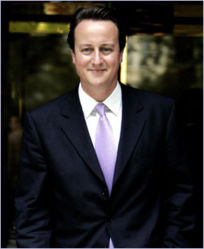 The political world is in turmoil today following the unexpected and wholly premature death of David Cameron's speech to the Conservative Party Conference. Once seen as the shining hope for both party and country, The Speech's sudden passing leaves behind countless devastated voters and a gleeful Norman Tebbit.
Conceived several weeks ago in an enthusiastic and energetic bout of love-making between Tory leader David Cameron, his spin doctors and large sections of the media, many had expected The Speech to grow up to be a triumphant tour d'horizon, that would see its maker swept to power on a wave of overwhelming enthusiasm. Given the difficulty of producing a wave of anything beyond faltering, Werther's-Original-and-Sanatogen-infused, breath from the aged audience who had gathered in the delivery room to greet it, it is hardly surprising that The Speech's entry into the world did not go well.
Matters worsened for The Speech as attempts to inject it with NHS, gay partnerships and the minimum wage - along with a total failure to administer life-saving tax cuts - by the junior spin doctors overseeing the delivery room caused the unfortunate oration's health to deteriorate more rapidly. With hopes for The Speech fading fast among well-wishers - and several members of the Shadow Cabinet - an emergency crash team of the armed forces, immigration controls and support for marriage were called in but to no avail. By 3.22pm The Speech was pronounced dead ... despite having another twenty minutes yet to go.
The Speech's funeral was attended by an audience of ageing party members, who gave The Speech a lengthy standing ovation after being told they could have tea and biscuits if they did so.
David Cameron's Tory Conference Speech is survived by David Davis, John Redwood, Edward Leigh and an unusually cheery Gordon Brown.


