 Members of the Catholic church, along with the veil-sellers of Abruzzo, are today mourning the passing of St Veronica's Veil, following the decision of Pope Benedict XVI to remove any reference to it from the Stations of the Cross.
The tale of St Veronica's Veil begins in the 6th century AD, at a time when churches across Europe were all letting it be known that they were stuffed to the rafters with holy relics, which they would be more than happy to allow pilgrims to gawp at or fondle for the price of a small, "well, I say small but, let's not beat about the bush, we're talking about improving the chances of avoiding your soul's eternal confinement in the lowest pits of Hell here" donation to the Church restoration fund.
It was surely a happy coincidence that at exactly this time the tale of St Veronica, a pious woman of Jerusalem in 33AD who wiped the face of Jesus with a cloth as he struggled under the weight of the cross, instantly imprinting a perfect image of Jesus's face upon the cloth ("only three groats a touch, keep the queue moving please"), arose.
The tale of the Veil soon spread throughout Christendom. By now hundreds were willing to asseverate that Veronica had travelled to Rome and used her Veil to heal the ailing Emperor Tiberius (a particularly miraculous event given the fact the Emperor was living on Capri at the time). Veronica's Miraculous Veil was now said to be able to quench thirst, restore sight and even resurrect the dead, though unlike Jamie's Magic Torch it was unable to create a magical helter skelter allowing one to go "over and over, faster and faster to Wonderland".
By the early 8th Century the shroud was so popular that it was given its own Chapel at old Saint Peter's in Rome by Pope John VII. For centuries it moved about Rome (presumably with human aid but who can tell with miraculous objects) until it was brought to Saint Peter's in 1297 by order of Pope Boniface VIII, who was outraged that the Chief site of the Western Church should be facing competition in the relic stakes from several hundred saints bones, enough splinters from the one true cross to build a fleet of ships and all three "one true" holy grails.
During reconstruction work on the basilica in 1506 the Veil disappeared, causing outrage in the Vatican and ensuring the Pope would never use that firm of cowboy builders ever again, however low their quote for the work be. Happily there were on hand many artists with an amazingly exact memory of the appearance of the Veil, all of whom were willing to make copies of it for the Church to sell. Unfortunately the industry reproductions of the Veil for the use of sincere pilgrims soon got out of hand, with so many copies being made that by 1616 Pope Urban V was forced to ban the practice altogether ... unless made by a canon of St Peter's Basilica, of course.
For centuries, the whereabouts of the miraculous Veil remained in question. In 1999, however, Father Heinrich Pfeffer announced that he had rediscovered it in a Capuchin monastery in Manoppello in Italy. All who saw the image were immediately struck by its miraculous nature - particularly as none had expected the true image of their Lord to look so exactly like a bog-standard Mediaeval forgery. Even more miraculous was the fact that St Peter's in Rome, Jaen and Alicante in Spain and the basilica of Sacré Coeur in Paris all claimed that they had the one true version of the Veil locked up in their own churches. Indeed, Pope Benedict was so moved by the sight of the Manopello Veil in 2006 that he went off straight away to have its role in the commemoration in the sixth station of the cross expunged as part of a move to remove the apocrypha from the "authentic" story of the Gospels.
The Veil of St Veronica was buried on Good Friday. It is survived by a new set of Stations of the Cross stripped of their Mediaeval traditions, a modernising Pope who speaks in Latin and thousands of distraught sellers of genuine reproduction Veils of St Veronica (guaranteed 100% natural rayon).
06 April 2007
| [+/-] |
The Veil of St Veronica c.33-2007 |
08 October 2006
| [+/-] |
Limbo 0-2006 |
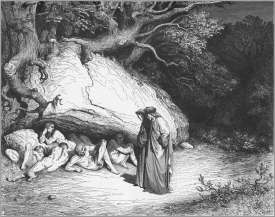 Unbaptised souls throughout the crystal spheres are today mourning the loss of their former home, Limbo. The news comes following the decision of Pope Benedict to abolish Limbo on the grounds (a) that the concept of unbaptised children being forever tainted by original sin is inconsistent with a modern interpretation of the gospels and (b) the feelings of bitterness he has held towards the very word limbo ever since that time he tried to shimmy under a low, low pole in his mitre while on a Sandals holiday in Jamaica.
Limbo was a bleak and lonely place on the borders of reality, free from the torments of Hell such as eternal fires, burning sand and double-glazing salesmen but forever excluded from the delights of heaven, such as being surrounded by devout theists for all eternity. Despite this it proved unpopular with visitors, the only tourists to that place of grim non-existence in the last 2,000 years being Jesus, Dante and anyone who has ever sat down in front of Countdown for more than three minutes.
Despite its unprepossessing aspect, for much of its 2,000 year existence Limbo was home to some of the greatest minds to have existed before the birth of Christ. Its inhabitants included some of the world's greatest poets and thinkers, including Homer and Virgil but sadly not Marge, Bart or Lisa or any other members of the Thunderbirds team. While the unbaptised are said to be distraught at saying goodbye to the only home some of them have known for the past two millennia, other residents of Limbo took the news of Limbo's death philosophically - the residents in question being Plato, Aristotle, Zeno and Socrates. Zeno in particular was untroubled by the news having proved beyond all possible doubt that Limbo could never be destroyed, just as an arrow could never, philosophically speaking, reach its target ... exactly two minutes before Pope Benedict decided to wipe it out of existence.
Limbo is survived by Purgatory, Hell and watching Adam Sandler movies.
17 September 2006
| [+/-] |
The 21st Century 2001-2006 |
 The population of the Vatican was today mourning the 21st Century, after it was declared dead by Pope Benedict XVI in a brief address from St Peter's Square.
It appears from his His Holiness's speech that, despite being born in a vigorous bout of distrust of modernity brought on by inoculation with the Millennium Bug, the still young century had been showing increasing signs of ill health over the past six years. In particular there was evidence that it had inherited several afflictions from its parents, the 19th and 20th centuries, including freedom of thought, belief in Darwinian Evolution, women's liberation, the unfortunate practice of prosecuting priests who wish to display their affections to young choir boys and a distressing lack of crusades in the Holy Land. The Century having failed to improve despite the finest leechcraft of the Vatican's doctors, the Holy Father eventually found himself with no alternative but to administer the last rites to the century ... whilst also administering a red hot poker to the Century's fundament.
Speaking to an assembled crowd of serfs, freemen, pardoners, clerkes, reeves, apothecaries and villeins, Pope Benedict announced that henceforth the 21st century will be replaced by the ever-reliable 14th century, adding that from now on the Sun will travel around the Earth, the Black Death will be endemic across Europe and the best way of improving Christian-Muslim relations will be at the end of a long and pointy lance. His Holiness's address was greeted by rapturous applause from the crowd, though the effect was somewhat lessened when several of the lepers' arms fell off. Fortunately the festive air was soon restored by the burning of an assortment of witches.
The 21st Century was buried on Saturday morning in a moving ceremony, marred only when Pope Benedict told the assembled relatives that the 21st Century was "evil and inhuman", although officials later explained His Holiness had not meant to cause any offence.


