 The Slow Train – the backbone of Britain’s “integrated transport system” for nearly two hundred years – has reached its terminus following the news that a French TGV (Train à Grand Vitesse – one of those French phrases which cannot be exactly translated into English but means something like "non-British train" or "untortoiselike means of locomotion that will not break down five miles out of Paddington") has broken the world speed record after travelling at 356mph between Paris and Strasbourg.
The Slow Train was born in 1825 – the offspring of Richard Trevithick’s steam locomotive (which was so slow it was practically stationary) and the desire to transport goods and passengers between points A and B faster than a team of sloths on Diazepam. George Stephenson’s optimistically-named Rocket travelled between Stockton and Darlington at speeds of up to 29mph, although when encumbered with passengers and goods it could only manage a measly 12mph… if moving downhill and with a following wind.
For nearly two centuries, the Slow Train became a feature of everyday British life, much-loved by comedians… and much-hated by anyone who had to make a connection at Crewe by midday, travel between Cardiff and Swansea in under three weeks or failed to appreciate the delights of having their nose pressed into a stranger’s armpit whilst the train stopped inexplicably between stations for longer than even Tantalus had to endure.
With the privatisation of British Rail in the mid-1990s, the Slow Train reached its finest hour (which occurred at least forty-five minutes later than the time printed on the timetable), as first the Conservatives and then Labour ensured that passengers would never again have to experience the horror of travelling faster than a nun on a bicycle or suffer the shock of arriving at their destination on time.
With the news that the French TGV had broken the world speed record for a train on rails1 – moving along the line faster than Keith Richards snorting his father’s ashes – the last Slow Train in Britain (last Tuesday’s 17:42 from Guildford to Woking, expected to arrive a week on Thursday) pulled into a siding and died of shame.
The Slow Train will be buried at the John Major Church of the Privatised Railway. This Service has been delayed and mourners are advised to use other forms of transport to reach their final destination.
The Slow Train is survived by The Stationary Train, The Train Withdrawn From Service and The Train Now Standing At Platform Nine Isn’t a Train – It’s a Virgin Express.
1Despite attempts to prevent the record by three men speaking only schoolboy French, and wearing stripey jumpers, berets, false moustaches and strings of onions, who were later arrested for impersonating French train drivers and named as Jeremy le Clarkfils, James Mais-Oui et Ricard Hammond-Legume.
04 April 2007
| [+/-] |
The Slow Train 1825-2007 |
06 December 2006
| [+/-] |
The Chelsea Tractor 1941-2006 |
 This morning middle-class mums across West London eager to drop their youngest off at prep school before making the dash to Harvey Nicks for coffee and a natter - not to mention the vast majority of automobile-owning North Americans and Jeremy Clarkson - were united in mourning the untimely death of the Chelsea Tractor, "4x4", "SUV" or "4WD", the powerful beasts that once roamed roads across the globe and which, for many, came to epitomise strength, versatility and total disregard for the environment.
First sighted in the wild in the early 1940s and known at the time as "Jeeps", Chelsea Tractors were initially seen by the vast majority as untameable creatures, always given to scrambling up hillsides and along twisting jungle paths and frequently involved in scenes of battle, whether they be in Central Europe in the dying days of the Second World War or outside Loretta Switt's trailer in M*A*S*H that time Alan Alda accidentally drove over her foot.
Some of the first attempts to tame the Jeep were made in Britain. A careful programme of cross-breeding resulted in the production of the "Land Rover", a sturdy (if usually slow) creature which spent its time skittering up mountainsides and down into valleys from the Scottish Highlands to the Cornish Coast, usually with a sheep or two in the back and often a lonely shepherd in a mounting state of excitement in the front.
By the late 1960s and early 70s, the rugged 4x4s had become a familiar sight across the countryside, with some of the braver individuals even being sighted on the outskirts of towns and cities. A confident furture for the species seemed certain. But then came the oil crisis of 1973. With their favourite food stuff (top grade petroleum) growing scarce, many predicted the powerful, if sometimes ungainly, animals could go the way of the Dodo. However, thanks to careful nurturing, they were able to survive in isolated rural pockets, living off a diet of red diesel and the odd drop of four-star. With the species' very survival under threat, top scientists at car manufacturers in America, Europe and Japan began selective breeding programmes. By the mid 1980's these programmes had borne fruit and the first Chelsea Tractors were able to be released into a new, safe environment - the city. Soon Chelsea Tractors were swarming over smog-filled traffic routes in urban centres the world over, braving hazards from speed bumps up to 5 centimetres high all the way to potholes up to 2 centimetres deep in their quest to carry little Julian from the front drive to soccer practice.
With the explosion of the species it could not be long before predators began to gather. Soon groups of environmental activists, teenagers eager for a cause and politicians eager to sweep up the green vote were seen gathering near the Chelsea Tractors' watering holes (or, as the locals know them "petrol" or "gas" "stations") and sniffing the air, before passing out due to all the fumes. Before long they took to setting up traps for the turbo-powered behemoths in the form of congestion charges and poisoning their food supply with green taxes.
By the mid-noughties, the Chelsea Tractor began to vanish from our streets. By the end there were only a few, unreliable sightings of the creatures - sometimes outside the palatial crib of an LA rapper, sometimes making the weary journey to Knightsbridge for the sales.
The Chelsea Tractor will be buried under a mountain of high petrol prices and increased environmental awareness. It is survived by an increasing number of erratic cyclists, scooters, bendy buses, the Smart car and trees.
22 September 2006
| [+/-] |
Jeremy Clarkson 1960-2006 |
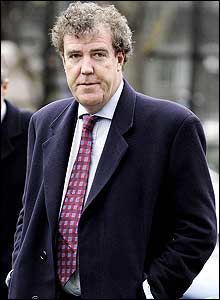 It is difficult to relay the impact that the sudden and unexpected death of journalist, broadcaster, motoring expert and professional loud-mouthed know-it-all Jeremy Clarkson will have upon the world.
Jeremy Charles Robert Clarkson was born in 1960 to a long line of Yorkshiremen and exhibited the virtues of his home county, namely forthrightness and plain-speaking (or "being loud" and "being rude" as they are known outside Yorkshire). He learnt the craft that was to bring him fame as a child when - allowed into the pub to collect the crisps and coca-cola he would be imbibing in the family car while his parents chatted with friends in the snug - he spotted his first pub know-it-all, holding forth at length on why Richard Nixon would beat Leonid Brezhnev in a fight and how all Italians smelled suspiciously of garlic. As he watched the frankly terrified expressions on the faces of the know-it-all's audience, Clarkson knew he had found his ideal job.
After spending many a night hunched under his bedcovers with the Big Boy's Book of Facts and The Hitler Youth Guide To Everything (not to mention several mysteriously soiled copies of Health and Efficiency) young Jeremy was ready to find the perfect tool to display his burgeoning skills. After realising that the perfect tool was himself, he went on to search for the arena in which to express his art and was soon to find himself among the tedious, mileage-and-torque-obsessed men of motoring journalism. With his ability to deliver outrageous and ill-thought-through opinions by means of heavily-prepared and overwrought metaphors, Clarkson soon found himself promoted to television where he became a hugely successful presenter of the BBC's Top Gear programme and a hugely less successful presenter of the chatshow "Clarkson".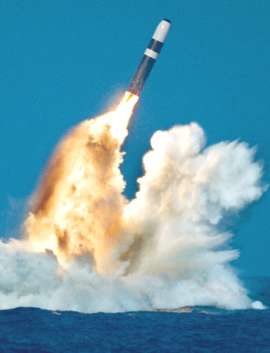 Friends believe Mr Clarkson was deeply affected by his friend and co-presenter Richard Hammond's recent, appalling, high-speed accident and - unable to cope with being second best in any area - was driven to outdo Mr Hammond's near-death experience by going "just that little bit further". This, at least, is the only reasonable explanation anyone can come up with for his decision - aided only by a BBC camera crew, a large collection of over-extended similes and extensive gurning to camera - to break into Her Majesty's Naval Base Clyde, Faslane and smuggle himself aboard nuclear submarine HMS Vanguard. Once inside the sub, Mr Clarkson strapped himself to a Trident nuclear missile and - having acquired the launch codes from a senior Naval official after reducing him to a quivering wreck with a three-hour tirade on the obnoxiousness of the French - launched himself at the nearest Greenpeace headquarters with a cry of "Eat atomic death, treehugggers" and a few pithy remarks about the lack of leather or walnut trim on the latest Inter-Continental Ballistic Missiles. As a result of his actions, it is understood several of Mr Clarkson's remaining atoms now hold the British water, air and land speed records.
Jeremy Clarkson is survived by a long-suffering family and a note reading "In your face, Hammond".


