 Following the release of Liverpudlian teacher/agent of Western corruption intent on destroying Islam* Gillian Gibbons from imprisonment in Sudan, As A Dodo has discovered tragic evidence of the fate of the bear at the centre of the row, in a series of documents sent to us by a Mr BB Milne.
Piglet was walking through Hundred Acre Wood when he spotted his good friend the bear hiding behind a bush.
"Hello Mo...," began Piglet.
"Shhh," said his friend, urgently, "Don't mention my name, Piglet"
"But why ever not, Moham... ?" Piglet started to reply before being shushed into silence by a large and furry paw.
"It's not safe to say it, Piglet, that's why. It could get you into all sorts of trouble. Just call me 'X'."
"Alright ... 'X'." said Piglet, "But why? And why are you hiding behind that bush?"
X's round face emerged slowly from among the branches. "Oh Piglet," he sighed, "I should never have agreed to let that nice Mrs Gibbons change my name to Mo... to my new name".
"Ah," said Piglet, sounding suddenly very wise, "I did try to warn you that your assuming the name of the Prophet could easily be used by local extremists to whip up anti-Western sentiment and by their friends in the Sudanese government to try to distract from the attempted genocide in Darfur"
Pooh examined his friend in surprise. "Did you really, Piglet?" He asked.
"Oh yes Mo... I mean, 'X'. Only you weren't listening," replied Piglet.
"I remember now," X said, "I was distracted on account of pretending to be a cloud and trying to ignore Eeyore who was complaining how I'd changed since selling out to the Disney Corporation".
"That's right," replied Piglet, who was very proud of how wise he had been and not very happy that his old friend had ignored him.
"Anyway," continued 'X', "That's why I'm hiding. They locked Mrs Gibbons up, you know."
"Did they now?" Piglet responded.
"Yes," said X, who had come out from behind his bush and was now trying to bury himself in a pile of leaves, "Some of them even threatened to kill her."
"Gosh," said Piglet.
"And that's why I'm hiding," said the bear formerly known as Pooh as he slumped down into a sad heap among the leaves. "Now I think about it, I realise I should never have changed my name from Winnie".
Piglet looked at the sorrowful bear, feeling a sudden anger rising inside him. "What was that you said, 'X'?" he asked, his little eyes flashing red.
X looked at him. "I said, 'I should never have changed my name from Winnie'".
Piglet stared back. "That's what I thought you said, X. Take the nickname of Britain's great wartime leader in vain would you?" he shouted. And as he yelled at his friend he stabbed him repeatedly, casting bits of stuffing across the wood, before throwing him into a large Heffalump trap.
What is left of the bear currently known as 'X' will be buried inside a large pot labelled "Hunny" in the middle of Hundred Acre Wood. He is survived by Rupert the Bear, Barnaby the Bear, Paddington Bear and the Three Bears but definitely not by Mo...well you know who we mean... the Bear.
* delete according to preference.
05 December 2007
| [+/-] |
Winnie the Pooh 1925-2007 |
19 November 2007
| [+/-] |
The Hardback Book c. The Middle Ages - 2007 |
 The Hardback Book now sits sadly beside the papyrus scroll and vellum codex upon the remaindered shelf in the great discount bookshop in the sky, following the decision of publisher Picador to issue all future novels in paperback, paperbacks being so much easier to pulp when an indifferent public prefers to spend its gift tokens on the new Leona Lewis CD.
Printed Material had been knocking around in libraries from Alexandria to Alnwick for centuries before some bright spark had the idea of collecting these loose pages and binding them between two hard covers. Indeed, monks had been illuminating manuscripts for hundreds of years - normally by dropping a candle on their painstakingly crafted vellum whilst half-blind from years of rising before dawn to knock out another chapter of The Book of Hours You'd Really Like To See and St Ethelburgha's "Be Everythinge inne Life Shitte or Be Itte Juste Me?". But, as William Caxton claimed in his book How I Inventedde Ye Booke - a bestseller in its day shifting almost 13 units and staying at the top of Ye Very Longe Rivere in Ye Undiscoverede Continente charts for nearly two hundred years - it was he and not "yon lying slagge" Johannes Gutenberg who had invented the modern Hardback as we remember it today.
Whilst printed material was taken up with gusto by medieval early adopters these technophiles remained a small minority as books failed to catch on with the public at large, thanks to their excessive cost and the failure of Ye Conservativves plan to ensure that every child in Britain would be able to read by the age of six (normally because, by the age of six, nearly every child in Britain was dead of ye plague).
The Hardback truly came of age in the 19th century when a more enlightened and educated middle class (and some uppity working class types) clamoured for something heavy and absorbent to line the walls of their libraries, parlours and drawing rooms and keep the cold at bay until a six-year-old could be shoved up the chimney to find out why the fire wouldn't draw.
The advent of the mass-produced Paperback in the 1930s proved the catalyst for the Nazis, allowing them to hold big book-burning rallies - as The Paperback burnt so much better than The Hardback. But despite its early flirtation with fascism, and despite being less weighty (and thus useless as a doorstop or as an accurate missile to project across a classroom to wake Timson Minor during double Latin) The Paperback proved more popular with the public as it was smaller, lighter and easier to dry out on the radiator after being dropped in the bath.
With sales plummeting over the decades, The Hardback desperately tried to adapt itself to modern life - hollowing itself out to offer aspiring spies a place hide their Walther PPKs or faking itself in plastic to give VHS pornography buffs a respectable place to hide their tapes on the living room shelves.
In desperation The Hardback swallowed its pride and turned to the fiction of Dan Brown and JK Rowling to reverse its ailing fortunes, but when even award-winning novelists (that award being the Olympic Medal for Literature - designed, judged and awarded by one J. Archer) such as Jeffrey Archer struggled to shift more than a few thousand in hardback, the publishing world realised the game was up and took a suicide pill (believed by some to be several thousand copies of As A Dodo: The Obituaries You'd Like to See
The Hardback Book will be pulped at St Naomi Campbell's Church of the Remaindered Book. The service will be conducted by the Right Reverend Mariella Frostrup and the congregation will sing Hymn 47, Paperback Writer. The Hardback is survived by The Paperback, The Audio Book, the e-Book and Dan Brown, JK Rowling and Jeffrey Archer.
24 October 2007
| [+/-] |
Those Who Knew Them: Mr Badger |
 In a double blow this week, following the sudden death of Children's Literature, As A Dodo has received tragic news from the Wild Wood. The following tribute to the late Mr Brock Badger was penned by his old friend (and The Wind in the Willows co-star) Ratty.
Ah Badger! You've never met a finer felllow! Hated company of course. Hated Society, and invitations, and dinners and all that sort of thing. Couldn't bear people fluttering and fussing around him. But still, one of the best of all the good creatures I've known - a better beast than Otter, Toad or even Moley. Always willing to help a friend in need. Always ready with wise words and good counsel. Stout of body and of heart, that was old Badger. Or at least, that's what we all thought.
I remember how I found out what had happened. I'd set out for the Wild Wood with dear old Mole. Oh come on, old chap, you know Moley: a bit beneath the salt perhaps but as kind and honest a fellow as one could want to meet. Besides which, one has to face it, we're all in trade these days, are'n't we? So it's best we muddle along together. Anyway, Moley had scrabbled and scratched his way up from that charming, little hole of his and popped in to ask me if I cared for a jaunt to see old Badger. Of course I said, "Yes."
To tell the truth, it had been quite a while since any of us had seen Badger. But there was nothing in the least odd about that. The best one could usually hope for was to catch the sound of a rustling in the hedgerow as he went past or maybe a brief sight of his stripey head and wide, high shoulders before he disappeared back into the woods. If you were especially lucky Badger might give you an "Oh ... company!" before he set off. Still, beneath it all he was the most decent of sorts. And he had a soft spot for Moley, what with them both living sub terra and all that.
As I say, Moley and I set off to see Badger. I'd packed a few little things for a picnic on the way - cold chicken, cold tongue, cold ham, cold beef, pickled gherkins, salad, french roll, cress sandwich, ginger beer, lemonade, just a snack as I say - and we made a very pleasant journey of it until we came to the Wild Wood. You know, I never understood why Badger would want to live in such a place. The squirrels are alright, and some of the rabbits, but as for the rest ... A fellow can't take two steps in there without seeing the pinched faces and beady eyes of all those stoats and weasels staring out at one. Wild things they are, and they let their children run wild too. Why only a few weeks ago, Toad dropped in to see Badger and left his new motor car outside and by the time he came out the car had gone and all that was left was the horn. A couple of days later and Otter was telling me he'd seen the very vehicle being advertised on eBay (whatever that may be). Still, it never worried Badger ... though he did always make sure to carry a big stick (for myself I always prefer a brace of pistols ... or at the very least a taser).
In any event, we made our way through relatively unmolested. The shock was to come when we got to the fine old hummock where Badger lived. At first we didn't suspect anything unusual at all - there was the door scraper, there the mat, there the engraved brass plate reading "Mr Badger". All seemed perfectly normal. But then we got to the door itself and saw the sign. I can still see Moley peering at it, rubbing those thick glasses of his to make sure he'd read it right. "Condemned by order of Sir David King, UK Government chief scientist," he said, "TB Hazard ... Keep out ... Gas."
"What does it mean, Ratty?" Mole asked me, "TB hazard - is that something to do with Mr Blair?"
"No, Moley, old chap," I replied, "I'm afraid it's tuberculosis. All the while we thought old Badger was a fine old fellow, it looks like he's been poisoning the cattle with TB."
"But I thought the Independent Scientific Group let Badger off," said Mole and I could see tears of concern welling in his eyes.
"Dear, kind-hearted Mole," I said. "Sir David is a knight of the realm, I'm sure he knows what he's talking about. And besides, Badger did always have that terrible cough didn't he?"
Mole paused a moment. "Yes," he said, "I wonder where he got it from."
Dear fellow that Mole is, I never had the heart to tell him. But there had always been rumours of course: there was always something a little furtive about the fellow, after all. And why would an old man like Badger would be wanting to hang round with all those young Wild Wood types? And, we must face it, we all know they've brought all these dreadful diseases with 'em, don't we?
Yes, it seems Badger wasn't quite the creature we all thought he was. Well, at least he had the good taste to keep his vices to himself.
Now then, who's for a nice slice of ham?
The As A Dodo editors add: Mr Badger will be gassed and cremated, in accordance with Sir David King's report. The stoats and weasels face instant deportation.
22 October 2007
| [+/-] |
Children's Literature c. 17th century-2007 |
 Children's Literature, that young sapling of creative writing that has enthralled children at bedtime and adults who ought to know better on the long commute to and fro their boring, stupid grown-up jobs in the city, has died of shock following the outing of Professor Albus Dumbledore by that gossipy chronicler of Hogwarts, JK Rowling, during her US book tour - a revelation almost as shocking as Enid Blyton's deathbed admission that the Famous Five were all members of the Hitler Youth, and that Timmy had died shortly after the end of the first book and had - unknown to Julian, Dick, Ann, George and Adolf - been replaced by an almost identical dog shortly before the start of the gang's second adventure.
Children's Literature got off to a slow start in the 17th century with the publication of picture books which contained stories of a mind-numbing simplicity that have only recently been rivalled by the films of Adam Sandler. And when the Brothers Grimm first published their collection of fairytales at the beginning of the 19th century there were sleepless nights all round as children begged to be read just one more chapter of the cruel and magical stories and adults went to bed unable to drop off for fear of the harm they were doing their children, and the angry dwarf they swore they saw lurking in the shadows at the foot of the bed.
Yet children had begun to delight in the magical wonderlands seen through the looking glass, found lurking beyond the wardrobe or inside the gates of the greatest chocolate factory known to man, woman and - most importantly, small child. While some authors enthralled young readers with fabulous tales spun from the wildest shores of their imagination, others set their stories in the more humdrum world of home and school. Yet Children's Literature prospered - quite happily refusing to grow up for nearly two hundred years. Indeed, the feared collapse of Children's Literature brought on by its neglect in favour of video games and crack cocaine on the school curriculum, had been averted, chiefly by the creative genius of JK Rowling in joining the magical world of CS Lewis with countless middlebrow boarding school novels of the mid-20th century in her well-written, exciting, never over-long and - most importantly - highly original series of Harry Potter books(1).
So it was with great surprise and horror that the unexpected death of Children's Literature was precipitated by an innocent question about Albus Percival Wulfric Brian Dumbledore's lovelife. Save for a chance remark in Harry Potter and the Order of the Phoenix by Griselda Marchbanks, Head of the Wizarding Examinations Authority, that the young Dumbledore had "done things with a wand(2) I'd never seen before" there were few clues to Dumbledore's sexual orientation. Indeed the issue had never occurred to most people, especially those in the media who were - rather disturbingly - far more interested in JK Rowling's wealth, Daniel Radcliffe's getting naked on stage and the precise date at which Hermione Granger would "be legal". When Ms Rowling - with an announcement in no way designed to further fill her golden coffers with what little is left of her readers' parents' money(3) - told a packed Carnegie Hall in New York that the Hogwarts headmaster would never get it on with Professor McGonagall, the shockwaves crashed through Children's Literature.
Revelation followed revelation as tearful children and shocked adults still clinging on to the nostalgic sanctity of their favourite bedtime reading from decades past learnt in quick succession that the Mad Hatter had married the Dormouse in a civil ceremony, the Cat in the Hat loathed children and Winnie the Pooh was not just addicted to honey but also "prescription painkillers".
Unable to show its face in public, Children's Literature went into a steep decline and within days of Ms Rowling's outing the last chapter had been read for ever, the bedside lamp extinguished and Once Upon a Time was no more.
Children's Literature will be buried in the St Bookhouse Cathedral of Remaindered Fiction. The service will be conducted by Archbishop Rowling herself. (Service begins at midnight, admission fee £14.99(4), all welcome). The congregation will read from the book of... No, we had that one last night... No, it's my turn to choose...
Children's Literature is survived by the works of JRR Tolkien, Dan Brown and JK Rowling's billions.
(1) Not that we would dare suggest that the billionaire author would ever have the need, let alone desire, to employ a team of the finest and most highly-overpaid lawyers...
(2) No, the wand wasn't Prada.
(3) for the love of God, see (1), Ed.
(4) at time of going to press that is approx $350.
20 July 2007
| [+/-] |
Harry Potter July 1997 - July 2007 |
 The As A Dodo Team is pleased to announce that one of its junior staff members - fresh from his previous work editing a documentary on Her Majesty the Queen - has today provided us with what must be the greatest scoop of the decade, a sneak peak at what he assures us are the final few paragraphs of Harry Potter and The Deathly Hallows (despite the fact that they seem to have been scrawled in his own hand on the back of a series of losing betting-slips made out in his name), paragraphs which reveal that Harry Potter is to die in tragic and unforeseen circumstances. Accordingly, we print the following paragraphs as the young wizard's obituary. Let them speak for themselves.
"So, Harry. We meet again", said Nosferatu Lord Voldemort, his long thin form gliding towards Harry.
"I'll kill you Ming the Merciless Voldemort", said Harry, angrily, in the first bit of direct speech he'd been granted in the last two hundred pages.
"Oh I doubt it, Harry Potter", hissed Saruman Voldemort, his red eyes gleaming.
Harry raised himself to his feet, preparing himself for the bout of sadistic cruelty that he always had to face at the end of one of his books. Fu Manchu Voldemort pointed his wand at the young wizard and muttered a word with just enough bad Latin in it to sound a bit magical. Harry struggled to stand but found himself frozen. The Dark Lord of the Sith slid towards him.
"No, Harry Potter, it is you who will die, though I will not be the one to kill you ... that task belongs to your true enemy", continued Lex Luthor Voldemort, the slits of his eyes widening. "But first I must give a long and involved recap of all that has happened so far in case any of the slower readers - not to forget all those people who have got so used to skipping turgid passages about Quidditch matches, magic lessons, O.W.L. examinations and your tedious and somehow strangely passionless 'passions' for a series of females lacking any deep characterisation that they've flipped straight to the final pages - have missed anything."
Harry was about to speak but remembered that if he did so he would break up Davros's Lord Voldemort's lengthy exposition. At last - several pages later - the red eyes turned once more to Harry.
"What a fool you are Harry!", Moriarty Voldemort cried. "You thought I was your enemy all along didn't you? Didn't you realise who was punishing you?"
"It was Snape! I knew it!" said Harry.
The Sheriff of Nottingham Voldemort sneered at him. "Snape! Don't be a fool - if he doesn't get a moment of Darth Vader-like redemption in the last book I'll eat my own horcrux! Your enemy, Harry Potter, is She Who Must Not Be Named!"
"She Who Must Not Be Named?" thought Harry, who was having one of those astonishingly thick periods he always got between making astonishing intuitive leaps when the author wanted to move the plot on. "Dolores Umbridge? Rita Skreeter? Not Professor McGonagall?"
Dr Doom Voldemort momentarily buried his head in his hands. "Dear Lord you're almost as stupid as Sam Gamgee C3PO Ron Weasley. Think boy! Think! I speak of the one who truly hates you. Who is it that has punished you for seven, ever longer, books? Who is it that has ensured that all around you ignored your warnings and called you a liar? Who has seen you pummelled and beaten, cruelly mocked and more cruelly tortured for thousands upon thousands of pages? Who has made you doubt your own sanity?"
Harry looked up at the man he had once thought was his greatest foe, who he had always feared - even after discovering his true name was, ridiculously, Tom Marvelo Riddle.
The Wicked Witch of the West Voldemort continued, "Oh she hates you, Potter. Don't doubt that. Think how she sent you away to the Dursleys ..."
Harry shivered. "They're awfully common aren't they?" he said, then brightened for a moment, "But I'm not like them - I go to boarding school and have friends called Hermione and live in a magical world that is exactly like a scene from a 1950s Ealing comedy."
"But without the warmth or humour" said Blofeld Lord Voldemort, stroking a Persian cat. Harry nodded to himself, he knew his enemy's words were true. The Hooded Claw Voldemort carried on, "She even killed off your uncle Boromir Sirius Black and your mentor Gandalf Dumbledore"
"You mean Obi-Wan Dumbledore won't 'unexpectedly' be making a reappearance in the final book?" Harry shouted, his knuckles whitening as he clenched his hands in anger and disappointment.
"I wouldn't put it past her", whispered Nogbad the Bad Voldemort. "Can you really be so stupid?", he continued, his rage mounting once more ... "Didn't you suspect anything even when you realised she'd made your best friend a ginger?!"
Harry just grabbed his wand and squeezed it tight, causing sniggers among any of his readers who'd ever laughed at a Carry On movie.
"It is your creator who detests you so! She Who Must Not Be Named is J.K. Rowling! And now she has chosen to kill you by creating a saga so long and so repetitive that you will be sucked into an endless sequence of quidditch matches and O.W.L. examinations, punctuated by the occasional death of a friend and several over-familiar plot-devices. You will die not by my wand, Harry Potter, but by the actions of ten fingers upon a keyboard!"
His speech finished, Abanazar Lord Voldemort looked down triumphantly at Harry but Harry could not see him for Harry was already dead.
Harry Potter will be buried at St Mickey Mouse's Church of the Marketing Wizardry, in a grave well set apart from Lewis Carroll's Alice Through the Looking Glass, Lloyd Alexander's The Chronicles of Prydain, Norton Juster's The Phantom Tollbooth, James Thurber's The Thirteen Clocks and The White Deer, Susan Cooper's The Dark Is Rising sequence, Alan Garner's Weirdstone of Brisingamen and the works of The Brothers Grimm. He is survived by a generation of young adults for whom thousands of years of myth and legend, wizardry and wild romance, fairy tales and gothic sagas, imagination and mystery have been distilled into a moderately-well written, deeply small "c" conservative, school story in which all the magic of "magic" has been rendered into a banal substitute for technology with all the eldritch mystery of a trip to McDonalds.
19 April 2007
| [+/-] |
Those Who Knew Them: Kurt Vonnegut 1922-2007 |
 We regret the tardiness of the following personal tribute to the late science fiction writer. Unfortunately its author, a test pilot and native of the planet Tralfamadore who knew the author well, exists in all time periods at once and decided to submit his piece to us in 1892. Having now managed to unearth it from among a pile of discarded copies of Punch, a collection of top hats and several bottles of Josiah Ackerthwaite's patented balsam, we are pleased to publish it here.
Kurt Vonnegut was an author, more or less. He was one of those people who turn facts into something more than fiction and fiction into something a lot like fact. When we met he wasn't at all old, except for his eyes which had seen too much. He called himself Billy Pilgrim. He called himself Kilgore Trout. You can never trust authors. Once he said he ran a Saab dealership without telling Saab themselves. It made him bankrupt. He said it cost him the Nobel Prize. He said a lot of things like that.
In the war, the big war, the one where you Earthlings tried to blow Europe into nothingness and your society into nowhere, he was a soldier. He fought against the Germans, which was funny because his family was German-American. That's the sort of irony aliens who live in all times at once can appreciate. Kurt or Billy or whoever wasn't trained very well for war or for German snow. He was captured and locked up. That's when he got unstuck in time.
He spent some time with us in our zoo. He was about as happy there as he was on Earth. We locked him up with Montana Wildhack, a motion picture star. She had great breasts and Billy Pilgrim had a tremendous wang. Authors get to write things that way, it's part of the fun.
In Germany, Kurt Vonnegut saw the bombing of Dresden from the wrong side. He saw thousands upon thousands of people killed in just two nights by other people who thought they were fighting evil. It changed him. He wrote Slaughterhouse 5 about what happened and people liked it. Most every English student in the United States had to read it. Students liked Slaughterhouse 5 because it had lots of short sentences and was kind of like science fiction. Professors liked it because it told an important story and even Professors of English like short sentences now and again.
Kurt Vonnegut wrote other books too. Some were great, some not so good. For a time he was a humanist but then he changed his mind. For a while he went about defending Intelligent Design, which just goes to prove that even novelists can make mistakes. He became a kind of conscience for a certain type of American. After Dresden he didn't have much time for war, which just goes to prove that even novelists can get things right. Someone named an asteroid after him, which was nice.
Kurt Vonnegut is dead now. So it goes.
08 October 2006
| [+/-] |
Limbo 0-2006 |
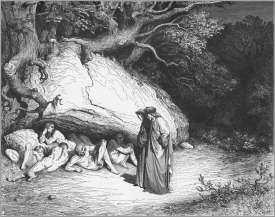 Unbaptised souls throughout the crystal spheres are today mourning the loss of their former home, Limbo. The news comes following the decision of Pope Benedict to abolish Limbo on the grounds (a) that the concept of unbaptised children being forever tainted by original sin is inconsistent with a modern interpretation of the gospels and (b) the feelings of bitterness he has held towards the very word limbo ever since that time he tried to shimmy under a low, low pole in his mitre while on a Sandals holiday in Jamaica.
Limbo was a bleak and lonely place on the borders of reality, free from the torments of Hell such as eternal fires, burning sand and double-glazing salesmen but forever excluded from the delights of heaven, such as being surrounded by devout theists for all eternity. Despite this it proved unpopular with visitors, the only tourists to that place of grim non-existence in the last 2,000 years being Jesus, Dante and anyone who has ever sat down in front of Countdown for more than three minutes.
Despite its unprepossessing aspect, for much of its 2,000 year existence Limbo was home to some of the greatest minds to have existed before the birth of Christ. Its inhabitants included some of the world's greatest poets and thinkers, including Homer and Virgil but sadly not Marge, Bart or Lisa or any other members of the Thunderbirds team. While the unbaptised are said to be distraught at saying goodbye to the only home some of them have known for the past two millennia, other residents of Limbo took the news of Limbo's death philosophically - the residents in question being Plato, Aristotle, Zeno and Socrates. Zeno in particular was untroubled by the news having proved beyond all possible doubt that Limbo could never be destroyed, just as an arrow could never, philosophically speaking, reach its target ... exactly two minutes before Pope Benedict decided to wipe it out of existence.
Limbo is survived by Purgatory, Hell and watching Adam Sandler movies.
18 August 2006
| [+/-] |
Albert Camus's "The Outsider" 1942-2006 |
Albert Camus's novel The Outsider ("L'Etranger") died today. Or maybe yesterday. The world-famous absurdist novel, about a man who shoots an Arab for no reason and then refuses to feel guilty for what he has done, was wounded in a fatal explosion of irony at the weekend when it was revealed that the book was at the heart of President George Bush's summer reading. The Outsider was born in 1942 to a union of absurdist philosophy and the retired goalkeeper of the University of Algiers second XI. A precocious child, by the late 1940's it was already to be seen hanging around with the likes of Jack Kerouac, its habit of wearing black polo-neck sweaters and chain-smoking Gauloises cigarettes, along with its habitual cry of "Je suis l'étranger, daddio" making it easy to spot on its trips outside the smoke-filled interiors of bebop jazz clubs.
Tiring of its dim surroundings, The Outsider soon found itself migrating to university campuses across the globe. It came to Britain in the 1950's where it soon became famed among duffel-coated male students as the key to French philosophy, to the coolness of alienation and to copping off with female students. With its influence ever-increasing, by the late 1960's The Outsider was to be found at the head of protests and sit-ins across the globe, from the riot-torn streets of Paris to the slightly disordered desks of the Pinner College Upper VIth Form Geography Class.
As both it and its friends drifted into middle age, The Outsider began to abandon its radical past, eventually being persuaded to appear on A-level syllabuses, where it was to confuse generations of teenagers. Despite this it was occasionally to be found, looking a little tattered, hanging around in coffee bars with would-be intellectuals, a cigarette dangling from its lips, still trying to impress young women.
Albert Camus's The Outsider will be buried in a student flat, beneath several posters of Che Guevara, some Leonard Cohen CD's and a rucksack full of dirty washing due to be taken back to mum next weekend. Anyone who does not cry will be hanged.


