Following Channel 4's "Death of a President" - the fictional account of the assassination of President George W. Bush - winning Best TV Movie/Miniseries at the International Emmys, we at As A Dodo towers decided this was a marvellous excuse to reprint an old favourite from the archives: our obituary for Fictional George Bush, which first appeared here in September 2006.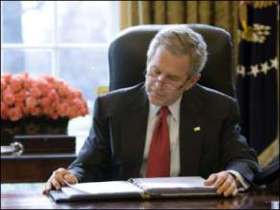 Fictional) George Walker Bush, (fictional) 43rd President of the United States has been assassinated in a (fictional) British television programme to be broadcast next month. The news of the death of one of the greatest (fictional) Presidents has led to scenes of piteous lamentation across a grief-stricken globe.
(Fictional)George W. Bush was born in 1946 into an old, established New England family. Despite the advantages afforded to him by his upbringing, (fictional) young George preferred not to rely on his patrician background, keen instead to get on in life by hard work and the application of his keen intelligence. It was these qualities that led him to Yale, from where he would graduate cum laude in 1968. Despite his academic brilliance, (fictional) George was ever eager to serve his country and, despite his misgivings about the conflict in Vietnam, immediately enlisted in the armed forces, ready and willing to serve on the front line.
Returning from war after several tours of duty and having refused all military honours - including the Purple Heart - despite his heroic service, (fictional) George quickly set himself to work on home territory. Wanting to avoid the feckless life of booze and drugs so common among the scions of America's ruling families and raring to make his own way in the world, (fictional) George chose not to accept repeated offers from his father's friends in the oil industry, instead choosing to put his deep scientific knowledge to good use by setting up a self-funded environmental technology company. It was, of course, the invention by that same company of the "(fictional) George W. 'Hydropower I' motor" that led to the abandonment of hydrocarbon-burning engines in the automobile industry.
Despite the heavy pressures on his time caused by his scientific and environmental work, (fictional) George was still insistent he had more to do. In 1994 he stood for and was elected Governor of Texas. Few Texans will forget his many successes in that role, including vast reductions in pollution, enormous improvements in educational standards for rich and poor alike, a massive fall in the State's prison population and the near-eradication of poverty. All this while displaying such probity that he insisted on refusing the blandishments of lobbyists and such local favourites as Enron's Kenneth "Kenny Boy" Lay. Given his astounding achievements it was certain from the moment he was reluctantly persuaded to stand that (fictional) George would become President of the United States in the year 2000. His record-breaking 50-state victory was made all the more remarkable by his decision to persuade brother Jeb Bush to stand down as Governor of Florida for the duration of the election, in order to avoid even the suggestion of any possible impropriety. Truly he was the man to bring a new light to the new millennium.
The achievements of (fictional) President George W Bush while in office are, needless to say, too numerous to mention. His farsighted choice to bring all his efforts to bear on the resolution of the Middle East conflict, combined with his decision to resist all those who called for an attack on Iraq following the terrible events of 9/11 and concentrate instead on the reconstruction of Afghanistan, undoubtedly contributed to the stability and peace the whole region enjoys today - especially following the capture of Osama bin Laden in 2003 by a US Special Forces group led by (fictional) George himself.
Thanks to (fictional) George's tireless championing of the Kyoto Agreement, his commitment to the sciences, leadership on the eradication of poverty throughout the globe and his belief in using America's might only with the greatest of care and planning, it came as no surprise when, earlier this year, the (fictional) President was awarded the Nobel prizes for Physics, Chemistry, Medicine, Economics and Peace. Indeed, many had expected him to complete the clean sweep next year, winning the prize for Literature with his moving novel based on the life of a poor black man struggling to rebuild his life after the destruction of home and family by Hurricane Katrina.
(Fictional) George W Bush will be buried on 9 October. A world will mourn.
20 November 2007
| [+/-] |
(Fictional) George W Bush 1946-2006: Redux |
19 November 2007
| [+/-] |
The Hardback Book c. The Middle Ages - 2007 |
 The Hardback Book now sits sadly beside the papyrus scroll and vellum codex upon the remaindered shelf in the great discount bookshop in the sky, following the decision of publisher Picador to issue all future novels in paperback, paperbacks being so much easier to pulp when an indifferent public prefers to spend its gift tokens on the new Leona Lewis CD.
Printed Material had been knocking around in libraries from Alexandria to Alnwick for centuries before some bright spark had the idea of collecting these loose pages and binding them between two hard covers. Indeed, monks had been illuminating manuscripts for hundreds of years - normally by dropping a candle on their painstakingly crafted vellum whilst half-blind from years of rising before dawn to knock out another chapter of The Book of Hours You'd Really Like To See and St Ethelburgha's "Be Everythinge inne Life Shitte or Be Itte Juste Me?". But, as William Caxton claimed in his book How I Inventedde Ye Booke - a bestseller in its day shifting almost 13 units and staying at the top of Ye Very Longe Rivere in Ye Undiscoverede Continente charts for nearly two hundred years - it was he and not "yon lying slagge" Johannes Gutenberg who had invented the modern Hardback as we remember it today.
Whilst printed material was taken up with gusto by medieval early adopters these technophiles remained a small minority as books failed to catch on with the public at large, thanks to their excessive cost and the failure of Ye Conservativves plan to ensure that every child in Britain would be able to read by the age of six (normally because, by the age of six, nearly every child in Britain was dead of ye plague).
The Hardback truly came of age in the 19th century when a more enlightened and educated middle class (and some uppity working class types) clamoured for something heavy and absorbent to line the walls of their libraries, parlours and drawing rooms and keep the cold at bay until a six-year-old could be shoved up the chimney to find out why the fire wouldn't draw.
The advent of the mass-produced Paperback in the 1930s proved the catalyst for the Nazis, allowing them to hold big book-burning rallies - as The Paperback burnt so much better than The Hardback. But despite its early flirtation with fascism, and despite being less weighty (and thus useless as a doorstop or as an accurate missile to project across a classroom to wake Timson Minor during double Latin) The Paperback proved more popular with the public as it was smaller, lighter and easier to dry out on the radiator after being dropped in the bath.
With sales plummeting over the decades, The Hardback desperately tried to adapt itself to modern life - hollowing itself out to offer aspiring spies a place hide their Walther PPKs or faking itself in plastic to give VHS pornography buffs a respectable place to hide their tapes on the living room shelves.
In desperation The Hardback swallowed its pride and turned to the fiction of Dan Brown and JK Rowling to reverse its ailing fortunes, but when even award-winning novelists (that award being the Olympic Medal for Literature - designed, judged and awarded by one J. Archer) such as Jeffrey Archer struggled to shift more than a few thousand in hardback, the publishing world realised the game was up and took a suicide pill (believed by some to be several thousand copies of As A Dodo: The Obituaries You'd Like to See
The Hardback Book will be pulped at St Naomi Campbell's Church of the Remaindered Book. The service will be conducted by the Right Reverend Mariella Frostrup and the congregation will sing Hymn 47, Paperback Writer. The Hardback is survived by The Paperback, The Audio Book, the e-Book and Dan Brown, JK Rowling and Jeffrey Archer.
16 November 2007
| [+/-] |
The Muffin Top 2003-2007 |
 It is with huge relief and no little thankfulness that As A Dodo can confirm the death of The "Muffin Top", which was first announced by the BBC on 15 August 2007.
The Muffin Top - the unsightly excess of flab spilling over the top of a pair of trousers, was born at some time in the early noughties. It was at this time that a Western population used to levels of activity more usually seen in a three-toed sloth and individual levels of food intake usually found only in Biblical-scale swarms of locusts first came into contact with large amounts of expensive, low-slung and tight-hipped trouserage originally designed to adorn the bodies of fashion models whose monthly ingestion consisted only of a piece of lettuce, several thousand cigarettes and enough white powder to mark out the pitch at Wembley for all eternity.
The early meetings of these two - one an irresistible piece of designer-inspired clothing, the other an almost immovable piece of lard - did not go well. Those who witnessed the early attempts to mate obese bodies and slim denim still recoil in horror at memories of twisted bodies, ripped fabric and shop assistants rendered blind by rivets popping free of their blue-jean homes. Yet somehow, union was achieved - hundreds of pounds of adipose tissue were eased slowly inside denim sheaths, copper riveted buttons were slipped into the appropriate holes and vast amounts of fat, together with wholly unnecessary inches of buttock crevice, leapt upward and outward in exuberant celebration.
For years, the new child went - like a child in a David Pelzer book - unnamed, wandering the streets of the Western world (and anywhere else obesity and poor fashion sense went hand-in-hand) lonely and unloved. It was in Australia that it first found its true home, after an irritatingly fit Aussie popping into Starbucks noted the similarity between the midportions of the American tourist in front of him and the overspilling extra large muffin she was holding and finally gave the phenomenon its name - just before being whacked in the face by the American tourist in front of his equally large husband.
From there on The Muffin Top went from strength to strength - seeing off such phenomena as the whale tail - and finding a place on streets across much of the globe, often just outside the nearest fast food restaurant. Many assumed that The Muffin Top would always be with us, a handy reminder of the evils of consumerist society, but it was not to be. Bored at last with their hipster jeans, designers now decreed that the world should wear high waisted skirts and trousers, forcing the overspilling flab within a new casing and starving it of the exposure it so obviously craved.
The Muffin Top will be buried in an overly small coffin at midday, only for most of it to pop out seconds after the lid has been banged on. It is survived by the belly bulge, the turkey wattle, the banana fold, the love handle and the bingo wings.
14 November 2007
| [+/-] |
Golf c. 15th century - 2007 |
 Golf has played its last stroke - a massive and terminal one - with the news that elderly golfers are hogging the courses at golf clubs up and down the country.
Although the Chinese may claim to have planted the first long drive onto the green in the 11th century and, a hundred years later, the Dutch were busy thwacking a leather ball into a hole (through a giant windmill - thus inventing Crazy Golf), it is the Scots who lay claim to the true invention of the game in the 15th century, when Scots began using a small mashie niblick (or any other deep-fried snack to hand) to whack a ball across the country.
The game quickly became popular with Scots of all ages and all classes taking it up with great enthusiasm, with even Mary Queen of Scots reputedly playing at the Musselburgh Links in 1567 - although her lack of a head meant she had trouble playing out of the bunkers onto the green.
While the Scots were arguing about the correct ratio of holes for playing golf to watering holes for refreshment, the rest of the world was mastering the basics of teeing off, chipping out of the rough, shouting at the caddy and breaking a putter over their knee at the difficult 17th. By the time 18 holes became standardised and the 19th was introduced, the game as we know it could be said to have finally arrived - as bores, boors and bigots knocked back the whiskies while telling taller and taller tales about their drive and revealing their smaller and smaller minds about the wisdom of accepting anyone who didn't possess the right sort of golfing qualifications - usually white skin, at least one testicle and the ability to prove ones pure Anglo-Saxon parentage back sufficient generations to get you into the SS.
Despite the existence of a bunker mentality (that bunker being located deep beneath the Reich Chancellery just before the dogleg onto the green at Potsdamer Platz), Golf raised its game and ditched its plus fours and argyle sweaters for a golden age as players such from Jack Nicklaus to Tiger Woods entertained spectators across the globe by powerfully driving up the fairway and delicately putting in, and Colin Montgomerie entertained spectators across the globe by disembowelling caddies with a glowering look - frequently, and unsportingly, without first uttering the warning cry of "Fore!"
However, this popularity was achieved not without cost. For every birdie chipped in from off the green by the likes of Ernie Els, two or three superannuated middle managers, solicitors or comedians took up the game with gusto and hacked their way slowly towards a G&T in the clubhouse. So when the Golf Club Secretary Newsletter reported that retired golfers were paying less and playing more than younger members at their golf clubs - clogging up the courses as they searched for their driving spectacles, their putting zimmer frames and remembering loudly "when this was all fields" - Golf sliced its last shot into the water and, feeling well below par, sank without trace. Thus was a good walk spoiled no more.
Golf will be buried at the bunker on the 18th hole of the St Jimmy of Tarbuck's Pro-Celebrity Church of the Royal and Ancient. The service will be conducted by the Reverend Peter Alliss ("Oh... Ah...! The coffin has pulled up just two yards short of the church... Monty, Monty, Monty...!") and the congregation will sing hymn 365, Lalo Schifrin's theme from The Eagle Has Landed as Colin Montgomerie defenestrates the vicar after smashing the crucial putt into the font.
12 November 2007
| [+/-] |
Dinner Party Conversation 19th Century - 2007 |
 Playwrights, sketch-writers and garrulous foodies from Stoke Newington in the north to Brighton in the south are today fumbling mutely with the remains of Julia's lovely spinach roulade ("it's a Nigel Slater recipe") and knocking back the remains of that rather good organic Vin de Pays d'Oc, in memory of Dinner Party Conversation which has been silenced by the arrival of a guest carrying an iPhone.
Ever since the arrival of servants and gas lighting in bourgeois homes in the 19th century allowed the middle classes to pop round for an evening meal at each other's homes, Dinner Party Conversation has been heard in dining rooms across Britain. Down the decades it has covered a vast number of topics - from the relative merits of the latest instalment of Mr Dickens's new tale in Master Humphrey's Clock and the way Mr Peel's awful Health and Safety inspectors prevent hard working parents sending their children up perfectly good chimneys, to the relative merits of the latest Will Self short story in The Independent and the way Mr Brown's Health and Safety Nazi's won't let you read a book while driving at a perfectly reasonable 65 mph in your own car, including more than nine trillion references to the current state of house prices and the difficulty of getting Tom and Jocasta into a decent school along the way.
Perhaps Dinner Party Conversation could have carried on in this manner forever. That it did not was the result of the sudden invasion of its natural territory by an unexpected rival. On Friday 11 November 2007 and during the evenings that followed, vast numbers of Dinner Party Conversations were suddenly and ruthlessly silenced by the arrival of guests smugly clasping in their hands the latest product of Apple Inc, the new iPhone. Bearing the shiny new piece of technology before them as if it were the host at a mass, each of these guests was at once awarded the place of honour at the repast, while their fellow diners silently queued up before them to touch the beautiful new mobile communications device.
Unwilling to go meekly to its death, Dinner Party Conversation tried to put up resistance - launching conversational gambit after gambit as it sought to speak of "the nine solid months of church attendance necessary to get little Toby into that CofE school", the "inexplicable reverence shown towards Stephen Poliakoff's bloody awful dramas" and even to "Stephen Fry's paean to Steve Jobs's new marvel in The Guardian". Yet all its efforts merely resulted in it being shushed into silence as otherwise sensible people partook in the sacrament of delicately stroking the new phone into life ... and choosing to ignore the sticky fingerprints on the screen, easily scratchable body, inadequate camera, lack of 3G connectivity, ridiculous contract lock-in, fixed battery, dodgy text entry and high price, as they wondered how quickly they could buy themselves one.
Dinner Party Conversation will be buried after the coffee and mints at St Nigella's Church of the How Did You Whip Up That Marvellous Starter? The congregation will be too busy marvelling at "the way the phone can tell which way up you're holding it" to notice.
09 November 2007
| [+/-] |
Belgium 1830 - 2007 |
 Belgium, the European country which has done so much to enliven so many dinner parties as couples vie to name six interesting things about that sovereign state before the cheese goes off, is believed to have fallen apart after nearly six months without a government.
Formed from the remnants of the Low Countries in 1830 following a, frankly, hard-to-believe Belgian revolution, Belgium quickly found its place in Europe as it inherited none of the flair and flamboyance of its southerly neighbour, France, nor any of the edginess and excitement of its northern neighbour, Holland, instead promoting itself as the national equivalent of a pair of sensible shoes or a wet weekend - or, preferrably, both.
With King Leopold I installed at the head of its constitutional monarchy, the people of Belgium - whether they be Flemish, Walloons or confused travellers who stopped off before reaching Paris or London - settled down in the traditional trades of brewing, chocolate-making or the burgeoning waffle R & D sector based around the capital, Brussels.
Having been invaded by Germany in 1914 (innocently letting the Kaiser's troops across the border to "retrieve a mislaid bratwurst...") Belgium made sure that before the kick-off of the next world war everyone knew it was neutral and "would be taking no part whatsoever in any future conflicts" only to be interrupted by Hitler's troops rolling across the border in order to take the rat-run to France.
Culturally Belgium was best known for the works of surrealist painter Rene Magritte and his most famous painting Ceci N'est Pas Un Waffle. To the surprise of many, several of France's best-loved musicians were in truth Belgian, though, less surprisingly, Django Reinhardt and Jacques Brel preferred to spend most of their life in France.
But without a doubt Belgium was most famous when it was most fictional. Made-up detectives Hercule Poirot, Tintin and... er... Snowy all raised the profile of Belgium abroad and for a brief instant made readers think it was a hotbed of international intrigue when, in reality, it was a country so dull that M. Poirot had to find work in London to escape the tedium of being asked to investigate yet another mysterious case of the disapperaing waffle.
When the Flemish Christian Democrats won last June's general election no one foresaw that they would fail to establish a ruling coalition. Despite the absence of a government in Belgium for nearly six months the country did not descend into anarchy, instead waffle prouduction at EU and NATO waffle mills exceeded projected targets month-on-month and the people of Belgium continued to drink beer, eat chocolates and look down on the unruly Swiss.
With the realisation that the 150-day run without a government was not an attempt to get into the Guinness World Book of Records (as that had been banned in Belgium since 1967 for fear of over-exciting the populous) talks between the 11 political parties became more protracted. But a split began to develop between the Dutch-speaking Flems and the French-speaking Walloons, and a move to end the right of French speakers in Flemish suburbs of bi-lingual Brussels to vote for French candidates proved so boring that the country shrugged its shoulders and returned to its jigsaws of giant waffles as the country split asunder in utter silence.
Belgium will be buried in two separate ceremonies at La Maison du Waffle and at Den Wafflehaus.
07 November 2007
| [+/-] |
Gordon Brown's Political Vision mid-1950s - 2007 |
 The death of Gordon Brown's Political Vision has come as a grave shock to all those who knew it and as a particular cause of grief to those members of the Labour Party who once held it up as a beacon of hope in a world of political ennui.
It would be impossible to recount the stirring tales that have been told of the Political Vision, many of them by the Prime Minister himself. It was a vast and noble thing, encompassing everything from the fate of the planet, nay the universe itself, all the way down to the tears of a single child born in poverty and even taking in the complex machinery of post neo-classical endogenous growth theory on the way. Thanks to its prodigious strength and mighty intellectual force, those who walked beside it - or perhaps it were better to say, "those who walked in its shadow" - could do so without fear that any harm might come to them.
The Political Vision was born on the knee of Mr Brown's own father, the Church of Scotland minister Dr John Brown, who lectured his son even as he dandled him in his hands, reminding the wee Gordon of his duty to his fellow man, to remember that many a muckle makes a mickle and - as the Prime Minister himself recalled - "to treat everyone equally" (whether Dr Brown added that "everyone" did not include either young Muslims suspected of terrorism or the super-rich is sadly unknown).
Throughout his time at university, and on into his early life in politics, Gordon was to cleave to his Political Vision. He was often seen parading it in public, whether as editor of The Red Paper on Scotland or as a rising young star of the Labour Shadow Cabinet of the 1980s and early 1990s. Gordon Brown's Political Vision took in all it surveyed: it was for fairness to all, hard work and duty, it stood for the poor against the rich and the downtrodden against the privileged.
It was in 1994 that the Political Vision was to suffer the tragic accident that would affect it for the rest of its life, running into the sharp end of Tony Blair's butter knife in the dim lighting of a fashionable North London restaurant. This accident, it would appear, left the Political Vision so hideously scarred that it fled the political stage, leaving it to the rival - we are assured inferior - vision of the young Tony Blair.
For years, Gordon Brown's Political Vision haunted the Labour Party - only bursting from the shadows at Budget time or during the party conference season, when its shocking appearance served both to remind the Labour party of the glories it had once been promised and to send a shiver down the spine of Mr Blair. Indeed, it was only with Mr Blair's own political death - tragically crushed under a large political machine that had somehow worked itself loose - that Mr Brown, and his Political Vision - emerged once more.
The years of isolation had clearly taken their toll. The Political Vision - so long masked from view - turned out to be a pale and paltry thing, little different from the vision of Mr Blair or - indeed - Tory leader David Cameron. As it stepped fully into the light with its first Queen's Speech, Gordon Brown's Political Vision crumbled into a ragbag of bills to detain people without trial, build on green belt and a bit of fiddling round the edges with school leaving ages, waste disposal charges and parental leave, all wholly ununited by any overarching theme.
Gordon Brown's Political Vision will be scattered by a light breeze. Mourners are asked to send donations to offshore tax havens.


